September 15, 2026
Process Safety Leadership: A Critical Link in SIF Prevention
Introduction
Serious Incident and Fatality (SIF) prevention is often discussed in terms of systems, procedures, and safeguards. Those elements matter, but in high-risk operations, SIF prevention also must include leadership in process safety, because leaders make the decisions that determine whether exposure is reduced, tolerated, or allowed to accumulate.
Most organizations in high-risk industries already have process safety management systems in place. The challenge is usually not the absence of a formal system, but whether that system is fully activated, properly resourced, and consistently reinforced by leadership.
That is why leadership in process safety matters so much. Process safety becomes real only when leaders treat it as part of business performance rather than a narrow technical or compliance issue.
When Good Safety Metrics Hide Serious Risk
Having senior operational leaders who are familiar with process safety is important because catastrophic incidents occur infrequently. When incidents don’t happen often, organizations naturally drift toward the more visible and frequent concerns of day-to-day safety performance.
History offers painful reminders of this pattern.
- In 2005, a BP refinery exploded in Texas City, Texas, killing 15 workers and injuring 180 others when a hydrocarbon release during startup ignited near temporary trailers. The U.S. Chemical Safety Board found that the site had a “massive backlog of overdue inspections and maintenance,” and OSHA later cited BP for “1,700 overdue inspections” at the plant. Because the plant had an excellent personal safety record, executives mistakenly believed the facility was safe, despite deteriorating mechanical equipment and chronic safety violations.
- The Deepwater Horizon disaster also underscores how maintenance and process safety gaps can contribute to a disaster. The 2010 offshore drilling blowout and explosion in the Gulf of Mexico killed 11 workers and injured 17 others, triggering the largest marine oil spill in U.S. history, yet a celebration of seven years without a lost-time incident occurred only hours before the event.
The lesson is clear: leadership must stay focused on process safety even when conventional safety indicators look good. SIF prevention requires leaders to be aware of the conditions that can lead to a major release, fire, explosion, or multiple-fatality event, no matter how infrequently they occur.
Applying the Krause Bell Group SIF Reduction Mechanism
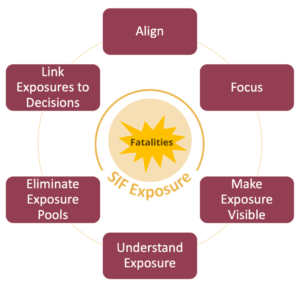
The Krause Bell Group SIF Reduction Mechanism provides a structured, leadership-driven approach to the reduction of serious incidents and fatality exposure. It offers a way to integrate SIF prevention into how an organization operates, including vital process safety exposures.
Step 1: Align
The first step in effective SIF prevention is leadership alignment. Senior leaders need a shared understanding of why process safety matters, what level of risk the organization is prepared to accept, and what resources are required to manage that risk properly.
Alignment must include both corporate and site leadership, and process safety leadership must have real decision-making power. If expectations are set centrally but site and process safety leaders do not have authority over capital spending, headcount, shutdown timing, or operational priorities, the system will not work as intended.
Alignment also requires other shifts. Organizations should not rely only on injury rates to define safety performance. Leaders need to explicitly address process safety exposure and leading indicators so the organization has a comprehensive view of their risk profile, and a SIF prevention plan addressing all risk – including process safety.
Step 2: Focus
Once alignment is in place, leaders need to be aware and focus on the process safety precursors that create exposure. These include high-risk tasks, degraded safeguards, overdue inspections, maintenance backlog, and other operational conditions that can amplify risk over time.
Leaders do not need to be the technical expert in every hazard review, but they do need to seek expert advice, actively sponsor Process Hazard Analyses (PHA), support safeguard reviews, follow up on findings, and make clear that those actions matter.
They also need to ask tough questions to help shift the conversation beyond compliance to real risk recognition. For example:
- Are there scenarios at this facility where multiple fatalities could occur?
- What conditions could lead to a major release?
- Has anything become normalized even though it represents potential exposure?
It is also important to identify the categories of decisions that shape serious risk. Shutdown strategy, maintenance planning, outsourcing, organizational change, and capital allocation all have direct consequences for process safety and therefore, SIF prevention.
Step 3: Make Exposure Visible
Leaders cannot address what they do not see. Making process risk exposure visible means going into the field, engaging in meaningful process safety conversations, participating in audits, and reviewing leading indicators that reveal the true condition of the operation.
This is not the same as a traditional safety walk that focuses mainly on PPE or housekeeping. Those issues matter, but effective process safety leadership requires a different set of questions to make exposure visible in the real world:
- What are the critical risks in this operation?
- Are any alarms disabled or overridden?
- Are there procedures that no longer match reality?
- Do operators have concerns that have not been surfaced?
One common warning sign is the temporary solution that becomes permanent. A bypass, workaround, or interim control may remain in place for months or years simply because no one questions it. Over time, that condition can become normalized, even though it no longer controls risk as originally intended.
Step 4: Understand Exposure
Visibility is not enough. Leaders also need to understand why exposure exists and what’s driving it. That means moving from identifying where risk is present to understanding the systems, context, and culture that allow it to persist.
For example, if maintenance is overdue, the real issue may not be maintenance discipline alone. The underlying causes may include a lack of resources, poor planning, contractor dependency, production pressure, or a combination of all of these. Without understanding those drivers, organizations tend to treat symptoms rather than causes.
This is where listening becomes a critical leadership skill. Operators and frontline teams often understand the practical realities of work better than anyone else, and their insight is essential when evaluating procedures, standards, and emergency plans. A procedure that looks robust in a conference room may be unrealistic in practice. Site-level leaders and process safety experts will understand the impact of night shifts, fatigue, and understaffing, as well as how factors like maintenance, operating standards, and other controls work in real conditions or during abnormal events.
Understanding exposure also means helping operators see how their actions connect to the full process. When people understand not just their task, but its impact on total risk exposure, they are better positioned to prevent escalation.
Step 5: Eliminate Exposure Pools
Once key process safety exposures are visible and understood, leaders need to act strategically. Rather than addressing each issue in isolation, they should group recurring exposures into patterns or “pools” and prioritize the ones that create the greatest potential for serious harm.
This is the point where the hierarchy of controls becomes essential. The objective is not only to manage risk better, but to eliminate or reduce exposure at its source wherever possible.
Two recurring exposure pools that often show up in companies across many industries include emergency preparedness and mechanical integrity.
- Emergency preparedness matters because even when prevention is strong, zero risk does not exist. Poor readiness — untrained crews, daytime-only drills, plans that ignore night and weekend staffing — can turn manageable events into catastrophes.
- Mechanical integrity matters because energy and hazardous materials must remain contained, and safeguards must remain available when they are needed most, yet because those safeguards are rarely called upon, it’s easy to assume they’ll work and let their maintenance slide.
Step 6: Link Exposure Decisions
The final step is to connect risk exposure back to the decisions that create it. Krause Bell Group’s Safe Decision Making® study shows that 67% of decisions that impact the occurrence of serious incidents are made by leaders, often months or years prior, where risk was piling up over time as further decisions were made in the context of previous decisions.
Since the initial 2015 study, Krause Bell Group has maintained a database of Safe Decision Making® findings across hundreds of organizations around the world. This real-world data correlates 51% of the decisions related to serious incidents with leaders, further validating the initial study.
This is why leaders need to recognize when a business decision has the potential to affect process risk. The challenge is that these decisions often don’t look like safety decisions at the time. They may appear as budget trade-offs, staffing changes, capital investments, outsourcing strategies, startup timing, or organizational restructuring; however, each of these can change exposure, weaken or strengthen safeguards, or alter the conditions under which work gets done.
Consider a decision to outsource maintenance while also reducing budget. Neither decision is necessarily problematic on its own, but together, and in combination with decisions that follow, they can begin to change the operating environment. Critical capability may be reduced. Fewer qualified people may return to the plant. Experience may gradually be diluted. The people making later decisions are now working within a different set of constraints than those who came before them. Over time, process safety exposure can increase without any one leader making what obviously looks like a “bad safety decision.”
Other examples of distorted priorities that increase SIF exposure are equally familiar:
- Deferring inspections on safety-critical equipment
- Accepting long maintenance backlogs
- Rushing startups before proper pre-startup safety reviews are complete
- Applying strong management-of-change discipline to technical changes while overlooking organizational changes
- Rewarding personal safety metrics while ignoring process safety leading indicators
Leaders need to get better at recognizing when a decision could affect safety. What could this decision change downstream? Could it weaken a safeguard or create a new constraint? Are we making assumptions about capacity, capability, or how the work will actually get done?
At the same time, we can’t expect leaders to anticipate every consequence of every decision. Conditions change, decisions interact, and risks can emerge that weren’t visible when the original decision was made. The people closest to the work are often the first to see those changes. This is why Steps 3 and 4 are so important.
Strong upward communication is essential. Organizations need feedback loops that get critical information to the people who can act on it, while there is still time to respond. This gives leaders a chance to adjust as conditions change and before risk has a chance to build.
Underscoring the Role of Process Safety in SIF Prevention
BP Texas City and other process safety incidents can frequently be tracked back to leadership priorities and decisions. The most recent example occurred while we were writing this article. The Barzan Gas plant explosion on June 21, 2026, killed 13 and injured 66 people. The explosion occurred during start-up following a 6-month maintenance shutdown.
The fact that these events continue to occur underscores the importance of leadership’s familiarity with process safety as a part of their SIF Prevention efforts. Informed leaders keep process safety connected to real work, real decisions, and real compromises, creating the conditions for more effective risk management.
For more information, visit the Krause Bell Group SIF Reduction Mechanism.
Search for articles
Share this post: