March 30, 2026
Safety Communication Strategies for Leaders
Great safety performance starts with how you communicate. As a leader, your words, questions and follow-through shape what people notice, how they decide and whether they speak up. Use this practical guide to communicate with clarity, build trust and prevent serious injuries and fatalities.
What effective safety communication looks like
Effective safety communication is clear, fast and relevant to the risks people face. It is consistent across channels, happens before something goes wrong and invites two-way dialogue. Your goals are to make hazards visible, align on roles, enable safe decisions and reinforce learning. Use these techniques for effective communication:
- Clarity – plain language, one action per message
- Timeliness – reach people at the moment of risk
- Specificity – tie messages to tasks, locations and shifts
- Two-way – ask, listen, act and close the loop
- Psychological safety – make it safe to surface concerns and near misses
Match words with decisions and actions to sustain credibility; see Make words match decisions and actions.
Techniques for high-impact safety conversations
On the floor and in the field, your conversations are the culture. Prioritize listening over telling and make every interaction lower risk and raise capability. For practical tactics, see Meaningful safety conversations.
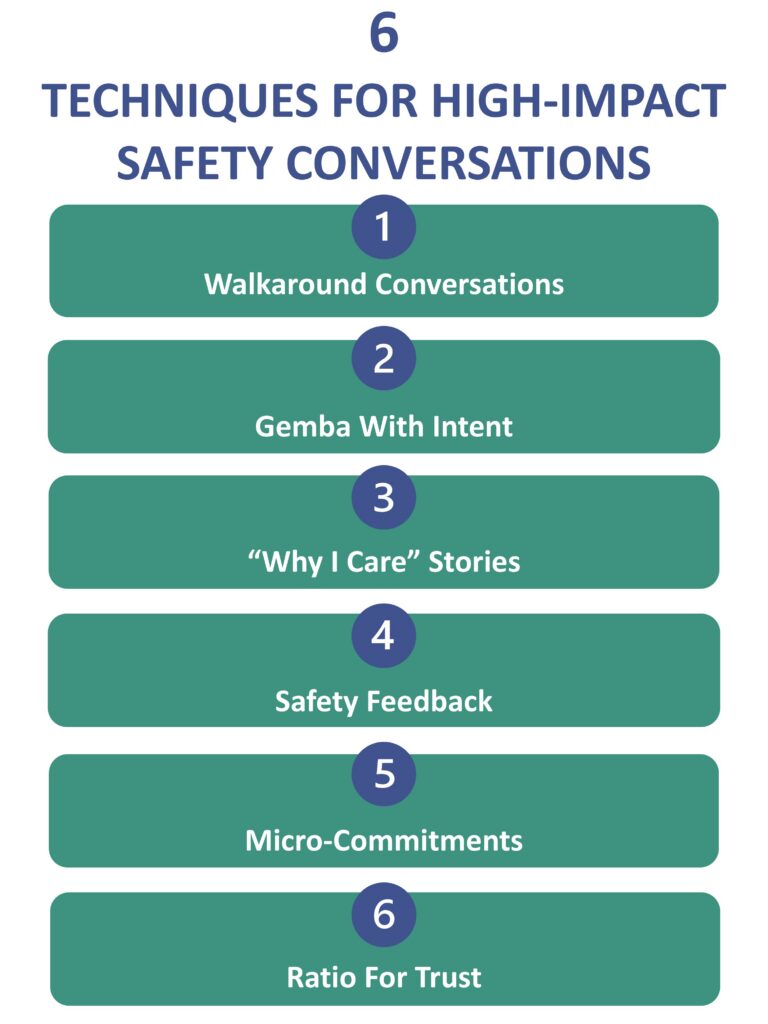
- Walkaround Conversations – go where the work is; ask open questions like What could hurt you here today and What would make this job safer right now.
- Gemba With Intent – observe the task, name the exposure, explore decisions and trade-offs people face under time and production pressure.
- “Why I Care” Stories – share a brief personal reason you prioritize safety to build credibility and connect purpose to practice. For ways to convey genuine care, see Conveying genuine care — the leadership challenge.
- Safety Feedback – be specific about the behavior or exposure you saw, the potential consequence and the safer alternative; invite the worker’s view.
- Micro-Commitments – end with a clear next action, owner and timeframe; confirm how you will follow up.
- Ratio For Trust – 80 percent questions and listening, 20 percent directing; avoid blame language and fix the conditions that drive choices. Learn more in Listening to learn.
Make safety training stick
Shift from long, infrequent sessions to short, frequent learning tied to real work. Onboard with essentials, then reinforce at the point of need. Use recent near misses, high-hazard tasks and loss trends to plan content. Rotate formats to keep engagement high and document competence, not just attendance.
Training methods ranked by effectiveness
- On-the-job coaching and practice with feedback
- Train-the-trainer and peer mentoring
- Job shadowing and guided walkthroughs
- Toolbox talks and safety moments
- Computer-based microlearning and quizzes
- Lecture-only sessions
Targeted, timely messaging
Send the right message to the right people at the right time. Segment by role, crew, location and shift. Pre-build simple templates for common scenarios to reduce delays and errors.
- Segment audiences – maintenance vs operations, contractors vs staff, day vs night shift
- Match channels – radio for live work, SMS for urgent alerts, signage for static reminders, messaging apps for updates
- Use templates – stop work, severe weather, chemical release, evacuation, all clear
- Schedule cadence – pre-job briefs in the morning, exposure reminders before high-risk tasks
Invite and act on employee feedback
Two-way safety communication only works when people see their input leads to action. Make it easy, safe and worthwhile to speak up.
- Low-friction reporting – quick near miss and hazard ID options in multiple languages, anonymous when needed
- Respond fast – acknowledge within 24 hours, triage by SIF potential and assign an owner
- Close the loop – share You said, we did updates in standups, boards and apps so people see impact
- Recognize learning – thank individuals and teams for surfacing risks and improvements
- Trend and share – show patterns and lessons learned across sites to prevent repeats
Use a feedback system that connects leadership, culture, systems and data so what you hear translates into safer conditions and decisions. This aligns with our integrated Safety Loop approach that continuously reduces exposure. For senior leaders, practical ways to collaborate with safety professionals are in Building a deeper relationship between senior leaders and safety professionals.
Inclusive communication for every worker
Reach all workers, not just those at desks. Design for remote and hybrid teams, contractors and varying literacy levels:
- Plain, visual messages – icons and photos that show the safe way
- Language access – translate critical content and use interpreters for high-risk tasks
- Multiple modes – offline printouts, QR codes, radio checks and briefings for areas without connectivity
- Accessibility – readable fonts, sufficient contrast and audio options where needed
Plan, templates and measurement
Document who communicates what, when and how. Build a crisis communication plan with roles, triggers, contact trees and pre-approved messages. Drill it so execution feels routine under pressure. Measure what matters and learn. Emphasize:
- Inputs – percent of workers reached within target time, template usage, drill frequency
- Signals – near miss volume and time to close, repeat exposures, stop-work activations
- Outcomes – reduction in high-energy exposures and serious injury potential
- Capability – periodic 360 feedback on leadership communication behaviors
FAQs
Bring it to life in your organization
If you want expert guidance to sharpen your safety communication and prevent SIFs, consider our two-day Executive Masterclass for Safety Leaders, where you build a tailored action plan with our consultants. Assess your leadership behaviors with the Safety Leadership 360 Tool and integrate communication, culture and data using the Safety Loop Model.
Explore upcoming Krause Bell Group masterclasses and tools at krausebellgroup.com – Masterclasses for leaders at any level, Safety Leadership 360 Tool, and our Safety Loop Model.
* Developed with the support of AI and reviewed by Krause Bell Group Editorial Team