July 8, 2026
Safety Observations Best Practices
Strong safety observations help you spot risk before it becomes an injury, serious event, or production-disrupting incident. The best programs do more than collect cards or counts. They make hazards visible, improve the quality of field conversations, strengthen accountability, and give leaders better leading indicators to act on. If you want safety observations to actually reduce exposure, you need a process that is practical, blame-free, measurable, and tied to meaningful follow-up.
This guide covers the safety observation best practices that matter most in high-risk environments. You will see how to define a good observation, what leaders and frontline teams should focus on, how to avoid low-value reporting, and how to use observation data to improve decision making, coaching, and risk reduction over time.
Why Safety Observations Matter in Modern Safety Management
Many organizations still rely too heavily on lagging indicators such as recordables, lost time, or incident rates. Those metrics matter, but they only tell you what has already happened. Safety observations are different because they can function as leading indicators. They help you identify unsafe conditions, unsafe behaviors, weak controls, and exposure to serious injury and fatality risk before harm occurs.
That is why an effective safety observations process should never be treated as a paperwork exercise. Its value comes from what it reveals about the work itself. A good observation program shows whether procedures are workable, whether controls are holding, whether supervisors are engaging in the field, and whether people are managing risk at the point of work.
For organizations in manufacturing, mining, oil and gas, pharmaceuticals, transportation, government, and other high-risk operations, this matters even more. In these environments, one missed line-of-fire exposure, energy control gap, or work-at-height issue can have severe consequences. Observation-based indicators can help you focus attention where exposure is highest, not just where activity is easiest to count.
What Makes a Good Safety Observation
A good safety observation is specific, objective, and useful. It does not just say that something looked unsafe. It identifies what was observed, where the exposure existed, which control was missing or weak, and what action is needed next. It also focuses on the work context leading to the control not functioning as intended, not just on the worker.
That distinction is important. Weak observations tend to be vague, judgmental, or disconnected from actual risk. Strong observations describe observable facts and create a path for improvement.
- Specific – describes the task, condition, behavior, or control gap clearly
- Objective – avoids blame, assumptions, and emotional language
- Relevant – focuses on meaningful risk, not trivial issues only
- Actionable – points toward correction, coaching, or system improvement
- Timely – is reported and discussed while the learning is still fresh
A good safety observation example would be: during a maintenance task, the observer noted that lockout/tagout verification was not confirmed before work began, creating exposure to unexpected energization. The operator told the observer that they have a particularly busy schedule today, the work permit process is cumbersome, and they have done this work already frequently, so know how to prevent an energy release even if the equipment is not locked out. That is far more useful than writing something broad like “employee was not following safety rules.”
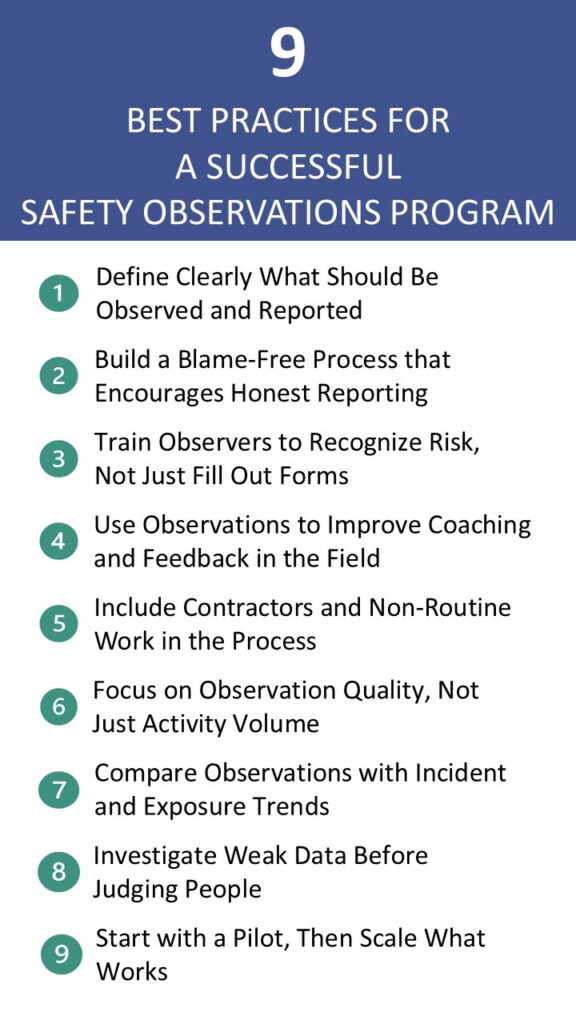
Best Practices for a Successful Safety Observations Program
1. Define Clearly What Should Be Observed and Reported
One of the fastest ways to weaken a safety observations program is to leave people guessing about what counts as a quality observation. If expectations are vague, you will usually get one of two outcomes: underreporting because people are unsure, or low-value reporting because people submit anything just to comply.
Give people practical guidance on where to focus. That often includes critical tasks, high-energy work, line-of-fire exposure, work at height, contractor interfaces, pre-job risk assessment quality, barriers and controls, and leadership field engagements. When possible, use fit-for-purpose checklists that guide attention without turning observation into a robotic inspection.
Examples help more than theory. Show teams the difference between a weak observation, a good observation, and an excellent one. This builds consistency much faster than a policy document alone.
2. Build a Blame-Free Process that Encourages Honest Reporting
If workers believe observations will be used to assign fault, participation drops and data quality suffers. People either stop reporting, avoid sensitive issues, or write observations that are technically complete but practically meaningless. That is why psychological safety is not optional in observation-based safety.
You should consistently reinforce that the goal is learning and risk reduction, not catching people. Observations should examine conditions, decisions, system factors, and control effectiveness alongside behavior. In many cases, what appears to be an unsafe act is tied to production pressure, poor planning, weak supervision, missing equipment, or an impractical procedure.
Some organizations also use anonymous reporting channels in limited situations to reduce barriers. That can help, but anonymity is not a substitute for trust. The stronger long-term solution is a culture where people believe speaking up leads to action, coaching, and improvement rather than embarrassment or punishment.
3. Train Observers to Recognize Risk, Not Just Fill Out Forms
Training should cover more than how to complete a checklist or submit a report. People also need to know how to recognize exposure, how to distinguish low-consequence issues from higher-risk conditions, and how to describe what they saw in a useful way. Without that, participation may increase while insight does not.
Effective training usually includes short field-based scenarios, side-by-side examples, and coaching on what to look for in real work. This is especially important when you want observations to support serious injury and fatality prevention. Observers need to understand critical risks such as energy isolation, dropped objects, mobile equipment interaction, confined space, work at height, and simultaneous operations.
For leaders, training should also include how to ask better questions, how to listen without defensiveness, and how to give immediate feedback that improves future decisions.
4. Use Observations to Improve Coaching and Feedback in the Field
A strong program does not end when the observation is recorded. The real value often comes from the conversation that follows. Immediate, respectful feedback helps correct risk in the moment and builds capability over time. It also turns observation into a leadership practice instead of an administrative task.
Field feedback should be direct but constructive. Start with what was observed, explain why it matters, and involve the worker or team in discussing safer alternatives. This keeps the conversation practical and avoids the dynamic where safety is something done to people instead of with them.
For supervisors and managers, this is also where development happens. Observation quality often improves when leaders shift from asking, “Did you do the observation?” to asking, “What did you learn about exposure, controls, and decision making?” That change in focus tends to produce better data and better engagement.
5. Include Contractors and Non-Routine Work in the Process
Many high-risk sites depend heavily on contractors, temporary labor, and specialized crews. If your safety observations program only captures employees doing routine work, it misses a large share of operational exposure. Best practice is to include contractors in a way that is practical, clear, and aligned with site expectations.
This does not have to mean giving every contractor full access to internal systems. It does mean making it easy for them to participate, understand reporting standards, and receive follow-up on what they raise. Observations around shutdowns, maintenance, start-ups, and other non-routine tasks are often especially valuable because those moments can involve changing conditions, unfamiliar interfaces, and elevated risk.
6. Focus on Observation Quality, Not Just Activity Volume
Counting the number of observations submitted can be useful, but only to a point. A high count does not automatically mean a healthy process. In some organizations, pressure to increase totals leads to pencil-whipped reports, overemphasis on minor housekeeping issues, or repeated observations that add no new learning.
That is why you should review both quantity and quality. If one team submits many observations but rarely identifies meaningful risk, that may indicate poor observer capability, avoidance of sensitive topics, or local pressure to keep reports positive. On the other hand, if another team submits fewer observations but consistently identifies weak controls and follows through on actions, that may be a stronger signal of program health.
Useful quality indicators can include risk significance, clarity of comments, relevance to critical tasks, balance between safe and at-risk findings, and closure of corrective actions. The goal is not more paperwork. The goal is better visibility into exposure and control effectiveness.
7. Compare Observations with Incident and Exposure Trends
One of the most valuable safety observations best practices is to compare observation data with lagging outcomes over time. Observations are a leading indicator. Incidents are a lagging indicator. Looking at both together helps you understand whether the program is surfacing risk early enough and whether actions taken are making a difference.
You should not expect a simple one-to-one relationship. There is often a time lag between stronger observations, improved controls, and a later reduction in incidents. Even so, pattern analysis is useful.
- High observations and low incidents can indicate good visibility and effective follow-up
- Low observations and high incidents may suggest weak participation, poor quality, or blind spots in the field
- High observations and high incidents can mean the organization is seeing risk but not controlling it effectively
- Low observations and low incidents may be positive, but they may also indicate underreporting if the work is high risk
For higher maturity, compare observations with exposure-specific data such as SIF precursors, hazard report closure time, quality of pre-job planning, or recurring control failures. That gives you a much more useful picture than totals alone.
8. Investigate Weak Data Before Judging People
Low-quality observation data does not always mean people are careless or incapable. Sometimes the problem is in the system around them. A supervisor may be signaling that negative findings are unwelcome. A team may never have been shown what good reporting looks like. Previous reports may have been ignored, teaching people that detail does not matter.
Before you criticize observers, look for the causes behind the pattern. Ask whether expectations are clear, whether coaching is happening, whether actions are visible, and whether leaders are rewarding honesty or only volume. This approach leads to better improvement than treating weak data as a performance flaw in isolation.
9. Start with a Pilot, Then Scale What Works
If you are building or resetting a program, start with a pilot. A single site, department, or operational area can show you whether the process is practical before you roll it out more broadly. Pilots also make it easier to test forms, checklists, definitions, training, and follow-up routines.
During the pilot, look at both participation and usefulness. Are people engaging? Are observations identifying meaningful exposure? Are leaders coaching in the field? Are actions being closed? Are there differences across shifts, teams, or contractor groups? The answers will tell you what to refine before scaling.
This is often where leadership-driven organizations gain an advantage. They use the pilot not just to test reporting mechanics, but to strengthen field engagement, clarify decision expectations, and improve the quality of conversations around risk.
A Practical Process for Conducting Safety Observations
If you want a simple structure, use a repeatable process that works in the field and supports learning after the fact.
Prepare Before Entering the Field
Know the task, location, critical risks, and expected controls. If you use a checklist, keep it focused on what matters most for that work.
Identify Key Observation Areas
Prioritize activities with the greatest exposure potential, both routine and non-routine work and tasks linked to serious injuries and fatalities.
Observe Work as it is Actually Done
Watch the task, the environment, the tools, the barriers, and the decisions people are making. Do not rely only on whether paperwork appears complete.
Document What You Saw Clearly
Record the condition, behavior, control gaps, and context in factual language. Include enough detail that someone else could understand the issue and act on it.
Provide Immediate Feedback Where Appropriate
Address urgent risks in the moment. Use respectful dialogue that improves understanding rather than simply enforcing compliance.
Report Findings and Track Actions
Make sure observations lead to ownership, corrective action, and visibility. A finding with no follow-up quickly weakens trust in the process.
Common Safety Observation Examples Worth Prioritizing
Many teams ask, “What is a good safety observation example?” The answer depends on the work, but the highest-value observations usually involve meaningful exposure, weak controls, or repeated deviations in critical tasks.
- Failure to verify lockout/tagout before maintenance begins
- Missing or ineffective fall protection during elevated work
- Line-of-fire exposure around suspended loads or moving equipment
- Bypassed machine guarding or unsafe equipment use
- Poor control of hazardous energy sources
- Weak pre-job risk assessment for a non-routine task
- Contractor work proceeding without clear interface controls
- Inadequate PPE for the actual hazard present
- Blocked access to emergency equipment or exits
- Housekeeping conditions that create slip, trip, or fire risk
These examples matter because they move beyond generic observations and connect directly to exposure, barrier failure, and operational risk.
Metrics that Help You Improve Safety Observations
If you want to measure and improve observations, use a balanced set of indicators. Tracking only submission counts is rarely enough. A stronger scorecard combines participation, quality, risk relevance, and follow-through.
- Participation rate by team, role, and location
- Observation quality based on clarity, usefulness, and relevance
- Percentage of observations tied to critical risks or priority tasks
- Ratio of safe findings to at-risk findings over time
- Severity or exposure significance of identified issues
- Time to close corrective actions
- Repeat findings that indicate weak control sustainability
- Quality of feedback conversations by leaders in the field
For many organizations, the biggest leap comes when observations stop being measured as isolated events and start being used as part of a broader leadership, culture, and risk-reduction system.
How Leaders Can Make Safety Observations More Effective
Leadership quality has a direct impact on observation quality. When leaders treat observations as a quota, teams respond with minimal compliance. When leaders use observations to understand work, remove barriers, and coach better decisions, participation becomes more meaningful.
That is why the most effective organizations connect observations with safety leadership development, culture change, and operational learning. They use field engagements to understand what is really happening, not just to verify whether rules are being followed. They also look at the quality of leadership interactions, not only the quantity.
This leadership-driven approach aligns well with broader efforts such as improving safety culture, strengthening decision making, and focusing on serious injury and fatality prevention. In practice, the best observation systems are rarely standalone. They are part of how the organization learns.
FAQs About Safety Observations Best Practices
* Developed with the support of AI and reviewed by Krause Bell Group Editorial Team