November 3, 2026
What Should You Do When Behavior is Your Primary Critical Control? A Guide for EHS Professionals.
The hierarchy of controls encourages organizations to eliminate serious injury and fatality (SIF) exposures, find less risky methodologies (substitute), or engineer safeguards. These control methodologies do not depend on flawless human performance. There are high-risk tasks where none of these methodologies are currently feasible. There are cases where organizations must rely on human behavior as a critical safeguard. When this is the case, EHS leaders and Operational leadership have a higher level of responsibility to remove barriers to safe work and to dampen the influence of amplifiers.
When Human Behavior is a Critical Control: An Example
Consider workers who support the rail industry that must ascend, descend, and traverse railcars. For these organizations:
- The railcars are not owned by the organization performing the work
- They are constantly on the move
- The access ladders can be damaged anywhere along the system
- The railcars cannot be spotted at a single location, so fixed access platforms are not available
- Conventional fall protection is not currently feasible
- Retrofitting or replacing the existing fleet would take decades
Note: This is not a blanket statement that higher-level controls cannot be utilized. There are excellent examples where the fall risk has been eliminated or reduced.
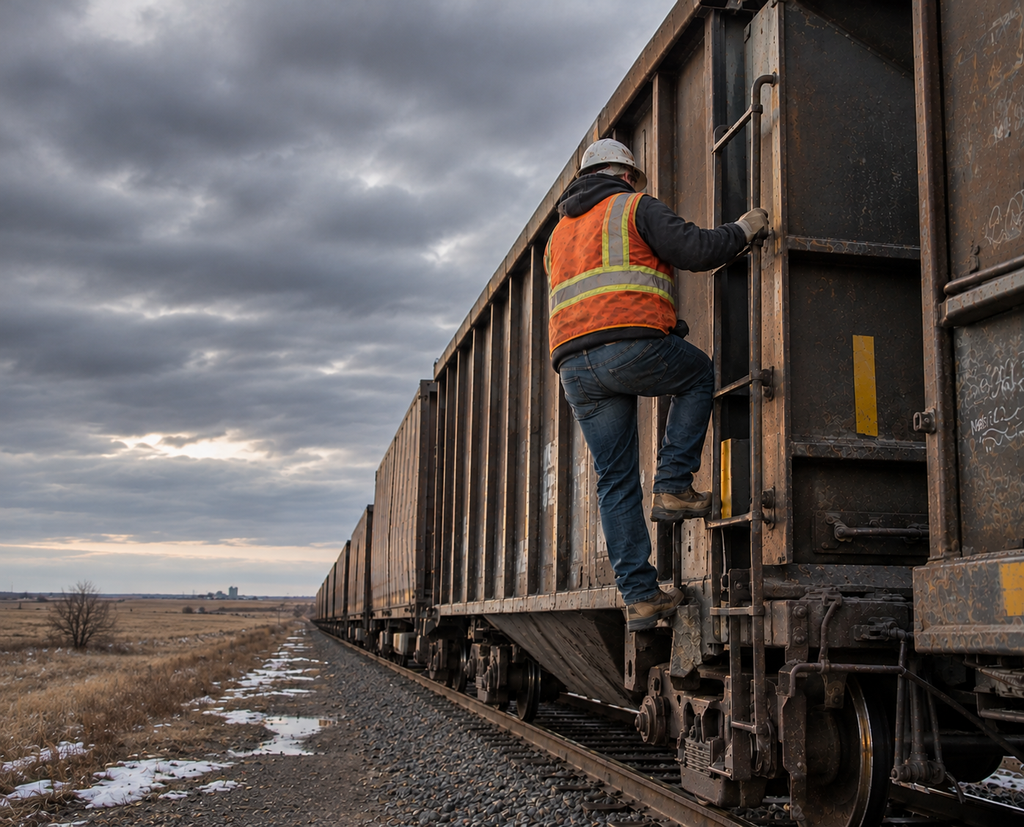
What keeps a worker from falling from height is consistently inspecting the ladder, maintaining three points of contact while climbing, using the prescribed shuffling technique and contact points when moving across the top of the car, and stopping work when any of these actions are not possible.
A single missed handhold or misplaced step can have catastrophic consequences. The control plan cannot be “training and hoping” for perfect compliance and personal accountability when things go wrong. As EHS professionals, we must build a system that makes the critical behavior dependable and a culture where it is unquestionably “safe” to stop work. For example, when ice has built up on the ladder, there are high winds, or the ladder has been damaged, and it is unknown if it is safe to use.
When an EHS leader is faced with this dilemma, it is imperative that they communicate to leadership that there is a higher level of leadership engagement and oversight required.
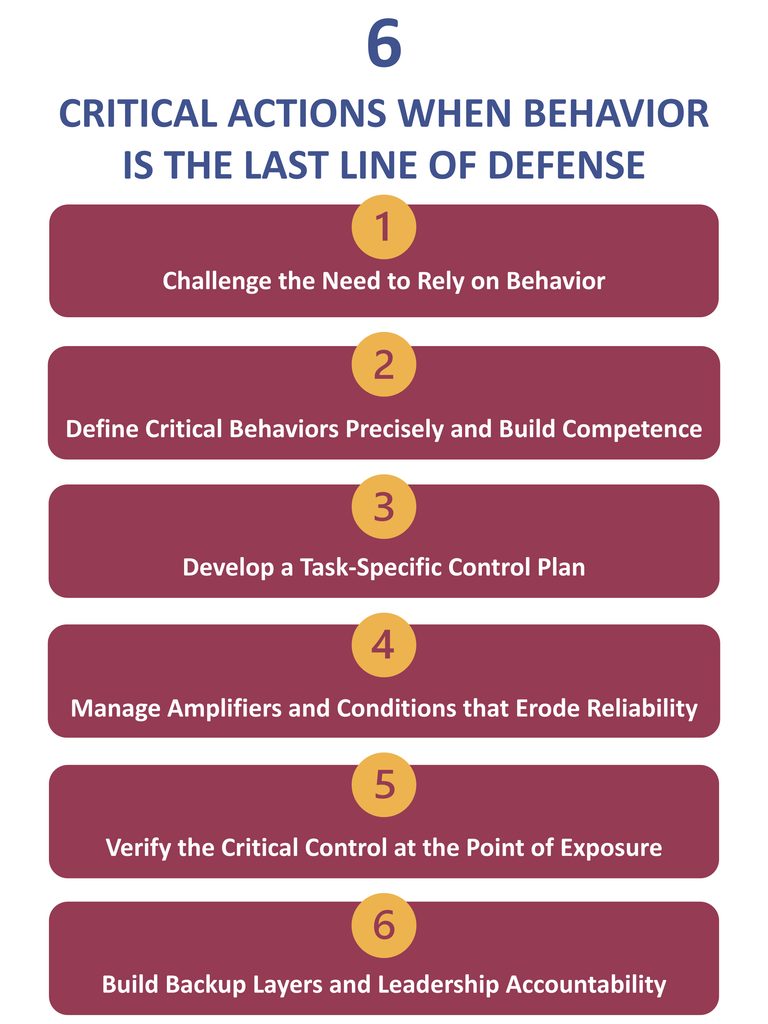
6 Critical Actions When Behavior is the Last Line of Defense
1. Challenge the Need to Rely on Behavior
Document why elimination, alternative work methods, engineered access, and fall-protection options are not practicable for the specific operation. The lack of ownership of the railcars, their mobility, and a decades-long fleet replacement cycle are real constraints, but they should trigger creative evaluation of site-based solutions, scheduling, access equipment, and coordination with railcar owners, not end the inquiry.
Revisit alternatives as technology and operating conditions change. Even if an organization finds a way to eliminate the fall exposure by 10%, it is a step in the right direction
2. Define Critical Behaviors Precisely and Build Competence
“Be careful” and “maintain awareness” are not verifiable. When an organization is relying on behavioral controls, they must be defined exactly. Anyone looking at the definition should be able to visualize and demonstrate what correct climbing and traversing looks like, including hand and foot placement. Employees need to understand both the required action and how failure could lead to a fall.
It is not enough to show and tell. In these instances, there needs to be a required practical demonstration under realistic conditions. During these practical demonstrations, employees need to understand the physical demands, equipment variability, and unusual situations employees may encounter. Management needs to refresh capability when tasks are infrequent, methods change, or verification reveals uncertainty. The test is whether a person can execute critical behavior reliably in the field, not whether they signed a training roster.
3. Develop a Task-Specific Control Plan
A control plan is a document that outlines all the actions and activities the organization has committed to control a specific SIF exposure. Controlling exposure has a multitude of elements. In this high-risk task example (ascending and descending railcars), the control plan could include hiring standards, training requirements, JSA/JHA, job briefings, critical control verification, pause work authority, and redesign efforts.
The importance of a control plan is that it puts into one document what is expected and who is responsible for its execution. If an incident happens, the first step in the investigation is to evaluate if gaps exist in the plan and whether the plan was effectively executed.
4. Manage Amplifiers and Conditions that Erode Reliability
Leaders and employees must be vigilant to changing conditions and influences that increase the probability of error. Wet or icy surfaces, contamination, poor lighting, fatigue, rushed work, awkward access, and damaged ladders can make behavioral reliability less dependable.
Establish explicit go/no-go criteria and a credible stop-work process. Supervisors and workers must have the authority and operational support to pause work rather than trying to overcome these unsafe conditions and amplifiers through extra vigilance.
5. Verify the Critical Control at the Point of Exposure
When an organization is relying on behavior as a critical control, high quality verification and positive reinforcement must happen more frequently. Critical Control Verification is different from a behavioral observation program or paperwork audit. It targets the small number of safeguards (identified from the control plan) that must be in place at the point of work to prevent an unacceptable level of exposure. Verification has two parts: physically observing whether the prescribed safeguard is being used, and second, engaging workers to assess their understanding of why it matters and what would make them stop work.
Both controlled and uncontrolled findings need to be documented. When uncontrolled exposure is found, the underlying barriers to safe work need to be identified and addressed. Data on who is doing the verification and what is found is important information for senior leadership to see and understand.
6. Build Backup Layers and Leadership Accountability
Where there is no independent physical barrier, the system has little tolerance for error. That warrants stronger proficiency checks, more deliberate field verification, equipment inspections, work planning, supervision, and clear escalation when a control cannot be maintained. These administrative layers support performance, but they should not be mistaken for an independent safeguard that will arrest a fall.
Leaders must act on recurring weaknesses, address amplifiers, and continue seeking ways to reduce exposure. There should be a layered verification system, where EHS and management verification results are compared to the findings of front-line leaders. Where significant differences appear, action needs to be taken to understand why there are differences and how to address them.
Moving From Compliance to High Reliability
High reliability does not mean assuming people will never make mistakes, it means:
- Making the safe action clear and practicable
- Anticipating circumstances that undermine it
- Detecting drift early
- Stopping or changing the work when the critical behavior cannot be maintained
The goal is not more observations of general safe behavior; it is greater confidence that the few controls standing between an employee and a fatality are effective when needed.
When behavior is the last line of defense, the organization’s responsibility increases, not decreases. EHS leaders must move beyond expecting compliance and deliberately build reliability into how the task is planned, taught, performed, supervised, and verified. They must never stop looking for a way to replace a behavior-dependent barrier with more robust control.