September 4, 2026
Building Trust for Safety Performance
Trust is one of the clearest predictors of whether people speak up, report risk, share concerns, and follow through on safe decisions when it matters most. If your workforce does not trust leaders, systems, or each other, safety performance becomes fragile. Hazards go unreported, weak signals get ignored, and teams focus on self-protection instead of risk reduction.
Building trust for safety performance is not about creating a softer culture at the expense of accountability. It is about creating the conditions for better judgment, stronger communication, faster learning, and more reliable execution. In high-risk environments, trust supports the behaviors that prevent serious events: questioning assumptions, escalating uncertainty, stopping work when needed, and learning from mistakes without fear.
For leaders, executives, and safety professionals, the real question is not whether trust matters. It is how to build trust in a way that measurably improves safety culture, decision making, and operational performance.
What Building Trust Means in a Safety Context
In safety-critical work, trust means people believe that raising concerns will lead to fair treatment, useful action, and respect rather than blame, delay, or retaliation. It also means teams trust that leaders make decisions with safety in mind, that systems are consistent, and that expectations apply across roles and levels.
This is closely connected to psychological safety, but the two are not identical. Trust often starts with relationships and credibility. Psychological safety shows up in team behavior: asking questions, admitting mistakes, challenging decisions, and sharing incomplete information before it becomes an incident. When trust is present, teams are more willing to take the interpersonal risk of speaking up. When it is missing, silence becomes normal.
That is why many organizations see trust not as a standalone culture topic, but as part of the infrastructure behind safety performance. Upward communication, procedural justice, leader-member relationships, and perceived organizational support all shape whether people believe it is safe and worthwhile to contribute to safety.
Why Trust Directly Affects Safety Performance
Safety performance improves when people consistently notice, communicate, decide, and act before exposure turns into harm. Trust strengthens each of those steps. Without it, even technically sound safety systems can underperform because people do not fully engage with them.
When trust is strong, workers are more likely to report hazards early, ask for clarification, flag conflicting priorities, and participate honestly in investigations and pre-task planning. Leaders get better information, sooner. Teams coordinate more effectively under pressure. Corrective actions are more realistic because they reflect what is actually happening in the field.
When trust is weak, the opposite happens. Teams withhold information, normalize workarounds, avoid difficult conversations, and manage image rather than risk. This is one reason trust has such a strong relationship with both day-to-day safety outcomes and the prevention of serious injuries and fatalities.
How Trust Improves Safety Performance In Practice
Better Reporting and Earlier Escalation
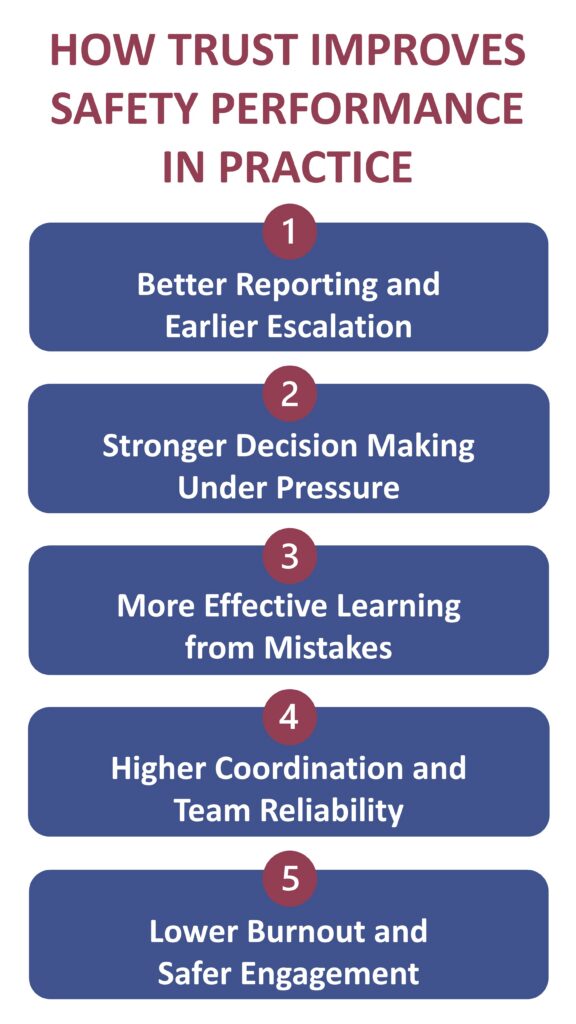
Trust increases the likelihood that people report hazards, near misses, equipment concerns, and human performance issues before they escalate. Early reporting gives leaders a chance to reduce exposure while options still exist. It also improves the quality of safety data because teams are less likely to hide, soften, or delay what they know.
Stronger Decision Making Under Pressure
In high-risk operations, poor decisions rarely come from a total lack of rules. More often, they come from incomplete information, unclear tradeoffs, or pressure that narrows judgment. Trust improves decision quality because people are more willing to surface uncertainty, challenge assumptions, and question plans that no longer fit the conditions on the ground.
This matters especially when organizations want more than compliance. They need leaders and frontline teams to make safe decisions in dynamic situations, not just follow procedures mechanically.
More Effective Learning from Mistakes
Teams learn faster when they can discuss mistakes, weak signals, and failed controls without turning every conversation into a search for blame. Trust does not remove accountability. It makes accountability more useful by shifting the focus from personal defensiveness to understanding what influenced the outcome and what needs to change.
Higher Coordination and Team Reliability
Safe work depends on handoffs, briefings, peer checks, and shared understanding across teams, contractors, supervisors, and functions. Trust reduces friction in these interactions. People clarify faster, verify more openly, and respond better when someone raises a concern or stops the job.
Lower Burnout and Safer Engagement
Low-trust environments create stress because people spend energy managing politics, protecting themselves, or guessing how leaders will react. Over time, that erodes attention, initiative, and willingness to engage. Trust supports wellbeing by making expectations clearer and communication more predictable, which in turn supports consistent safety performance.
Common Signs Trust is Missing in your Safety Culture
Many organizations do not realize trust is weak until they see repeated breakdowns in reporting, learning, or execution. The warning signs usually appear before major events.
- Hazards and near misses are underreported or reported late
- People stay quiet in meetings, pre-job briefs, or toolbox talks
- Only a few voices influence decisions while others disengage
- Supervisors hear about problems after the fact, not in real time
- Employees avoid admitting mistakes unless evidence forces it
- Investigations focus on who failed before asking what shaped the decision
- Workarounds are common but rarely discussed openly
- Different groups do not trust each other’s motives, especially across operations, maintenance, contractors, and leadership
- Employees believe speaking up will hurt their standing, schedule, or workload
These are not just culture issues. They are safety performance issues because they weaken visibility, coordination, and response before exposure can be controlled.
Why Trust Breaks Down in Modern Workplaces
Building trust for safety performance is harder when organizations operate across multiple sites, contractors, leadership layers, and changing risk conditions. Trust often erodes through patterns, not single events. Mixed messages about production and safety, inconsistent consequences, poor follow-up, and weak communication all tell employees what the organization really values.
In many workplaces, trust also breaks down because the system feels unfair. If two people make similar mistakes but receive very different treatment, employees notice. If leaders ask for honest reporting but react defensively when concerns affect schedule or cost, employees notice that too. These moments shape whether people believe it is safe to be candid.
Contractor relationships can add another layer of difficulty. If contractors feel they are judged more harshly, heard less often, or brought in too late to influence planning, they may withhold information or comply superficially. The result is a weaker safety culture precisely where alignment matters most.
Remote coordination, fast staffing changes, and cross-functional complexity can also reduce trust. Teams have fewer informal conversations, less context about leadership decisions, and fewer chances to build confidence through small interactions. In these environments, trust has to be built intentionally through systems, leadership practices, and everyday communication.
Who is Responsible for Building Trust
Trust is shaped by the whole organization, but leaders have the greatest influence because they control priorities, responses, resources, and consequences. Employees contribute to trust through respectful peer behavior and honest communication, yet the daily climate is strongly affected by how leaders listen, decide, and respond when something goes wrong.
Executives influence trust by aligning business decisions with stated safety values. Mid-level leaders influence trust by translating those values into consistent expectations, support, and follow-through. Supervisors influence trust most directly because they shape the immediate experience of speaking up, asking for help, and reporting concerns.
If leaders want trust, they cannot delegate it to communications campaigns or annual training. It is built through repeated evidence that people will be heard fairly, treated consistently, and supported in making safe decisions.
How to Build Trust for Better Safety Performance
There is no single trust program that fixes safety culture. Trust grows when leadership behavior, decision processes, and organizational systems send the same message over time. The actions below are the ones that most directly support safety performance.
Create Fairness People Can See
One of the fastest ways to build trust is to make decisions and responses feel procedurally fair. Employees do not expect every outcome to go their way, but they do expect consistency, explanation, and respect.
- Apply standards consistently across levels and functions
- Explain why decisions were made, especially after incidents
- Separate blame from fact-finding in reviews and investigations
- Make it clear how reported concerns will be evaluated and acted on
Procedural justice matters because people judge trustworthiness not only by outcomes, but by how the process feels. Building visible fairness in safe work environments helps reinforce that trust.
Strengthen Upward Communication
If people cannot safely communicate upward, trust will remain limited no matter how strong the messaging is. Leaders need reliable channels for concerns, but channels alone are not enough.
Employees must believe that using them leads to attention and action.
- Ask directly what teams are worried about before asking whether they are compliant
- Respond to concerns with curiosity before evaluation
- Close the loop by sharing what was learned and what changed
- Track repeat concerns that signal unresolved system issues
When teams see that raising issues changes decisions, trust rises. When concerns disappear into a black box, trust falls.
Model Trust-Building Leadership Behaviors
Leaders build trust through visible habits, not intent alone. Teams pay close attention to how leaders react under pressure, especially when production, deadlines, or reputation are at stake.
- Admit uncertainty when conditions are changing
- Invite challenge and questions before finalizing plans
- Acknowledge mistakes without becoming defensive
- Follow through on commitments, even small ones
- Treat stop-work decisions as contributions to performance, not disruptions
These behaviors show that speaking up is part of how work gets done well, not an exception that slows things down. Practices like conveying genuine care also help make those behaviors credible.
Improve Decision Quality, Not Just Rule Compliance
Trust grows when workers see that leaders care about how decisions are made, not only whether targets are met. In safety-critical settings, this means examining assumptions, competing pressures, and exposure to risk before actions are taken.
A stronger decision process helps teams understand that safety is part of operational judgment, not a separate conversation. This is especially important for preventing serious injuries and fatalities, where exposure, system weaknesses, and leadership choices often interact long before an event occurs.
Make Learning Safe and Useful
If every error conversation feels punitive, people will protect themselves and learning will stay shallow. To build trust, leaders need processes that help teams examine what made the decision seem reasonable at the time, what signals were missed, and what barriers failed.
- Discuss near misses with the same seriousness as actual events
- Look for system contributors, not only frontline actions
- Share lessons across teams quickly and clearly
- Recognize people who raise uncomfortable but important information
Build Connections Across Leaders, Teams, and Contractors
Trust weakens when groups operate in parallel with different assumptions, pressures, and interpretations of risk. This is common between leadership and the field, and between host employers and contractors. Safety performance improves when these groups understand each other’s constraints, expectations, and decision boundaries.
That requires more than formal meetings. It requires regular dialogue about what is changing, where exposure is increasing, and what support teams need to execute safely. In contractor environments, trust depends heavily on whether communication is early, respectful, and integrated into planning rather than added after key decisions are made.
A Practical Framework for Building Trust
If you want to improve trust in a measurable way, focus on the conditions that shape behavior every day. The framework below helps connect trust-building actions to safety performance outcomes.
| Trust Driver | What it Looks Like in Practice | Safety Performance Impact |
| Procedural justice | Consistent responses, clear explanations, fair treatment | More reporting, less silence, better credibility of leadership |
| Upward communication | Concerns are welcomed, heard, and acted on | Earlier hazard identification and escalation |
| Leader-member exchange | Respectful day-to-day interactions between leaders and workers | Higher engagement, stronger coordination, better follow-through |
| Perceived organizational support | Employees believe the organization supports safe work | More discretionary effort and safer decisions under pressure |
| Safety climate | People believe safety is genuinely prioritized | Stronger alignment between stated values and field behavior |
How to Measure Whether Trust is Improving
Trust should be treated as an operational factor, not just a sentiment. If you want to know whether trust-building efforts are working, combine perception data with behavioral and system indicators.
- Survey measures related to leadership credibility, fairness, support, and communication
- Quality and volume of hazard, near miss, and concern reporting
- Participation rates in pre-job briefs, safety meetings, and learning reviews
- Patterns in stop-work use, escalation timing, and follow-up quality
- Differences in reporting and speaking-up behavior across departments or contractors
- Recurring themes in serious event precursors and decision breakdowns
The goal is not to chase a single score. It is to understand whether people trust the system enough to contribute the information and judgment needed for safe performance.
Building Trust in High-Risk Industries
Trust matters in any workplace, but it becomes critical in industries where exposure can quickly lead to severe outcomes. In manufacturing, oil and gas, mining, transportation, pharmaceuticals, military, and government settings, workers often deal with changing conditions, complex systems, and decisions that carry serious consequences. In these environments, trust is not only cultural. It is protective.
That is also why trust-building should be connected to risk exposure and serious injury and fatality prevention, not treated as a general engagement topic. When trust is built into leadership practices, culture systems, and decision processes, organizations are better positioned to reduce exposure before serious events occur.
Where Many Trust Initiatives Fail
Organizations often say they want openness, but undermine trust through inconsistency. A few common patterns cause trust efforts to stall:
- Launching culture messaging without changing leadership behavior
- Encouraging reporting but failing to respond visibly
- Talking about learning while investigations remain blame-heavy
- Measuring lagging outcomes only and ignoring communication quality
- Expecting supervisors to build trust without giving them tools, time, or support
Trust is built when systems and decisions reinforce the same expectations repeatedly. If leadership actions contradict the message, employees will believe the actions.
FAQ About Building Trust for Safety Performance
* Developed with the support of AI and reviewed by Krause Bell Group Editorial Team