June 5, 2026
Confined Space Entry SIF Risks
Confined space entry SIF risks demand more than routine hazard awareness. When a task involves a space with restricted entry, poor ventilation, energy hazards, or engulfment potential, the consequence profile changes fast. Even routine tasks in confined spaces can become life-threatening very quickly if controls fail or hazards change.
If you are responsible for operational risk, frontline supervision, or safety leadership, it helps to look at confined space entry through a serious injury and fatality prevention lens. That means focusing less on minor injury potential and more on the conditions most likely to kill, permanently disable, or trap a worker before rescue is possible.
This guide explains the most important confined space entry SIF risks, why these events so often escalate, and which controls matter most when the goal is preventing catastrophic outcomes rather than simply meeting minimum compliance.
Why Confined Space Entry is a High-Potential SIF Exposure
Confined spaces are defined as spaces large enough for a worker to enter, with limited or restricted means of entry or exit, and not designed for continuous occupancy. These conditions can allow hazardous atmospheres, including oxygen-deficient or toxic atmospheres, to accumulate quickly. In many cases, workers are exposed to multiple hazards at the same time, such as a hazardous atmosphere, moving equipment, and difficult egress.
From a SIF perspective, confined space entry is not just another hazardous task. It is a high-energy, high-consequence exposure where the margin for error is small. Atmospheric changes can happen quickly. Isolation failures can expose entrants to mechanical, electrical, hydraulic, pneumatic, or chemical energy. An entrant can collapse without warning, and unplanned rescue attempts can put attendants and coworkers at risk as well.
This is why confined spaces account for a significant portion of workplace fatalities. For example, from 2011 to 2018, U.S. data show 1,030 confined-space-related deaths. The issue is not only the presence of hazards, but the speed of escalation and the difficulty of recovery once something goes wrong.
What Counts as a Confined Space and When it Becomes a SIF Concern
A confined space is generally a space that is large enough for you to enter, has limited or restricted means of entry or exit, and is not designed for continuous occupancy. Common examples include tanks, pits, silos, vaults, vessels, tunnels, sewers, sumps, ductwork, and some excavated or enclosed process areas.
Not every confined space automatically presents the same level of SIF exposure, but many do because of the hazards they can contain or create. The risk becomes especially serious when the space includes one or more of the following:
- Hazardous atmosphere
- Potential for engulfment
- Internal shape that can trap or asphyxiate you
- Mechanical or other uncontrolled energy sources
- Heat, chemical, or biological exposure severe enough to disable quickly
- Entry conditions that make self-rescue or external rescue difficult
In practical terms, confined space entry becomes a SIF concern when a worker could be killed, rendered unconscious, trapped, or permanently injured before effective intervention is possible.
The Main Confined Space Entry SIF Risks You Need to Control
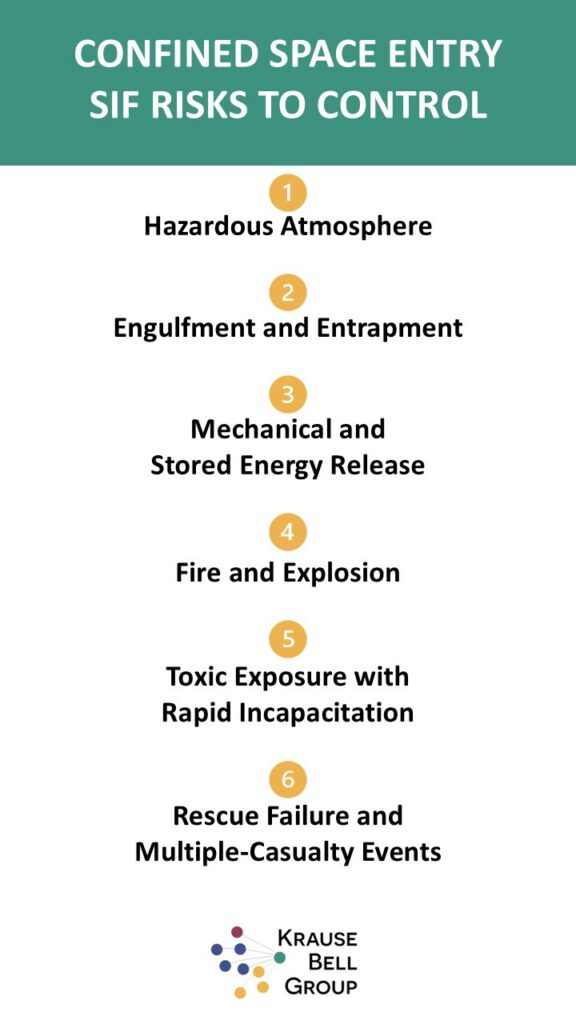
1. Hazardous Atmosphere
Atmospheric hazards are one of the most significant confined space entry SIF risks because they can incapacitate or kill without much warning. Oxygen deficiency, oxygen enrichment, flammable vapors, toxic gases, and airborne contaminants can all create immediate danger. The absence of smell or visible signs does not mean the atmosphere is safe.
Examples include nitrogen displacement, hydrogen sulfide, carbon monoxide, solvent vapors, methane, and process-related residues that release harmful gases when disturbed. A worker may enter a space that tested safe earlier, only to face changing conditions caused by ongoing work, product release, temperature shifts, or inadequate ventilation.
Atmospheric hazards are especially severe because they reduce the ability to recognize danger and act in time. Once an entrant is disoriented or unconscious, rescue becomes more complex and the SIF potential rises sharply.
2. Engulfment and Entrapment
Engulfment occurs when a worker is surrounded or buried by a material such as grain, powder, sludge, sand, liquid, or other flowable contents. Entrapment can also occur because of converging walls, sloping floors, or internal geometry that causes the body to become wedged or compressed. These are classic high-consequence hazards because they can lead to suffocation, crush injury, and delayed recovery.
Bins, silos, hoppers, sumps, and tanks are particularly dangerous when material bridging, unexpected flow, or residual contents are present. Even a partial release can pin a person or make breathing impossible. In some spaces, the shape itself becomes the hazard. Narrow sections, funnel-shaped bottoms, or internal structures can trap a worker in a position where self-extrication is unrealistic.
3. Mechanical and Stored Energy Release
Many serious confined space incidents involve isolation failures. Agitators, augers, conveyors, mixers, valves, rotating parts, hydraulic systems, steam lines, pressurized systems, and electrical equipment can all expose entrants to fatal energy if they are not fully isolated, locked out, tagged out, verified, and controlled.
This category also includes residual pressure, gravity, spring force, and line contents. A space may appear inactive, but if stored energy remains or process connections are not positively isolated, an entrant can be struck, crushed, burned, drowned, or exposed to chemicals without warning.
For SIF prevention, the key point is simple: permit paperwork does not control energy. Effective isolation does.
4. Fire and Explosion
Confined spaces with flammable gases, vapors, dusts, or residues can escalate into catastrophic fire or explosion events. Hot work, static discharge, non-classified equipment, friction, sparks, or process reactions can act as ignition sources. Because the space is enclosed, pressure and thermal effects can be more severe, and escape options are limited.
Even when atmospheric testing is performed, conditions can change during the job. Cleaning operations, coating work, chemical reactions, or disturbed residues can release flammable contaminants after entry has already begun.
5. Toxic Exposure with Rapid Incapacitation
Some confined space hazards do not just irritate or injure over time. They can disable you within seconds or minutes. Hydrogen sulfide, carbon monoxide, solvents, process gases, and oxygen-deficient atmospheres can quickly impair judgment, coordination, and consciousness. That makes them major SIF exposures, even when measured concentrations seem borderline or intermittent.
The real danger is not just toxicity itself. It is the combination of toxic exposure plus delayed recognition, limited egress, and the tendency for coworkers to attempt rescue without proper equipment.
6. Rescue Failure and Multiple-Casualty Events
One of the most overlooked answers to the question, what are the dangers of confined space entry, is that a single incident often becomes a multiple-fatality event. Unplanned rescue attempts are a recurring pattern in confined space deaths. A worker collapses, a coworker enters to help, and then both are overcome by the same atmosphere or trapped by the same hazard.
This is why rescue capability is not a secondary detail. If retrieval systems are missing, access is poor, communications fail, or the rescue team is not competent for the actual hazards present, the SIF exposure remains unacceptably high even if the job appears otherwise well planned.
What are the 6 Specific Risks in Confined Space Work?
If you want a practical way to group the most critical confined space entry SIF risks, these six categories cover the hazards most often linked to fatal and life-altering events:
- Oxygen deficiency or oxygen enrichment
- Toxic gas or vapor exposure
- Fire and explosion from flammable atmospheres
- Engulfment by solids or liquids
- Mechanical, electrical, hydraulic, pneumatic, or pressure-related energy release
- Entrapment and rescue failure
These are often the hazards people mean when they ask, what are the 6 hazards of confined space or what hazards may be present in a confined space rescue. The number varies by source, but the high-consequence themes stay largely the same: atmosphere, energy, engulfment, configuration, and rescue difficulty.
Why Confined Space Incidents Become Fatal So Quickly
Confined space events escalate faster than many other workplace incidents because the worker’s ability to detect danger, move freely, communicate, and escape is already constrained.
The environment works against recovery. A hazardous atmosphere may provide no reliable warning. Toxic effects can impair judgment before the entrant understands what is happening. Physical layout may slow both self-rescue and assisted rescue.
There is also a common decision-making problem. Teams may normalize the task because it has been done before without incident. When familiarity replaces critical verification, permit checks become routine, assumptions go unchallenged, and weak controls remain hidden until conditions line up for a catastrophic failure.
For SIF prevention, this matters. Fatal confined space incidents rarely depend on one issue alone. They usually involve a chain of control breakdowns, such as poor hazard identification, incomplete isolation, inadequate atmospheric monitoring, changing work conditions, weak supervision, and rescue arrangements that do not match the actual risk.
Critical Controls That Reduce Confined Space Entry SIF Risks
If the objective is to prevent serious injuries and fatalities, your controls need to focus on the few barriers that stop catastrophic outcomes. These controls should be treated as critical, verified in the field, and never reduced to paperwork alone.
Hazard Identification Before Entry
You need a clear understanding of the space, its history, connected systems, residues, configuration, process hazards, and the work to be performed inside. Hazard identification should account for both existing conditions and hazards introduced by the job itself, such as welding, cleaning agents, line opening, or pressure washing.
Isolation of All Hazardous Energy and Materials
Isolation should address every source that can introduce energy, movement, pressure, flow, chemicals, or heat into the space. This may include lockout and tagout, blanking or blinding, disconnecting lines, blocking moving parts, draining contents, depressurizing systems, and verifying zero energy. The standard should be proof, not assumption.
Atmospheric Testing and Continuous Awareness
Pre-entry gas testing is essential, but it is only the start. Testing should match the hazards reasonably expected in the space, and where conditions can change, continuous or periodic monitoring is often necessary. Sampling method, sensor limitations, stratification, and instrument calibration all matter. A single acceptable reading at one point in time does not eliminate atmospheric SIF risk.
Ventilation Matched to the Hazard
Forced air ventilation can reduce some atmospheric hazards, but it is not a universal solution. You need to know whether ventilation is controlling the hazard effectively, whether dead zones exist, and whether the work itself is introducing contaminants faster than they can be removed.
Entry Authorization and Role Clarity
Entrants, attendants, and entry supervisors need clear responsibilities. Everyone involved should understand the hazards, stop-work triggers, communication methods, and rescue escalation path. Where role confusion exists, delayed response and poor decisions become much more likely.
Rescue Readiness
Rescue planning should be specific to the space, the hazards, and the access conditions. Non-entry rescue should be used where feasible, but only when it can actually be performed effectively. If entry rescue is required, the rescue capability must be real, timely, trained, equipped, and suitable for the actual conditions.
Field Verification of Critical Controls
One of the strongest SIF prevention practices is direct verification in the field. Leaders and supervisors should confirm that the controls assumed in planning are physically in place and functioning. This includes checking isolation points, testing methods, ventilation setup, communication equipment, permit conditions, and rescue arrangements at the point of work.
Confined Space Entry SIF Risk Indicators Leaders Should Watch For
Many confined space fatalities are preceded by weak signals that were visible but not treated as significant. Looking for these indicators helps you identify elevated exposure before the event occurs.
- Entry permits completed as a routine administrative step
- Incomplete understanding of line contents or prior use of the space
- Isolation based on valve closure alone without positive verification
- Gas testing done once, too early, or with the wrong instrument
- Ventilation assumed effective without confirming actual conditions inside the space
- Work scope changes after entry begins
- Hot work or chemical cleaning added late in the planning process
- Attendants managing multiple tasks or lacking authority to stop work
- Rescue equipment is present, but not practical for the actual entry geometry
- Teams relying on experience rather than disciplined control verification
These are not minor process issues. In a SIF context, they are warning signs that the system may be underestimating high-consequence exposure.
A Practical SIF-Focused Confined Space Risk Review
Before entry, it helps to use a short, consequence-based review rather than relying only on whether the permit form is complete. Ask questions that test whether the fatal risk is actually controlled:
- If the atmosphere changes suddenly, how will you detect it and how quickly can the entrant get out?
- What could enter the space unexpectedly through connected systems?
- What stored energy could still be present even after isolation?
- Could the space trap, compress, drown, or engulf an entrant?
- What job steps could create new ignition, toxicity, or oxygen hazards?
- Can rescue be performed in time under real conditions, not ideal conditions?
- Which controls are critical enough that if one fails, the event could become fatal?
This style of review shifts attention from compliance completion to exposure reality, which is exactly where SIF prevention needs to focus.
Common Gaps Between Compliance and Real SIF Prevention
Many organizations have confined space procedures and still remain vulnerable to catastrophic incidents. That usually happens because the system is designed to satisfy procedural requirements but not to consistently detect and control high-consequence failure pathways.
Common gaps include:
- Permits that document controls but do not verify them physically
- Training that explains rules but does not build hazard recognition under changing conditions
- Rescue plans that exist on paper but are not realistic for the specific space
- Audits focused on form completion rather than control effectiveness
- Leadership reporting centered on low-severity events while weak SIF signals go unnoticed
A stronger approach is to treat confined space entry as a critical risk management exposure that needs disciplined leadership attention, operational verification, and learning systems aimed specifically at serious injury and fatality prevention.
How a SIF Lens Improves Confined Space Decision-Making
A SIF lens changes the questions you ask. Instead of asking whether the task is common, whether the team is experienced, or whether the permit is filled out, you ask whether the controls can reliably prevent a catastrophic outcome if conditions degrade. That shift matters because high-potential events often occur in routine work that feels familiar.
For leaders, this means prioritizing the exposures that can kill, ensuring critical controls are understood at every level, and building a culture where operational verification is normal. For organizations focused on SIF prevention, confined space entry is a clear area where leadership quality, supervision, and control discipline directly influence fatal risk.
Krause Bell Group’s broader work in SIF prevention and safety culture improvement aligns with this kind of thinking: identifying the SIF precursors that matter most, strengthening critical control discipline, and helping leaders make better decisions where the consequence profile is severe.
FAQs
* Developed with the support of AI and reviewed by Krause Bell Group Editorial Team