March 2, 2026
What Is Serious Injury and Fatality Prevention?
Serious Injury and Fatality (SIF) prevention focuses your safety effort on eliminating life-altering harm and deaths. Instead of counting all injuries equally, you identify exposures that can kill or permanently disable and install the critical controls that reliably prevent them. This means learning from potential SIF events, verifying controls where risk is high, and building leadership capability to make better risk decisions every day.
What counts as a Serious Injury and Fatality event?
A SIF event is an incident that results in death, life-threatening harm, or long-term, life-altering injury. Many organizations also track potential SIFs – incidents or near misses that could reasonably have caused SIF-level harm if conditions were slightly different. Typical SIF exposures include working at height, confined spaces, energy isolation failures, vehicle and mobile equipment interactions, line-of-fire hazards, and high-voltage electrical work.
Why treat SIFs differently from minor injuries? Frequency and severity do not move in lockstep. You can drive recordable rates down while leaving catastrophic exposure unchanged. Focusing on SIFs doesn’t mean ignoring smaller injuries. SIF prevention therefore prioritizes identifying SIF-related tasks and scenarios, assessing their potential, and ensuring the few controls that matter most are present, effective, and used as designed.
Why SIF prevention deserves a distinct strategy
SIF events have disproportionate human and organizational impact. They create irreversible harm, carry major financial and reputational consequences, and often expose systemic weaknesses. Traditional metrics like Total Recordable Incident Rate can improve through minor injury reductions without touching the low-frequency, high-consequence events that matter most. A distinct SIF strategy focuses leaders, supervisors, and teams on the limited set of exposures that can be catastrophic and the critical controls that prevent them.
The power of potential SIFs (pSIFs)
Potential SIFs are your best early-warning system. When you capture and analyze near misses and incidents with credible SIF potential, you reveal fragile safeguards, gaps in procedures, and patterns in decision-making. Treat pSIFs as learning opportunities: define clear criteria, train people to recognize and report them, require cause analysis that examines controls and leadership decisions, and close the loop by strengthening the specific controls that failed or were missing. For a deeper dive into building an organization that learns to prevent SIFs, see Learning to Prevent Serious Injuries and Fatalities (SIFs).
Core components of an effective SIF prevention approach
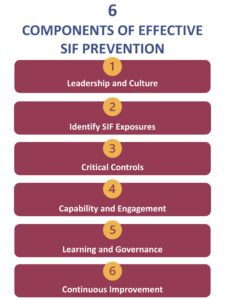
- Leadership and culture – Set SIF as a strategic priority, align goals and incentives, and model risk-informed decisions over speed and convenience. SIF prevention must start with leadership.
- Identify SIF exposures – Map high-risk tasks and scenarios, classify credible worst-case outcomes, and flag pSIF precursors.
- Critical controls – Specify the few controls that make the difference, define performance standards, and use verification rather than assumption.
- Capability and engagement – Build decision-making skills for supervisors and workers, with scenario-based training on SIF exposures.
- Learning and governance – Analyze SIF and pSIF events for control effectiveness, not blame; track actions to closure and share learnings quickly.
- Continuous improvement – Review SIF metrics, test new safeguards, and adapt as operations, technology, and risks change.
To pressure-test your approach, review these 10 questions to ask about your SIF elimination plan.
High-risk scenarios you should prioritize
- Working at height – Falls remain a leading SIF source. Emphasize engineered fall protection, certified anchors, and pre-use verification.
- Confined spaces – Toxic atmospheres and engulfment demand permits, atmospheric testing, isolation, attendant duties, and rescue readiness.
- Energy isolation (LOTO) – Hazardous energy kills when isolation is incomplete. Require written isolation plans, verification, and group control.
- Mobile equipment and traffic – Struck-by and runover risks call for separation, spotters, exclusion zones, and line-of-sight technology.
- Electrical work – Arc flash and shock require de-energization by default, boundaries, PPE, qualified persons, and strict work permits.
Metrics that matter for SIF prevention
- SIF and pSIF rates – Count actual and potential SIF events to understand exposure and learning volume.
- Critical control verification – Measure how often key controls are present, functional, and used during high-risk work.
- Quality of learning – Track cause quality, systemic action closure, and time to resolution for SIF and pSIF analyses.
- Leadership engagement – Monitor leadership field interactions focused on SIF exposures and decision quality.
To visualize and monitor the indicators that matter, explore Dashboards for Serious Injury and Fatality Prevention.
FAQs
Advance your SIF results with leadership and decision-making
If you want to accelerate SIF prevention through stronger leadership and better risk decisions, explore our Masterclasses or contact us to discuss tailored workshops and advisory support.
* Developed with the support of AI and reviewed by Krause Bell Group Editorial Team