March 11, 2026
How to Identify SIF Precursors
Serious injuries and fatalities (SIFs) rarely happen without warning. They are preceded by specific conditions and behaviors that elevate exposure to risk. This page shows you how to identify SIF precursors in the field, why many are missed, and what to do in the moment so you reduce the likelihood and impact of serious events.
Why many SIF precursors go unseen
Most people do not miss hazards because they do not care. They miss them because the human brain takes shortcuts. Strengthening visual literacy and critical thinking helps you notice what blends into the background and challenge assumptions about risk and control effectiveness. For practical methods, see Learning to Prevent Serious Injuries and Fatalities (SIFs).
- Expectation bias: You see what you expect. Familiar jobs look “safe,” so new or degraded conditions are overlooked.
- Normalization of deviance: Workarounds that “worked last time” start to feel acceptable, masking real SIF exposure.
- Anchoring on low severity: Minor injuries dominate memory, so you underestimate credible worst-case outcomes.
- Social influence: Group confidence and status can discourage speaking up about weak or missing controls.
Improve what you see by slowing down to scan for change, comparing what is present with what should be present, and deliberately testing the strength of controls against a credible worst-case scenario. Understanding exposure to risk in the Safety Loop helps connect precursors to system factors.
High-risk SIF precursors to watch for
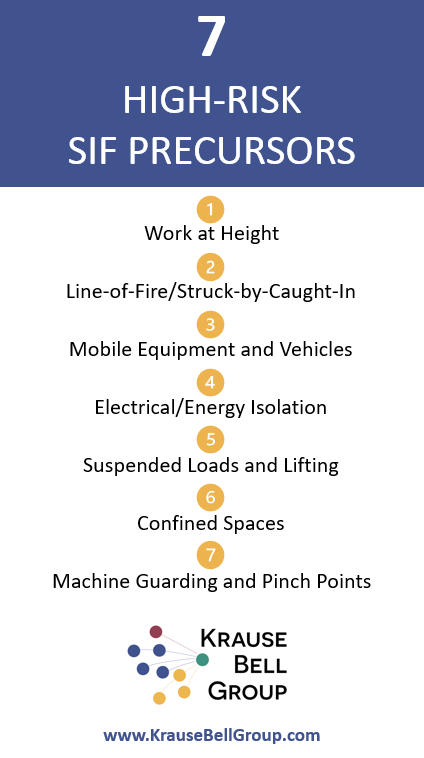
Use this list to focus your attention on conditions most associated with serious injuries and fatalities. For each category, identify the exposure, then verify that effective controls are in place and working.
- Work at height: Look for unprotected edges, incomplete guardrails, mismatched anchor points, damaged fall-arrest gear. Controls: engineered guardrails, certified anchors, 100 percent tie-off, rescue plan.
- Line-of-fire/struck-by-caught-in: Look for people within swing radius, pinch points, stored energy, hands in the danger zone. Controls: physical barriers, lockout of motion, tool use that keeps distance, sequence checks.
- Mobile equipment and vehicles: Look for blind spots, mixed pedestrian-vehicle paths, spotter gaps, unstable loads. Controls: dedicated walkways, spotters/radios, speed limits, restraint checks, pre-use inspections.
- Electrical/energy isolation: Look for exposed conductors, temporary power, missing covers, ambiguous labeling. Controls: LOTO with verification, absence-of-voltage test, barriers, qualified persons only.
- Suspended loads and lifting: Look for people under loads, side loading, rigging wear, uneven ground. Controls: exclusion zones, qualified riggers, load charts, inspected slings, leveled and cribbed equipment.
- Confined spaces: Look for uncontrolled atmospheres, line-of-fire from product or energy, single egress, poor comms. Controls: permit, test/ventilate, isolate, attendant, retrieval, continuous monitoring.
- Machine guarding and pinch points: Look for bypassed interlocks, removed guards for “quick” tasks, auto-restart hazards. Controls: fixed guards, interlocks, lockout, verification of zero energy, restart prevention.
To monitor leading indicators and signals that reveal precursors earlier, use dashboards for SIF prevention.
When you find any of the above exposures, ask two questions: What is the credible worst case if controls fail, and how confident am I the controls will hold under real conditions.
Quick field method to identify SIF precursors
Use this 6-step scan to turn observations into SIF prevention in about 8 minutes.
- Define the task and credible worst case if things go wrong.
- Map the energy sources present (gravity, motion, electrical, pressure, chemical).
- Find line-of-fire paths between the energy and people.
- Check controls for effectiveness: engineered first, then administrative and PPE. Verify, do not assume.
- Look for drift: workarounds, production pressure, time squeeze, unclear roles.
- Act: pause the job if needed, strengthen controls, and align on a safer sequence before resuming.
To pressure-test your approach, use these 10 questions to ask about your SIF elimination plan.
FAQs
Partner with Krause Bell Group
If you want to accelerate results, our Executive Masterclasses and consulting help leaders apply Safe Decision Making® principles, strengthen the Safety Loop, and reduce SIF exposure across operations.
Learn more by visiting our Masterclasses or Consulting Services pages.
* Developed with the support of AI and reviewed by Krause Bell Group Editorial Team