June 12, 2026
How to Verify Critical Controls
If you want to prevent serious injuries, fatalities, and major loss events, you cannot stop at identifying critical controls. You also need a clear way to verify that those controls are present, functional, used correctly, and able to perform when the risk is real. That is what critical control verification is about: turning assumptions into evidence. In practice, that means defining what “working” looks like, checking the control at the right frequency, documenting proof, and acting fast when something fails.
This guide shows you how to verify critical controls in a practical way. You will learn the critical control verification process, what evidence to collect, how to avoid checklist-only thinking, and how to build a verification approach that supports stronger risk management and SIF prevention.
What Critical Control Verification Actually Means
AA critical control is a specific barrier or system that directly prevents a high-consequence event. Critical control verification is the process of confirming that the safeguard is in place, effective, and reliable in real operating conditions.
That means you are not only asking whether a control exists. You are asking better questions, such as:
- Is the control installed or available where it should be?
- Is it in the right condition and fit for purpose?
- Is it being used as intended?
- Can you show evidence that it works?
- Will it still perform under normal work pressures and field conditions?
This distinction matters. A guard, permit, interlock, isolation step, alarm, procedure, or competency requirement may be listed as a critical control, but it only protects people when it consistently performs its intended function.
Why Verifying Critical Controls Matters
Verification closes the gap between design and reality. Many organizations have risk registers, bowties, procedures, and control lists that look strong on paper. The real question is whether the most important safeguards are holding up in the field.
When you verify critical controls well, you can:
- Detect control degradation before it leads to an incident
- Find gaps between procedure and actual work
- Strengthen accountability for high-consequence risks
- Support audits, investigations, and governance reviews
- Focus leadership attention on the controls that matter most
Without verification, teams can drift into false confidence. A control may be assumed to be effective simply because it was installed, trained, or checked once in the past.
Start with the Right Controls, Not Every Control
The first step in the critical control verification process is deciding which controls truly deserve that level of attention. Not every preventive measure is a critical control. A control becomes critical when its failure could directly allow a fatality, permanent injury, or other major unwanted event.
In most organizations, this selection should come from an existing risk assessment, bowtie analysis, major hazard review, or similar process. You should be able to link each critical control to:
- A specific unwanted event or exposure
- A clearly defined hazard or pathway to harm
- A reason the control is considered critical
- A measurable performance expectation
If a team cannot explain why a control is critical, it will be hard to verify it consistently
Define What “Effective” Looks Like Before You Verify Anything
One of the biggest reasons verification programs become weak is that teams start inspecting before they define success. If “working” is vague, the verification result will also be vague.
For each critical control, define the specific conditions that prove effectiveness. This can include:
- Availability – the control is present where and when needed
- Integrity – the control is in good condition and not degraded
- Functionality – it performs the intended protective action
- Use – people apply it correctly in the work process
- Assurance – records, tests, or observations confirm ongoing performance
This creates a more useful standard than a simple yes or no inspection. It also helps you avoid checking for presence when you should be checking for performance.
A Practical, Step-By-Step Critical Control Verification Process
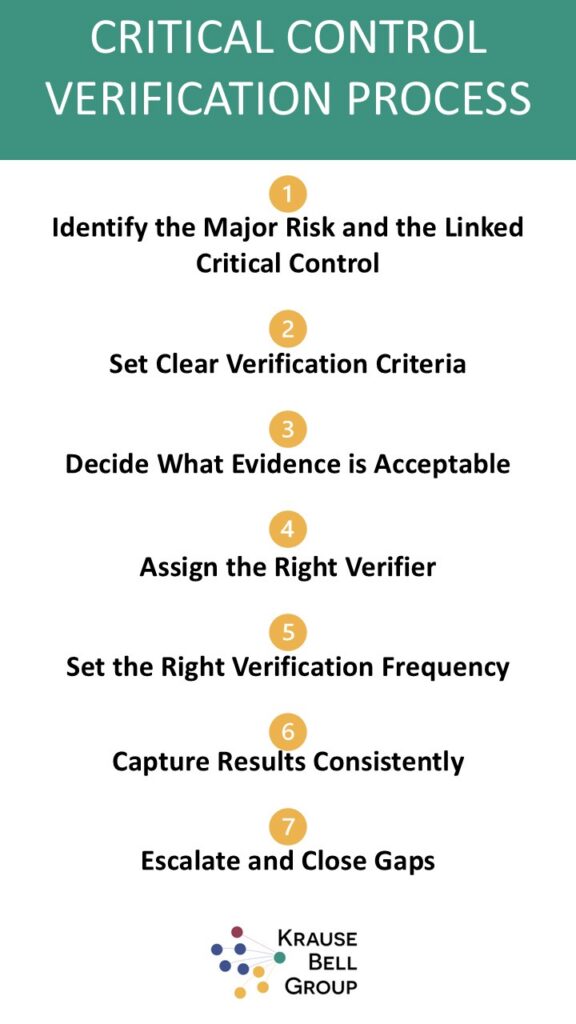
1. Identify the Major Risk and the Linked Critical Control
Start with the serious event you are trying to prevent. Then identify the control that interrupts that pathway. Keep the connection explicit. Verification works best when each check clearly ties back to a defined risk, not just a generic safety activity.
2. Set Clear Verification Criteria
Write down exactly what needs to be true for the control to be considered effective. This should be observable, testable, or documentable. Avoid broad wording like “good condition” unless you define what that means.
3. Decide What Evidence is Acceptable
Evidence may include direct observation, function testing, photos, inspection records, calibration reports, maintenance logs, interviews, system data, or permits. Choose evidence that actually proves the control is working, not just that paperwork exists.
4. Assign the Right Verifier
Some controls can be verified by frontline supervisors or operators. Others require engineering, maintenance, technical authorities, or leadership review. The more complex or high consequence the control, the more important verifier competence becomes.
5. Set the Right Verification Frequency
Frequency should reflect the risk, failure mode, operating environment, and how quickly the control can degrade. Some controls need pre-use checks, others daily, weekly, monthly, or scheduled assurance reviews.
6. Capture Results Consistently
Your verification method should make it easy to record findings, note deviations, attach evidence, and trend repeat failures. A good checklist can support this, but only if it drives useful observation rather than fast box-ticking.
7. Escalate and Close Gaps
If a critical control is not effective, the response cannot stop at documentation. The issue needs action, ownership, due dates, and follow-up. In some cases, work should not continue until the control is restored or a suitable alternative is in place.
What Good Verification Evidence Looks Like
Strong evidence is specific, timely, and relevant to the control’s actual purpose. Weak evidence often proves that a task happened, but not that the risk was controlled.
| Type of critical control | Examples of useful verification evidence | Weak evidence to avoid relying on alone |
| Physical barrier or guard | Field observation, condition inspection, function test, repair history | Old installation photo |
| Interlock or shutdown device | Test records, fail-safe check, maintenance and calibration data | Statement that it is fitted |
| Isolation or lockout control | Observed verification of zero energy, signed isolation checks, field audit | Completed form without field confirmation |
| Permit to work | Permit quality review, field compliance observation, supervisor interview | Permit issued in system only |
| Competency-based control | Observed task performance, assessment records, refresher status | Training attendance only |
| Inspection or maintenance control | Completed inspection, defect closure, condition trend, overdue tracking | Scheduled task with no quality review |
Example of How to Verify a Critical Control in the Field
A simple example is machine guarding on equipment with moving parts. If the guard and interlock are treated as a critical control, verification should go beyond confirming that the guard exists.
You would want to verify:
- The guard is installed in the correct position
- It has no damage, gaps, or unauthorized modification
- The interlock stops the machine as intended when tested
- The control cannot be easily bypassed
- Maintenance and inspection records show continued integrity
- Operators are actually using the equipment within the intended safeguards
Useful evidence could include a field observation, function test results, maintenance history, defect records, and direct operator discussion. This is much stronger than a checklist item that only states “guard in place.”
Common Mistakes When You Verify Critical Controls
Many verification systems fail for the same reasons. They collect activity, but not assurance. They produce records, but not insight.
Checking Presence Instead of Performance
A control can be physically present and still fail when needed. Presence matters, but it is only one part of verification.
Treating Paperwork as Proof
Records are useful, but they are not always enough. A completed checklist or permit does not automatically mean the field condition was safe.
Verifying in Isolation From Real Work
If you never ask how the task actually gets done, you can miss workload, access, design, time pressure, and workarounds that weaken the control.
Using Unclear Criteria
Teams struggle to verify controls consistently when standards are vague or open to interpretation.
Failing to Act on Weak Signals
Repeated small deviations often point to a control that is drifting toward failure. Verification should trigger learning and correction, not just record keeping.
How to Avoid Checklist-Only Verification
Checklists can be useful, but they should support judgment, not replace it. A good critical control checklist prompts the verifier to confirm performance, not just completion.
For example, instead of asking:
- Is the control present?
Ask questions like:
- What shows that this control is currently effective?
- How was it tested or observed?
- What could prevent it from working today?
- Are there signs of bypass, degradation, or workaround?
- If it failed, how would you know?
This style of verification improves the quality of conversations in the field and makes the process more useful for risk management.
How Often Should You Verify Critical Controls?
There is no single frequency that works for every control. The right interval depends on how severe the consequence is, how fast the control can degrade, how often the task occurs, and how much confidence you already have in the system.
As a practical rule:
- Use frequent checks for controls that can fail quickly or are exposed to daily variation
- Use scheduled assurance reviews for controls that depend on maintenance, testing, or specialist oversight
- Increase verification after incidents, modifications, abnormal conditions, or repeat deviations
If you are unsure, start by asking how long the control could be ineffective before someone gets exposed to unacceptable risk. That answer usually points you toward the right frequency.
Who Should Verify Critical Controls?
The best verifier is the person with enough knowledge, access, and authority to judge whether the control is actually effective. In many organizations, verification works best when it happens at more than one level.
- Operators or frontline workers can confirm use and immediate condition
- Supervisors can check field application and short-term compliance
- Maintenance or technical specialists can verify integrity and functionality
- Managers and leaders can review trends, recurring failures, and system weaknesses
This layered approach helps you catch both local failures and broader system issues.
How Verification Connects to Broader Risk Management
Critical control verification should not sit apart from your risk process. It should connect to your major hazard analysis, control standards, incident learning, action tracking, and leadership oversight.
When verification findings are linked back to the risk register or similar framework, you can see patterns more clearly:
- Which controls fail most often
- Which sites or teams struggle with consistency
- Where maintenance, training, or design gaps exist
- Which risks need stronger assurance or leadership attention
This is where verification becomes more than inspection. It becomes a source of operational learning.
How CCPs can be Identified, and Why that is Different from Critical Controls
Some searchers asking about how to verify critical controls are also looking for information related to CCPs. In food safety, CCP usually refers to a critical control point in HACCP. That is related in principle, but not identical in method or context.
In general, CCPs are identified by assessing where control is essential to prevent, eliminate, or reduce a food safety hazard to an acceptable level. Critical controls in operational risk or SIF prevention serve a similar high-consequence purpose, but they may involve different hazards, evidence, and verification methods.
If you work in process safety, manufacturing, construction, mining, or energy, your verification process should be based on your own risk framework rather than copying a HACCP checklist directly.
What a Useful Critical Control Checklist Should Include
If you use a checklist, keep it focused on evidence and action. A practical checklist should cover:
- The specific risk or unwanted event
- The defined critical control
- The performance standard for that control
- The verification method
- The evidence reviewed or observed
- The result of the verification
- Any deviation, action owner, and due date
A critical control checklist becomes much more valuable when it is tied to a clear standard and a required response for failure.
FAQs
Build Verification Around Learning, Not Just Compliance
If you want better outcomes from critical control verification, focus on whether the control really protects people under real conditions. That means using clear standards, collecting meaningful evidence, involving the right people, and responding quickly when a control is weak.
The goal is not to create more inspections. The goal is to create confidence that your most important safeguards will work when they are needed most. Done well, verification strengthens risk management, supports the SIF reduction mechanism, and helps you see where your system is strong, where it is drifting, and where action is needed now.
* Developed with the support of AI and reviewed by Krause Bell Group Editorial Team