July 17, 2026
Incident Investigation Leadership Response
When a serious incident happens, leadership response shapes what comes next. It affects how quickly facts are established, how well people are protected, whether the investigation reaches root causes, and whether the organization learns enough to prevent recurrence. A weak response turns an already serious event into a wider failure of trust, decision-making, and safety culture. A strong response creates structure under pressure, protects the integrity of the investigation, and helps you move from reaction to meaningful learning.
For executives, operational leaders, and safety leaders, incident investigation leadership response is not just about being visible. It is about taking command without rushing to blame, setting expectations for evidence preservation, clarifying roles, supporting the people involved, and ensuring that the investigation examines systems and decisions rather than only frontline actions. This is especially important in environments where Serious Incident and Fatality Prevention depends on leadership quality as much as procedure quality.
What Effective Leadership Response Means After an Incident
Effective leadership response is the disciplined way leaders guide the organization from the first notification through investigation, corrective action, and organizational learning. It combines immediate incident response with sound incident investigation management. In practice, that means you create stability, establish facts, protect people, preserve evidence, assign decision rights, and make sure the investigation is robust enough to uncover both direct causes and deeper system weaknesses.
Strong leaders do not confuse activity with control. They avoid speculative statements, resist pressure to simplify the story too early, and make it clear that the goal is learning and risk reduction, not fast political closure. They also recognize that leadership during routine operations is different from leadership under incident pressure. In a serious event, your communication, judgment, and presence become part of the risk picture.
- Set a clear command structure
- Prioritize people, scene safety, and verified facts
- Preserve the integrity of the investigation
- Direct communication internally and externally
- Ensure root cause analysis goes beyond immediate errors
- Convert findings into actions, learning, and prevention
The First Leadership Priorities in The Early Phase
The early phase is where many leadership failures begin. People want answers immediately, but leaders need to separate urgent action from premature conclusions. The first priority is always safety and stabilization. Once the scene is controlled, leadership must quickly shift into investigation discipline.
This is the stage where questions similar to the 5 W’s of investigation become essential: what happened, when did it happen, where did it happen, who was involved, and why does the event appear to have unfolded the way it did. You may not know the final answer to the last question yet, but you must frame the investigation around it.
Stabilize the Situation and Confirm Command
Someone must own coordination from the start. If command is unclear, teams duplicate effort, key decisions are delayed, and evidence can be lost. Leadership should confirm who has operational authority, who owns investigation oversight, and how support functions such as HR, legal, communications, and technical experts will be engaged.
Protect People Before Protecting Narratives
Leaders must focus first on injured parties, exposed teams, and immediate risk controls. The worst early mistake is treating the incident mainly as a messaging problem. The organization must show, through action, that people and risk control come before reputation management.
Establish Verified Facts
Your first version of events is usually incomplete. Good leadership response requires disciplined fact gathering, not assumptions. Confirm time, location, task, conditions, equipment status, personnel present, and what actions were taken before and after the event. Mark what is known, what is uncertain, and what still needs validation.
Preserve Evidence and Decision Trails
Preserve the scene where possible, secure documents and logs, retain digital evidence, and document early decisions. In many investigations, what leaders said, approved, delayed, or escalated becomes highly relevant. Decision quality is part of the evidence base.
A Practical Leadership Response Framework for Incident Investigation
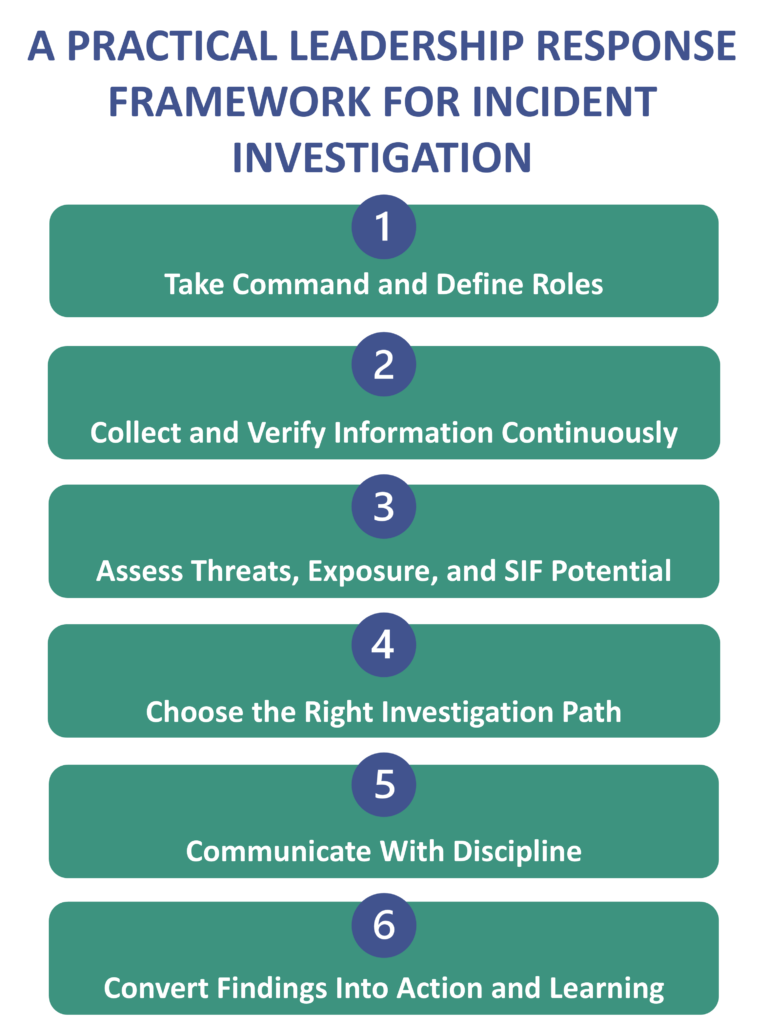
For this topic, a practical leadership framework should combine command, communication, investigation rigor, and learning. The sequence below works well across industries where safety, operational continuity, and governance matter.
1. Take Command and Define Roles
Confirm who is leading the response, who is leading the investigation, and who approves major decisions. If multiple functions or locations are involved, define the handoffs and interfaces early. This reduces confusion and prevents parallel investigations that produce conflicting versions of events.
2. Collect and Verify Information Continuously
Information gathering is not a one-time step. As in major incident response, leaders need to keep updating the picture as new facts emerge. Initial reports, witness accounts, shift logs, permit records, supervision history, maintenance data, and digital system records should be reconciled rather than accepted in isolation.
3. Assess Threats, Exposure, and SIF Potential
In serious operations, the event itself may not be the full story. Leaders should assess whether the incident had Serious Injury and Fatality potential, what exposures still exist, and whether similar conditions remain elsewhere. This shifts the response from site-specific recovery to enterprise risk awareness.
4. Choose the Right Investigation Path
Not every event needs the same level of investigation, but serious incidents and high-potential events require a deeper approach. Leadership should decide early whether a formal better root cause analysis, cross-functional review, external facilitation, or enterprise escalation is needed.
5. Communicate With Discipline
Leaders must provide factual updates, clarify what is being done, and explain what is not yet known. Communication should support operational control and trust. It should never compromise witness integrity or pressure people toward a preferred story.
6. Convert Findings Into Action and Learning
The investigation is not complete when the report is finished. Leadership response includes deciding what changes will be made, who owns them, how effectiveness will be checked, and how learning will be shared across teams and sites.
Command, Authority, and Decision Rights During the Investigation
One recurring weakness in incident response is ambiguity around who leads. That ambiguity can be operational, organizational, or political. In an incident investigation leadership response, confusion over authority often causes delays, mixed messages, and weak accountability.
Leaders should define decision rights in writing as early as possible. This includes who can authorize scene release, who approves interviews, who owns regulator communication, who signs off on findings, and who approves corrective actions. In cross-functional environments, unified coordination may be needed, but that should not mean blurred accountability.
- Operational leader – stabilizes the event and risk controls
- Investigation leader – manages evidence, interviews, analysis, and report quality
- Executive sponsor – removes barriers, aligns priorities, and ensures follow-through
- Functional experts – provide technical, human factors, engineering, or process insight
- Communications and legal support – advise on external messaging and governance requirements
If you do not define these roles early, the investigation can become over-managed by hierarchy or under-managed by diffusion of responsibility.
How Leaders Should Communicate After a Serious Incident
Communication is one of the most visible elements of leadership response, but it is also one of the easiest to get wrong. Good communication creates calm, direction, and credibility. Poor communication creates speculation, fear, silence, or defensiveness.
Internal Communication Principles
Teams need timely, factual updates. They also need to know how the organization will handle interviews, what support is available, and how decisions will be made. Communication should be consistent across shifts and functions so that no group is left operating from rumor.
- State verified facts only
- Be clear about what is still under investigation
- Explain immediate safety actions taken
- Set expectations for cooperation and confidentiality
- Reinforce that the goal is learning, not premature blame
External Communication Principles
External communication may involve regulators, customers, contractors, families, partners, or media. Leadership should align these communications tightly so the organization remains accurate and credible. Messaging must not get ahead of the evidence.
Leadership Presence Under Pressure
People read leadership behavior before they absorb leadership words. If you appear reactive, defensive, or uncertain in a chaotic way, the organization amplifies that signal. If you appear composed, focused, and honest about uncertainty, others are more likely to stay disciplined.
Leadership presence does not mean pretending to know more than you do. It means showing controlled judgment when others are looking for direction.
What the Investigation Must Cover Beyond Immediate Causes
Many investigations fail because they stop at what happened on the front line. Effective incident investigation leadership response demands a broader lens. If you only document the direct act, you miss the conditions, systems, and decisions that made the event possible.
This is where root cause analysis matters. Methods such as the 5 Whys can help, but leadership must ensure the process does not turn into a mechanical exercise. The point is to identify contributing causes across work design, supervision, planning, resource allocation, training quality, decision-making, and culture.
Core Investigation Domains
- Task and work conditions at the time of the event
- Equipment condition, maintenance, and reliability
- Hazard identification and risk assessment quality
- Training, competency, and supervision
- Shift, fatigue, workload, and staffing factors
- Procedure design and usability in real work
- Leadership decisions before the event
- Signals that were missed, normalized, or not escalated
Questions Leaders Should Ask Investigators
- Are we describing the event or explaining the system behind it?
- What conditions increased exposure to serious injury or fatality?
- Which leadership or organizational decisions shaped the risk?
- Did local work reality differ from the written process?
- What has happened before that should have warned us?
- What changes will actually reduce recurrence risk?
Balancing Accountability and Learning
One of the hardest parts of leadership response is managing the tension between accountability and learning. If leaders move too quickly into blame, people protect themselves, evidence quality drops, and the investigation becomes shallow. If leaders avoid accountability entirely, trust and standards erode.
The right balance is to separate fact-finding from disciplinary conclusions. Establish what happened and why before deciding whether behavior was reckless, mistaken, system-driven, or influenced by unclear conditions. This creates a more just and useful process built on fairness in the investigation process.
Leaders also need to model the idea that accountability applies upward as well as downward. If resource decisions, conflicting priorities, weak oversight, or poor planning contributed to the event, the investigation must say so. Mature organizations do not ask only who was closest to the failure. They ask which decisions made failure more likely.
Documentation Leaders Should Expect and Review
Documentation is central to both operational learning and defensibility. Missing records weaken both the investigation and the leadership response. Leaders should know what information should exist before the incident and what must be created after it.
Pre-Incident Records That Often Matter
- Risk assessments and control plans
- Training and competency records
- Induction and authorization records
- Maintenance and inspection history
- Shift logs, permits, and supervision records
- Previous incident and near miss reports
- Corrective action closure history
Post-Incident Records That Should be Controlled Carefully
- Initial notification timeline
- Scene photographs, video, and sketches
- Witness statements and interview notes
- Equipment isolation and evidence chain records
- Leadership decision log
- Investigation charter, scope, and team structure
- Root cause analysis outputs
- Corrective action register and verification plan
Interviews, Evidence, and Fact Quality
Leaders do not need to conduct every interview themselves, but they do need to protect the quality of the process. Witnesses should be approached quickly, respectfully, and without coaching. Interview methods should be designed to understand sequence, context, and decision-making, not to force simple admissions.
Evidence quality also depends on timing. Physical conditions change, memories fade, systems get reset, and informal stories spread fast. That is why the investigation team needs rapid access to the scene, records, and people. Leaders should remove barriers rather than create them.
| Investigation Element | Leadership Expectation |
| Witness interviews | Conduct promptly, without leading questions or blame pressure |
| Physical evidence | Preserve, isolate, and document before cleanup or restart |
| Digital records | Secure logs, footage, alarms, system data, and communications |
| Timeline reconstruction | Use multiple sources to validate sequence and decisions |
| Analysis quality | Look for interacting causes, not single-point explanations |
Common Leadership Failures in Incident Investigation Response
Leaders often weaken investigations in predictable ways. Recognizing these patterns is useful because they tend to recur across sectors and geographies.
- Speaking with certainty before facts are verified
- Focusing on image before people and evidence
- Allowing unclear authority or parallel reporting lines
- Treating the event as an isolated frontline mistake
- Ignoring SIF potential and enterprise-wide exposure
- Failing to preserve records, scene conditions, or decision logs
- Running a compliance investigation instead of a learning investigation
- Closing actions on paper without checking effectiveness in practice
These failures usually reflect deeper issues in leadership development, decision-making discipline, and safety culture. That is why many organizations need more than a better template. They need stronger leadership capability around high-stakes incidents.
Turning Investigation Findings Into Organizational Learning
The quality of your response is ultimately measured by what changes afterward. Strong leadership response extends beyond the report into corrective action design, communication, and capability building. If findings stay local, generic, or untested, the organization does not really learn.
Learning should include both local correction and broader transfer. If an event revealed a weak decision process, poor supervision standard, flawed planning assumption, or inconsistent control, other sites may face the same exposure. Leaders should decide what needs site-level action, business-unit action, and enterprise action.
How to Make Learning Stick
- Translate findings into specific risk-reduction actions
- Assign owners, deadlines, and verification methods
- Share lessons across similar operations and sites
- Update standards, tools, and leadership expectations
- Check whether changes work in normal operations, not only in presentations
This is where organizations often connect incident learning with broader safety strategy, culture improvement, and leadership development. Done well, the investigation becomes a catalyst for stronger decisions before the next event happens.
The Role of Senior Leaders and Executives
Senior leaders should not try to run every detail of the investigation, but they do have a critical role. They set the tone, allocate resources, remove political pressure, and make sure the process reaches beyond technical analysis into organizational truth. They also decide whether lessons will be treated as local exceptions or strategic signals.
Executives should ask whether the organization had the right controls in place before the event, whether prior warnings were understood, and whether leadership decisions unintentionally increased exposure. They should also make sure the response remains forward-looking. The aim is not only to explain the past, but to prevent the next serious incident.
Building Stronger Capability Before the Next Incident
The best incident investigation leadership response starts long before the incident. Organizations respond the way they are led and prepared to respond. If leaders have not practiced decision-making under pressure, clarified investigation expectations, or built a culture where truth can surface quickly, the response will be slower and weaker than it should be.
Preparation should include clear investigation protocols, leadership role definition, SIF-focused escalation criteria, cross-functional exercises, and practical training in communication, root cause analysis, and decision quality. This is also where psychological safety and listening to learn can add real value. The goal is not simply compliance readiness. It is a more resilient organization that can think clearly, investigate honestly, and learn fast when risk becomes real.
FAQs About Incident Investigation Leadership Response
* Developed with the support of AI and reviewed by Krause Bell Group Editorial Team