September 24, 2026
Measuring Psychological Safety
If you want to encourage speaking up, better decision-making, and fewer hidden risks, you need a reliable way of measuring psychological safety. In high-hazard environments, psychological safety is not a soft metric. It affects whether people raise concerns, ask for help, challenge assumptions, and share critical information before a serious incident occurs.
The challenge is that psychological safety is easy to oversimplify. A quick pulse survey may give you a number, but a number alone rarely tells you why people stay silent, where trust breaks down, or whether leader behavior is helping or suppressing upward communication. A useful psychological safety measure needs to do more than produce a score. It should help you understand patterns, identify barriers, and support action.
This guide explains how to measure psychological safety in a practical, defensible way. You will learn when to use a psychological safety scale, what a psychological safety measurement tool should include, how to interpret a psychological safety score, and why a combined approach often works better than surveys alone.
What Measuring Psychological Safety Actually Means
Measuring psychological safety means assessing whether people believe they can take interpersonal risks without fear of embarrassment, punishment, exclusion, or damage to their standing. In practice, that includes whether team members feel safe to:
- Speak up about concerns or hazards
- Admit mistakes or uncertainty
- Ask for help
- Challenge decisions respectfully
- Offer ideas that may be unpopular or unfinished
- Share bad news early
This matters in every workplace, but it becomes critical in industries where silence can contribute to operational failure, injury, or fatality risk. In those settings, measuring psychological safety at work should be tied to leadership, safety culture, and decision quality, not treated as a stand-alone morale exercise.
It is also important to measure the right things. Psychological safety is often discussed as an individual feeling, but in most organizations it operates as a team climate shaped by shared experiences, norms, and leadership behavior. That means a good psychological safety measurement tool should help you understand both perception and pattern. You want to know not only how people answered, but also what behaviors and systems are reinforcing those answers.
Why Organizations Measure Psychological Safety
Most organizations do not measure psychological safety just to confirm that it matters. They measure it because they need visibility into organizational risks. If people are withholding concerns, second-guessing whether it is safe to challenge authority, or avoiding hard conversations, leaders need a way to surface that before it shows up in quality failures, operational drift, or serious events.
A well-designed measurement process can help you:
- Establish a baseline for team climate and speaking-up capability
- Identify where silence is most likely to occur
- Understand whether leader behavior is supporting or suppressing candor
- Prioritize interventions in teams, sites, or functions
- Track change over time after leadership or culture initiatives
- Support a broader safety culture assessment with more precise insight
Measurement also creates language. In many organizations, employees know when speaking up feels risky, but they do not always have a structured way to describe it. A good assessment process makes the issue discussable. That alone can be valuable, provided leadership is prepared to respond in a credible way.
Start with the Purpose Before Choosing a Psychological Safety Scale
Before you pick a survey or calculate a psychological safety score, clarify what decision the measurement is supposed to support. This step is often skipped, and that is where weak assessments begin.
Ask questions such as:
- Are you trying to establish a baseline?
- Do you want to compare teams, sites, or functions?
- Are you evaluating the impact of a leadership intervention?
- Do you need specific insights into safety-related speaking up?
- Will results feed into a broader culture assessment or strategy?
Your purpose affects the design. If you want a quick directional pulse, a short psychological safety scale may be enough. If you need to understand communication patterns in high-risk work, you will usually need more than a survey. In that case, measurement should be connected to leadership behavior, upward communication, trust, and local decision-making conditions.
This is where context matters. A general survey may tell you people are hesitant to speak up. It may not tell you whether the issue is status differences, inconsistent supervisory responses, blame after failure, low procedural fairness, or pressure to maintain production. The stronger your purpose, the more useful your method selection becomes.
Common Ways of Measuring Psychological Safety
There is no single best method for every organization. The right approach depends on the decision you are trying to make, the maturity of the team, and the risk context. In most cases, the most useful design combines a psychological safety scale with qualitative and behavioral inputs.
Survey-Based Measurement
Surveys are the most common way to measure psychological safety because they are scalable, efficient, and easy to repeat over time. They are useful for establishing a baseline, spotting broad patterns, and comparing groups.
A survey works well when you need to:
- Collect input from many employees quickly
- Track changes over multiple time periods
- Identify low-scoring teams or functions
- Integrate findings into a larger culture survey
However, surveys also have limitations. They depend on participation, interpretation of wording, and honest responses. They can show where concern exists, but often not why it exists.
Qualitative Measurement
Qualitative methods include interviews, focus groups, open-text responses, listening sessions, and facilitated team discussions. These methods help uncover what the numbers mean in practice. They are especially useful when you need to understand barriers to speaking up, local norms, or team-specific dynamics.
Qualitative methods help answer questions such as:
- What happens when someone raises a concern?
- Which topics feel safe to discuss, and which do not?
- Does the response differ for peers versus leaders?
- Are there differences between stated values and lived behavior?
Behavioral and Observational Measurement
Observation adds another layer by looking at what people actually do in meetings, shift handovers, reviews, planning sessions, and decision forums. This can reveal patterns that surveys miss, such as who speaks first, who gets interrupted, whether dissent is welcomed, and how leaders respond to bad news or uncertainty.
For organizations focused on safety culture, this can be especially valuable. Observed behavior around escalation, questioning, learning, and deference to expertise often tells you more than a headline score alone.
Why Surveys Alone are Not Enough
Survey-only approaches dominate the conversation around measuring psychological safety, but they have clear limitations. A survey can be useful, but it is still self-report data. People may answer based on recent events, local politics, social desirability, or uncertainty about anonymity. Some groups may also be less likely to respond at all, which can distort the picture.
Common issues include:
- Response bias from highly engaged or highly dissatisfied employees
- Fear that answers are not truly anonymous
- Different interpretations of the same question across teams or cultures
- Low participation in survey-fatigued environments
- Scores that identify a problem but do not explain its drivers
There is also a practical risk. Once you attach attention to a metric, people may begin managing the score rather than improving the underlying climate. That is one reason a psychological safety score should never be used in isolation or as a simplistic performance target for leaders.
For many organizations, especially those operating in high-risk settings, a stronger approach is to combine survey data with interviews, focus groups, or structured safety culture survey criteria that look at communication, trust, fairness, leadership consistency, and conditions that affect decision-making.
What Should a Strong Psychological Safety Measurement Tool Include?
If you are choosing or building a psychological safety measurement tool, focus on utility. A strong tool should help you collect trustworthy data, interpret it correctly, and connect it to action.
Core Criteria
- Clear construct focus: It should measure interpersonal safety, not general engagement or satisfaction.
- Context fit: Questions should make sense in your operating environment and workforce language.
- Practical length: Long instruments can reduce response quality and completion rates.
- Actionability: Results should point toward specific leadership, team, or system actions.
- Repeatability: The method should support trend tracking over time.
- Complementary insight: It should work alongside broader culture data, especially around upward communication and trust.
What to Assess Alongside Psychological Safety
In many organizations, psychological safety is best understood as part of a wider cultural system. If you only measure whether people feel safe to speak, you may miss why they do or do not speak. Related dimensions can include:
- Upward communication
- Leader-member exchange
- Procedural justice
- Perceived organizational support
- Consistency of response to bad news
- Quality of team decision-making
This broader lens is especially useful in safety culture work, where communication climate is tied to leadership, fairness, and system signals.
Example Survey Questions to Measure Psychological Safety
If you are creating a practical psychological safety measure, your survey items should cover speaking up, fallibility, inclusion, help-seeking, and response to mistakes.
Below are examples of the kinds of statements organizations commonly use. These are not a substitute for validation, but they reflect the areas a useful scale often needs to capture.
- I can raise a concern on this team without fear of negative consequences.
- People here can admit mistakes openly.
- If I disagree with a decision, I can say so respectfully.
- It is safe to ask for help when I am uncertain.
- Different viewpoints are welcomed in team discussions.
- People on this team respond constructively when problems are raised.
- I can share bad news early, even when it may create tension.
- Senior people on this team genuinely want to hear concerns.
- I would feel safe challenging a plan that could create risk.
- People are not sidelined or embarrassed for speaking up.
In higher-risk environments, it is often helpful to include wording that reflects operational reality. For example, questions about escalation, hazard reporting, assumptions in planning, or concern about consequences for speaking up may provide stronger insight than generic team language alone.
How to Write Better Questions for Measuring Psychological Safety at Work
The wording of your survey matters more than many teams assume. Small phrasing choices can affect whether respondents think about interpersonal climate, management style, operational discipline, or personal confidence. To improve data quality, design questions around observable team experience rather than abstract ideals.
Good Practice for Question Design
- Use plain language that employees actually use.
- Avoid double-barreled questions that ask two things at once.
- Keep the recall frame realistic and current.
- Make sure items reflect team climate, not only personal preference.
- Test whether wording lands differently for frontline staff and leaders.
- Review whether terms like risk, error, or challenge could be misread.
Be Careful with Context-Specific Wording
In safety-sensitive industries, words such as risk-taking can create confusion. Psychological safety is about interpersonal risk, not encouraging unsafe operational behavior. If a question is likely to be interpreted as endorsing physical or process risk, clarify the wording. The goal is to measure whether people can voice concerns, ask questions, and challenge assumptions, not whether they take more chances.
When Should You Not Rely on a Survey Alone?
There are situations where a survey should not be your primary method. New teams, temporary crews, highly unstable organizational periods, or environments with deep mistrust may produce weak or misleading survey data. In those cases, interviews, facilitated dialogue, and observation may give you a more accurate starting point.
You should be cautious about survey-only measurement when:
- Teams have not worked together long enough to form a stable climate
- Employees doubt confidentiality
- The organization has recent history of retaliation or blame
- Participation is likely to be very low
- You need to understand high-consequence communication failures in detail
None of this means surveys are useless. It means method choice should match the environment. If silence is itself a risk indicator, you need methods that do not depend entirely on voluntary self-report.
How to Interpret a Psychological Safety Score
A psychological safety score can be useful, but only if you treat it as an indicator rather than a verdict. A single number does not explain culture. It tells you where to look next.
When reviewing a psychological safety score, pay attention to:
- Overall average by team, function, or site
- Distribution of responses, not just the mean
- Items with the lowest scores
- Gaps between leaders and frontline groups
- Trend over time after interventions
- Alignment with other culture signals such as upward communication or trust
High scores are not always a sign that everything is healthy. In some settings, uniformly perfect results may reflect fear, impression management, or weak trust in anonymity. Likewise, a moderate score may hide sharp differences between subgroups. This is why interpretation should include both statistics and context.
A Simple Framework for Reading Results
| Pattern | What It May Suggest | What To Do Next |
| Low average across most items | Broad hesitation to speak, ask for help, or challenge decisions | Use follow-up interviews and leader review to identify root causes |
| Low score on speaking-up items only | Employees may collaborate well but still fear escalation or dissent | Examine supervisory response, power distance, and escalation pathways |
| Large gap between leaders and employees | Leaders may overestimate openness or approachability | Use 360 feedback, facilitated dialogue, and behavioral observation |
| Very high scores with low trust history | Possible response distortion or concern about anonymity | Recheck administration method and gather qualitative input |
| Mixed scores across teams | Local leadership and team norms likely matter more than enterprise messaging | Target intervention locally instead of using one broad solution |
Risks and Mistakes in Psychological Safety Measurement
One of the strongest themes in top-ranking content is that measuring psychological safety can backfire when done poorly. That point deserves emphasis. The act of measurement changes expectations. If you ask employees whether it is safe to speak up, they will reasonably expect the organization to care about the answer.
Common mistakes include:
- Measuring without a plan to act
- Using a survey as a substitute for real dialogue
- Comparing teams without considering context
- Treating the score as a leader ranking metric
- Ignoring low participation or skewed samples
- Assuming one instrument fits every site or culture
There is also a strategic risk in tying incentives too tightly to the score. Once a metric carries consequences, people may start managing the metric. That can create pressure to suppress negative data or discourage candor. If the goal is better speaking up, your measurement process should reinforce trust, not create new reasons for caution.
Why Combining Quantitative and Qualitative Methods Works Better
The most reliable approach to measuring psychological safety is usually mixed-method. Surveys provide breadth. Qualitative methods provide explanation. Observation provides behavioral evidence. Together, they help you triangulate rather than guess.
A combined approach is often stronger because it lets you answer three different questions:
- How much of a problem is there? Survey scores show scale and distribution.
- Why is it happening? Interviews and open responses reveal drivers.
- What does it look like in real work? Observation shows actual interaction patterns.
This is especially relevant when psychological safety is part of a broader safety culture assessment. For example, if survey results suggest low willingness to challenge decisions, you can examine whether leadership behavior, fairness, production pressure, or weak escalation systems are contributing factors. That leads to better interventions than score tracking alone.
How Psychological Safety Fits into Broader Culture and Safety Measurement
For many organizations, measuring psychological safety is most useful when it is not isolated from the rest of the culture system. Speaking up is influenced by trust, fairness, leadership credibility, support, decision quality, and the consequences people observe when concerns are raised.
That is why psychological safety is often most actionable when assessed alongside adjacent culture dimensions. Within a broader culture survey or safety culture assessment, related measures can help you understand not just whether people speak, but whether the system invites and uses their input.
In practice, this may mean looking at:
- Upward communication
- about safety-relevant information
- The quality of leader-member relationships
- Whether procedures are applied fairly
- Whether employees feel supported when they raise concerns
- How teams make decisions under uncertainty and pressure
This integrated view is often more useful than a standalone psychological safety score because it points toward intervention levers. If psychological safety is low, leaders need to know whether to focus on communication behavior, fairness, role modeling, escalation pathways, or local decision processes.
A Practical Process for Measuring Psychological Safety
If you want a structured process rather than a one-off survey, use a sequence that moves from purpose to action.
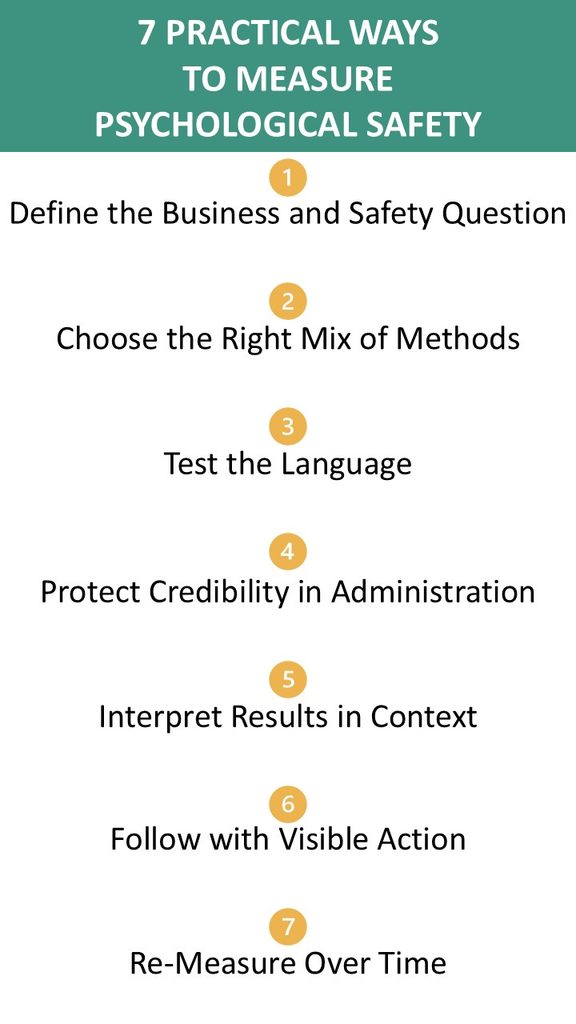
1. Define the Business and Safety Question
Clarify what you are trying to understand and why it matters now. Tie the effort to communication risk, leadership effectiveness, operational learning, or culture change.
2. Choose the Right Mix of Methods
Select a psychological safety scale, then decide what additional data you need. In many cases, that includes open-ended questions, targeted interviews, or structured observation.
3. Test the Language
Pilot the instrument with a sample of your intended audience. Check that wording is clear, relevant, and interpreted consistently across roles.
4. Protect Credibility in Administration
Be explicit about anonymity, how data will be used, and what will happen next. If employees do not trust the process, the data will be weaker and the act of measurement may itself reduce trust.
5. Interpret Results in Context
Look beyond the average score. Examine patterns by team, role, leader, and topic. Compare results with other culture indicators and operational realities.
6. Follow with Visible Action
Share what you learned, what you are prioritizing, and what will change. If employees take the risk of telling you the truth, leadership must take the responsibility of responding.
7. Re-Measure Over Time
Repeat measurement after meaningful action, not just on an arbitrary schedule. Trend data becomes valuable when it tracks real interventions and observable changes in behavior.
What Does Improvement Look Like After Measurement?
Measurement only matters if it drives better conditions for speaking up and learning. In practice, the response should rarely be limited to telling teams to be more open. Psychological safety improves when leaders and systems change what happens after people speak.
Examples of useful next steps include:
- Training leaders to respond constructively to concerns and bad news
- Improving escalation pathways for operational and safety issues
- Using team discussions to clarify norms around challenge and dissent
- Reviewing whether production pressure discourages upward communication
- Building stronger routines for learning from near misses, uncertainty, and mistakes
Where the stakes are high, measurement should support practical prevention. If people hesitate to question assumptions or raise weak signals, the organization is operating with hidden exposure. Better measurement helps make that exposure visible.
FAQs About Measuring Psychological Safety
* Developed with the support of AI and reviewed by Krause Bell Group Editorial Team