August 4, 2026
Safety Culture and SIF Prevention
Safety culture and SIF prevention belong together because serious injuries and fatalities are rarely prevented by rules alone. If you want to reduce exposure to high-consequence events, you need a culture where leaders notice risk, teams speak up early, and critical controls hold under real operating pressure. A low total recordable rate does not automatically mean your organization is protected from life-altering outcomes. SIF prevention requires a sharper focus on exposure, decision making, work conditions, and the quality of your controls.
This guide explains what SIF prevention means, why safety culture matters so much, and what practical elements make a prevention strategy effective. You will also see how leadership, learning, reporting, and control verification connect in day-to-day operations.
What is SIF Prevention?
SIF prevention stands for serious injury and fatality prevention. It is a focused safety approach that helps you identify and control the situations most likely to produce fatal or life-changing outcomes. Instead of treating all incidents as equal, SIF prevention separates low-severity events from high-potential exposures.
That distinction matters. A minor cut and a near miss involving heavy mobile equipment should not carry the same learning priority. In a mature approach, you look beyond injury counts and ask different questions: What could have happened? Which exposures had the potential to be catastrophic? Which controls failed, were missing, or were bypassed?
This is why many organizations now use the idea of potential SIFs, sometimes called pSIFs or HiPos. These are incidents, near misses, or conditions that may not have caused severe harm this time, but under slightly different circumstances could have led to a serious injury or fatality.
Why Safety Culture is Central to SIF Prevention
A strong safety culture improves SIF prevention because it shapes how people recognize exposure, escalate concern, follow critical controls, and make decisions under pressure. In high-risk work, the biggest failures are often not a lack of written procedures. The breakdown usually happens when production pressure, routine, assumptions, poor handoffs, weak supervision, or unclear accountability interfere with safe execution.
Culture determines whether people feel responsible for stopping work, whether leaders respond seriously to warning signs, and whether near misses are investigated for SIF potential instead of being dismissed as lucky escapes. It also affects whether the organization learns from recurring exposure patterns or simply repeats them.
In practical terms, safety culture and SIF prevention reinforce each other in four ways:
- They improve exposure recognition before an event occurs.
- They strengthen the quality and consistency of critical controls.
- They support honest reporting without fear or blame.
- They help leaders make better decisions when conditions change.
The Leadership Role in Preventing Serious Injuries and Fatalities
Leadership is one of the strongest predictors of whether SIF prevention becomes real or remains a slogan. If senior and operational leaders only review injury rates, audit scores, and compliance status, they may miss the exposures that matter most. Effective leaders ask where catastrophic risk exists, how it is being controlled, and whether those controls can withstand normal operational variability.
That means you should expect leaders to do more than sponsor safety programs. They need to set priorities, make exposure visible, test assumptions in the field, and create conditions where teams can raise concern early. This is especially important in environments such as manufacturing, oil and gas, mining, transportation, pharmaceuticals, and other operations with high-energy or high-consequence work.
Useful leadership behaviors in a SIF-focused culture include:
- Discussing high-consequence exposure in routine operational reviews
- Asking whether critical controls are present, understood, and verified
- Using meaningful safety conversations to explore how work is really done
- Responding to weak signals before they become events
- Separating accountability from blame so learning is not suppressed
This is where leadership development becomes highly relevant. If leaders are not trained to recognize exposure, challenge drift, and make safer decisions in complex conditions, even a well-designed system can fail when it is needed most.
What are the 4 Pillars of Safety Culture in a SIF Context?
The phrase “4 pillars of safety culture” can be defined in different ways, but in a SIF prevention context, four pillars are especially useful:
- Leadership Commitment – leaders consistently prioritize serious risk reduction, not just low injury numbers
- Worker Involvement – employees and contractors identify exposure, report concerns, and participate in learning
- Critical Control Discipline – the controls that prevent high-consequence events are defined, understood, and checked
- Learning and Adaptation – the organization investigates pSIFs, finds patterns, and improves systems over time
These pillars matter because they connect culture to operational reality. Without leadership commitment, safety fades under pressure. Without worker involvement, weak signals stay hidden. Without control discipline, known hazards remain exposed. Without learning, the same failure paths return.
What are the 5 Elements of Safety Culture that Support SIF Prevention?
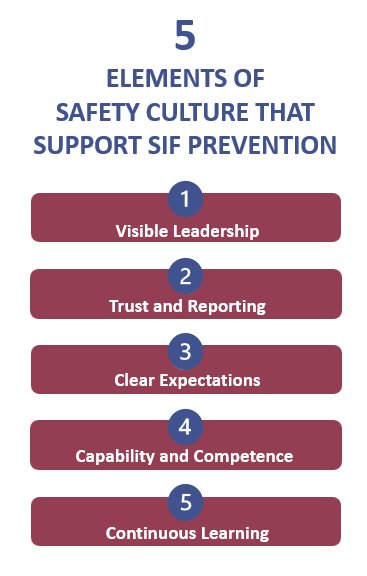
If you prefer a five-element framework, the following structure works well for safety culture and SIF prevention:
- Visible Leadership – leaders demonstrate that SIF exposure is a real business priority
- Trust and Reporting – people can speak up about hazards, near misses, and poor conditions without fear
- Clear Expectations – roles, controls, and decision boundaries are understood across the organization
- Capability and Competence – people know how to identify exposure and manage high-risk work
- Continuous Learning – incidents, pSIFs, and recurring patterns are translated into system improvement
These elements are practical because they move safety culture away from vague language and toward observable organizational habits.
How to Identify SIF Exposure Before a Serious Event Happens
One of the main lessons from the top-ranking pages is that identifying exposure is more valuable than relying only on lagging indicators. SIF events often come from recognizable categories of work and energy sources. Your task is to identify where the outcome could be severe, even if the task is routine and even if no serious incident has happened recently.
Common SIF exposure areas include:
- Working at heights
- Confined spaces
- Lockout/tagout and hazardous energy
- Mobile equipment and vehicle interactions
- Electrical work
- Lifting and suspended loads
- Line of fire exposure
- Contractor interfaces during complex work
The right question is not only “What injuries have we had?” but also “Where do we have the potential for catastrophic loss?” That shift helps you prioritize the work, conditions, and decisions that deserve the most attention.
From Incident Counts to Potential SIF Learning
Traditional metrics can be useful, but they are not reliable predictors of serious injury risk by themselves. An organization can have acceptable recordable performance and still be highly exposed to a fatal event. That is why mature SIF programs examine potential severity, not just actual outcome.
When you review incidents and near misses, classify them for SIF potential. A low-outcome event may reveal a major weakness in a critical control. A near hit involving stored energy, heavy equipment, or a fall exposure may deserve more learning attention than several minor first-aid cases combined.
Useful review questions include:
- What was the worst credible outcome?
- Which critical controls should have prevented that outcome?
- Were those controls absent, weak, bypassed, or misunderstood?
- Did supervision, planning, or handoff contribute to the exposure?
- Is this an isolated event or part of a recurring pattern?
Critical Controls are where Culture Becomes Operational
In SIF prevention, critical controls are the safeguards that must work to prevent a serious injury or fatality. They can be engineering, procedural, administrative, or human-performance related, but the most important point is that they must be clearly defined and verified. If the organization cannot say which controls are critical for its highest-risk work, it will struggle to prevent catastrophic events consistently.
A strong safety culture supports critical controls in practice by making them non-negotiable, visible, and reviewable. That means teams understand which steps are essential, leaders check whether controls are truly in place, and the organization acts quickly when a control is degraded.
Examples of control questions include:
- Is the hazardous energy actually isolated and verified?
- Is the fall protection system appropriate for the task and environment?
- Are exclusion zones around mobile equipment maintained in real time?
- Is permit quality strong enough for the conditions being faced?
- Are contractors using the same critical control expectations as employees?
Processes that Strengthen Safety Culture and SIF Prevention
Culture alone is not enough. It needs process support. The strongest pages in the search results consistently point to process quality as a major factor in SIF performance. If reporting, investigation, work planning, and follow-up are weak, even committed teams will miss exposure signals.
Key processes that support SIF prevention include:
SIF-Focused Risk Assessment
Risk assessments should explicitly identify tasks and situations with the potential for severe consequences. This often means treating exposure severity and control reliability as primary factors, not just frequency or probability alone.
Consistent Event Classification
Your organization should use clear definitions for pSIFs, HiPos, serious exposures, and critical controls. Inconsistent language makes trend analysis weaker and hides learning opportunities.
Incident Investigation for System Causes
Investigations should move beyond operator error. Look at planning quality, supervision, communication, workload, contractor coordination, resource decisions, equipment condition, and competing priorities.
Action Tracking and Closure Quality
Corrective actions should reduce exposure, not just close paperwork. If actions do not improve the conditions that made the event possible, the risk remains.
Feedback Loops to Operations and Leadership
Findings need to return to the people who plan, supervise, and execute the work. SIF prevention improves when the organization can see recurring exposure patterns and respond at system level.
Training and Competence for High-Consequence Work
Competence-based learning is another direct link between safety culture and SIF prevention. People need more than general awareness. They need to understand the exposures in their work, the controls that matter most, and the decisions that can increase or reduce risk.
Effective learning for SIF prevention usually includes:
- Recognizing SIF precursors in routine work
- Understanding how serious exposure differs from minor injury risk
- Practicing stop-work and escalation decisions
- Improving supervisor judgment in changing conditions
- Teaching teams how to verify critical controls, not just reference them
This is especially important for leaders, supervisors, frontline employees, and contractors who influence work quality in the field. When competence is weak, culture becomes reactive. When competence is strong, people are more likely to spot drift early and intervene effectively.
Why Reporting Culture Matters in SIF Prevention
You cannot learn from what stays hidden. Reporting culture matters because serious events are often preceded by weak signals such as degraded equipment, confusing work plans, repeated deviations, rushed decisions, or near misses with high-consequence potential. If people think raising these issues creates blame, delay, or friction, they stop reporting the exact information you need most.
A useful reporting culture does not mean accepting poor performance. It means creating enough trust for people to surface real conditions, while still holding clear standards for critical work. The goal is to expose risk early, not to wait until harm proves it was there.
Good reporting systems support SIF prevention when they make it easy to:
- Report hazards, pSIFs, and weak signals quickly
- Separate high-consequence events from low-risk observations
- Route urgent exposures to the right decision makers
- Track recurring themes across sites or business units
- Share learning back to crews, supervisors, and leaders
What is the SIF Safety Model?
There is no single universal SIF safety model used by every organization. In practice, most credible models include the same core building blocks: identify high-consequence exposure, define critical controls, strengthen leadership and culture, investigate pSIFs and incidents for system causes, and continuously improve based on evidence.
A practical SIF model usually follows this logic:
- Identify where serious injury or fatality exposure exists.
- Determine the conditions, tasks, and energy sources involved.
- Define the critical controls that must prevent catastrophic outcomes.
- Verify whether those controls are present and reliable in real work.
- Build leadership, reporting, and learning systems around the highest exposures.
- Use data, field observations, and recurring patterns to improve over time.
For many organizations, the challenge is not understanding the theory. It is integrating exposure recognition, culture, and decision making into normal operations instead of treating SIF prevention as a stand-alone initiative.
How to Measure Whether Your Safety Culture Supports SIF Prevention
You can measure alignment between culture and SIF prevention by combining leading and lagging indicators. Lagging measures still matter, but they should be supported by indicators that tell you whether the organization is improving control performance before a serious event occurs.
Useful leading indicators may include:
- Quality of pSIF identification and classification
- Critical control verification rates
- Repeat exposure patterns by task or location
- Quality of corrective actions
- Leadership field engagement focused on high-risk work
- Contractor alignment on critical controls
- Time to escalate and resolve serious exposures
- Employee willingness to report concerns
If you use culture surveys, leadership assessments, and field learning methods well, they can help reveal whether your organization is truly learning from exposure or only managing appearances.
Common Barriers that Weaken SIF Prevention
Several barriers show up repeatedly across organizations trying to reduce serious injury risk:
- Overreliance on Low Injury Rates – teams assume good general safety performance means low SIF exposure
- Weak Definition of Critical Controls – people know the hazards but not which controls are non-negotiable
- Blame-Driven Investigations – learning stops at human error instead of reaching system causes
- Poor Contractor Integration – high-risk work is managed by groups operating under different expectations
- Inconsistent Leadership Capability – supervisors and managers vary in how they identify and respond to exposure
- Limited Feedback Loops – recurring patterns are seen locally but not translated into enterprise learning
The solution is rarely a single new procedure. More often, you need a tighter connection between leadership, exposure data, control verification, and culture change.
Building a More Effective Safety Culture and SIF Prevention Strategy
If you want to improve safety culture and results, start by narrowing the focus to the exposures that can change lives forever. Review where high-consequence work exists, how it is currently controlled, and whether leaders have a clear view of real operating conditions. Then strengthen the system around those exposures through better definitions, more useful reporting, stronger investigations, and targeted leadership learning.
This is also where structured support can help. Consulting, assessments, leadership development, culture diagnostics, and focused learning programs can accelerate progress when your organization needs a more disciplined approach to SIF reduction mechanism and prevention. The most effective efforts connect systems and culture instead of treating them as separate topics.
FAQ About Safety Culture and SIF Prevention
* Developed with the support of AI and reviewed by Krause Bell Group Editorial Team