August 20, 2026
Types of Safety Culture
Understanding the types of safety culture helps you see why some organizations rely on rules, others depend on supervision, and the strongest ones embed safety into everyday decisions. In most workplaces, safety culture is not just about procedures. It reflects leadership, trust, accountability, communication, and how people respond to risk in real conditions. If you can identify the current culture, you can make better choices about what needs to change next.
What Safety Culture Means in Practice
Safety culture is the shared pattern of values, attitudes, decisions, and behaviors that shape how people manage risk at work. It influences what leaders prioritize, what supervisors reinforce, what employees speak up about, and how the organization reacts when something goes wrong.
That is why safety culture is broader than a written safety program. You can have policies, training, and reporting systems in place and still have a weak culture if people do not trust leadership, do not raise concerns, or feel pressure to work around safeguards. A strong culture makes safety visible in daily operations, not just in formal documentation. If you need a clearer foundation, it helps to understand what safety culture is.
The 4 Main Types of Safety Culture
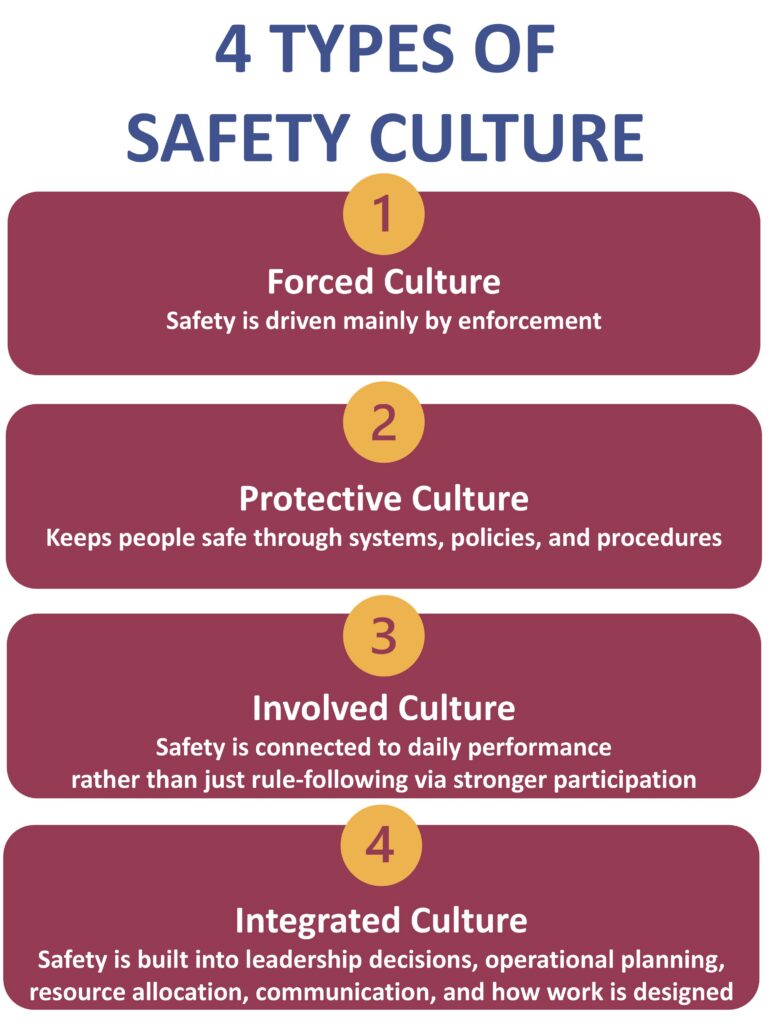
A common way to classify the types of safety culture is through four maturity-based models. These are often described as forced, protective, involved, and integrated culture. The names vary slightly across sources, and you may also see integral culture or integrated safety culture used for the highest level.
- Forced culture
- Protective culture
- Involved culture
- Integrated culture
In reality, one organization can show more than one type at the same time. A site may have strong frontline ownership but weak executive involvement, or good procedures but poor learning after incidents. The model is most useful when you use it as a diagnostic tool rather than a label.
Forced Culture
In a forced culture, safety is driven mainly by enforcement. People follow rules because they want to avoid punishment, criticism, or negative consequences. Supervisors and safety staff are often seen as police rather than partners.
This type of culture may produce short-term compliance, but it rarely creates lasting ownership. Employees do the minimum required, conceal mistakes, and focus on not getting caught instead of understanding risk. Near misses may go unreported, and learning stays shallow because fear discourages openness.
Typical signs of a forced culture include high dependence on discipline, low trust, blame after events, and weak employee voice. It may look strict from the outside, but it usually performs poorly when conditions change or when people need to make sound decisions under pressure.
Protective Culture
A protective culture moves beyond pure enforcement and tries to keep people safe through systems, policies, and procedures. Management takes responsibility for safety, but the main response to risk is often to add more rules, more checklists, and more controls.
This approach can improve consistency, especially in complex or highly regulated environments. The problem is that it can become bureaucratic. When every incident leads to another procedure, employees may face rule overload, confusion, or a gap between written expectations and operational reality.
In this culture, safety is valued, but often managed from above. People may comply with the process without fully engaging with the purpose behind it. That makes the organization more stable than a forced culture, yet still limited when it comes to adaptability, learning, and ownership at every level.
Involved Culture
An involved culture is marked by stronger participation from employees and frontline leaders. Training is more meaningful, communication improves, and safety becomes more connected to daily performance rather than just rule-following. Morale is often better because people feel less controlled and more respected.
At this level, employees are more likely to report hazards, share ideas, and contribute to solutions. Supervisors may coach instead of only enforce. Safety starts to become something people help shape.
The common limitation is that executive leadership may still not be deeply engaged, or the organization may settle for being good enough. When that happens, improvement slows down. A culture can be involved without being fully integrated into strategy, business decisions, or serious injury and fatality prevention.
Integrated Culture
An integrated culture is the most mature of the four types of safety culture. Safety is not treated as a separate program. It is built into leadership decisions, operational planning, resource allocation, communication, and how work is designed.
In this environment, leaders at all levels participate visibly. Employees are trained and heard, executives stay engaged, and safety professionals have both influence and support. Different parts of the organization share information well, and risk is managed as a real operational issue rather than a paperwork exercise.
Integrated culture also depends on trust. People can raise concerns without fear, learn from weak signals, and respond to changing conditions without abandoning standards. This is where safety culture and business performance begin to reinforce each other instead of competing with one another. For a practical benchmark, compare this with what good safety culture looks like.
How the 4 Types Compare
| Type Of Safety Culture | Main Driver | Leadership Pattern | Common Weakness |
| Forced | Fear, discipline, compliance pressure | Top-down enforcement | Low trust and minimal ownership |
| Protective | Policies, procedures, control systems | Management-led structure | Rule overload and bureaucracy |
| Involved | Participation, training, shared engagement | Stronger frontline involvement | Limited executive integration or plateauing |
| Integrated | Shared values and embedded decision-making | Leadership alignment across all levels | Requires sustained discipline and alignment |
Why Organizations Rarely Fit Only One Category
Many companies search for a simple answer to what their culture is, but safety culture is rarely uniform. One business unit may be highly involved while another depends on rigid supervision. A plant can have strong reporting habits and still show weak contractor alignment or poor executive follow-through.
This matters because improvement efforts often fail when leaders assume the whole organization has the same needs. Real progress comes from identifying where culture differs by level, function, or location. That is also where assessment becomes valuable. If you cannot see the real pattern, you are likely to apply the wrong intervention.
Types of Safety Culture vs. Safety Climate
Safety culture and safety climate are closely related, but they are not identical. Safety culture refers to the deeper values, norms, and patterns that shape behavior over time. Safety climate usually reflects how people currently perceive safety priorities, leadership commitment, communication, and support in the organization.
A simple way to think about it is this: climate shows what people are experiencing now, while culture explains why those experiences keep repeating. Both matter. Climate can reveal early warning signs, and culture shows whether the organization has the deeper conditions needed for lasting performance.
For organizations trying to improve safety outcomes, it is useful to look at both visible commitment to safety and the broader quality of organizational functioning, including trust, communication, and collaboration.
How to Move from One Safety Culture Type to the Next
Most organizations do not jump from forced culture to integrated culture overnight. Improvement usually happens in stages. The first step is to identify the current state honestly. After that, leaders need to remove the barriers that keep the culture in place.
- Clarify the current culture through interviews, surveys, observations, and incident learning
- Identify what is reinforcing the current pattern, such as blame, weak leadership alignment, or overreliance on procedures
- Define the next realistic level of maturity rather than aiming for a vague culture change goal
- Build leadership behaviors that support openness, accountability, and better decision-making
- Strengthen employee involvement so safety is shaped by operational reality, not only policy
- Track progress through culture and leadership measures, not just lagging incident data
For higher-risk organizations, this progression is especially important because weak culture can leave serious exposures hidden until a major event occurs. A useful next step is learning how to improve safety culture.
The Role of Leadership in Safety Culture Maturity
Leadership is one of the clearest differences between weaker and stronger safety cultures. In low-maturity environments, leaders often show up after a problem, enforce compliance, or delegate safety too far down the organization. In high-maturity environments, leaders shape the conditions before failure occurs.
That means executive involvement matters. When senior leaders visibly participate, ask better questions, support safety professionals, and make sound tradeoff decisions, the culture changes faster. People watch what leaders reward, tolerate, and prioritize under pressure.
For this reason, culture improvement is not only a training issue. It is also a leadership system issue. Decision-making quality, resource choices, operational alignment, and trust all influence whether safety becomes integrated or stays superficial. This is closely tied to how leadership creates culture.
What to Assess if you want to Identify Your Current Culture
If you are trying to determine which type of safety culture best describes your organization, focus on observable patterns rather than slogans. Useful indicators include:
- How leaders respond to incidents, errors, and reporting
- Whether employees speak up about risk without fear
- How much safety depends on procedures versus judgment and collaboration
- Whether executives stay actively involved or leave safety to specialists
- How well departments coordinate around operational risk
- Whether safety efforts are linked to serious injury and fatality exposure
Research-based culture assessment can help make these patterns visible. On complex sites, a structured approach is often necessary because safety culture includes both what people say they value and how the organization actually functions under stress. That is why it is important to understand how to measure safety culture.
FAQ About Types of Safety Culture
Why Understanding Safety Culture Types Matters
If you want better safety performance, you need more than a list of rules or a generic culture campaign. You need to understand what type of culture is operating today, what is sustaining it, and what leadership actions will move it forward. The most effective organizations do not treat safety as separate from decision-making, organizational functioning, or business performance. They build a culture where people can recognize risk, speak up early, and make safer choices consistently.
* Developed with the support of AI and reviewed by Krause Bell Group Editorial Team