June 10, 2026
What Does a Good Safety Culture Look Like?
A good safety culture is easy to recognize when you know what to look for. People speak up early, leaders listen, hazards are addressed before they become incidents, and safety is treated as part of how work gets done – not as a slogan or a compliance exercise. In strong organizations, safety shows up in daily decisions, in how supervisors respond to concerns, and in whether people feel respected enough to report risk without fear.
If you are asking, “what does a good safety culture look like?”, the practical answer is this: it looks consistent. Safety priorities do not disappear under schedule pressure. Communication moves upward as well as downward. Accountability is fair. People understand the risks in their work, and leaders create the conditions for safe performance instead of relying on reminders alone.
This article breaks down the clearest signs of a positive safety culture, how it differs from weak or reactive cultures, and how you can assess whether your organization is building the right environment for long-term performance.
The Clearest Definition of a Good Safety Culture
Safety culture broadly refers to the shared beliefs, attitudes, and practices regarding safety within an organization. It is not defined by posters, policy binders, or low injury numbers alone. It is reflected in what people do when no one is watching, what leaders reinforce under pressure, and how the organization responds when something goes wrong.
In practice, research and guidelines indicate that strong safety cultures involve five commonly cited factors:
- Leadership commitment that treats safety as a core organizational value.
- Open reporting and communication across levels.
- Active employee participation in identifying and solving safety issues.
- Effective follow-through, learning, and improvement on reported concerns and incidents.
- Fair accountability that supports trust, reporting, and learning.
This is why safety culture and safety climate are related but not identical. Safety climate reflects how people currently perceive safety in the organization. Safety culture runs deeper. It includes the beliefs, norms, leadership habits, and systems that shape those perceptions over time. As such, these are not just directly linked to safety but to how people feel and think of the organization more in general: do they feel the organization supports them, what is the overall relationship they have with their direct supervisor, and do they feel they are being treated fairly? If you want to learn more about the elements that are foundational to create a strong safety culture, take a look at the Krause Bell Group Culture Survey.
What a Positive Safety Culture Looks Like in Daily Operations
The strongest answer to “what does a positive safety culture look like?” is found in day-to-day work. Good culture is visible in meetings, on the floor, during planning, after near misses, and in the quality of conversations between leaders and frontline teams.
Leadership Makes Safety Visible
In healthy organizations, leaders do more than approve safety messages. They show up, ask good questions, and pay attention to how work is actually being done. They do not only engage after an incident. They spend time understanding exposure, learning from workers, and reinforcing safe decisions before something goes wrong.
Visible leadership often includes:
- Regular presence in the field or on site
- Asking about risk, controls, and changing conditions
- Responding constructively to concerns
- Making time for safety in operational discussions
- Backing safety decisions when production pressure rises
People Feel Safe to Speak Up
One important sign of a good safety culture is psychological safety. Employees report hazards, near misses, and weak signals because they believe speaking up is worthwhile. They expect to be heard, not blamed or ignored. Upward communication matters because many serious events are preceded by small signs that someone noticed but did not escalate.
When psychological safety is strong, people are more likely to:
- Raise concerns early
- Challenge unclear instructions
- Report near misses and unsafe conditions
- Ask for clarification before starting a task
- Share what is not working in the current system
Safety is Integrated into How Work Gets Done
In a mature safety culture, safety is not a separate activity added after planning. It is built into work design, pre-job discussions, supervision, contractor expectations, and change management. Teams talk about risk before the task starts. Supervisors address changing conditions in real time. Learning from incidents shapes future decisions.
Follow-Through is Fast and Credible
Workers quickly lose trust when they report the same issue multiple times and nothing changes. Strong cultures protect reporting by following through. Hazards are tracked, owners are clear, actions are completed, and employees can see progress. This matters as much as the reporting process itself.
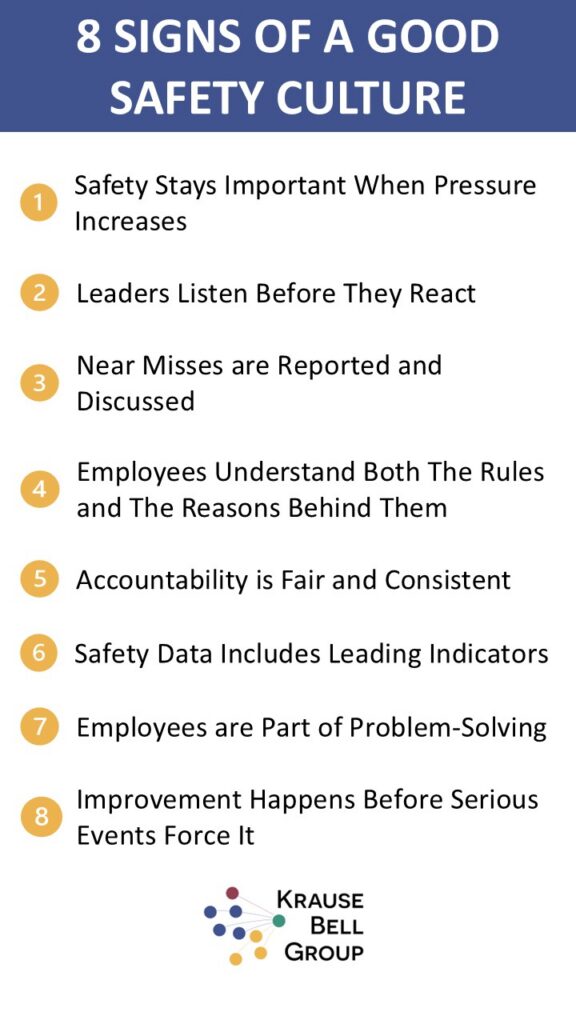
8 Signs You Have a Good Safety Culture
If you need a practical self-check, these are some of the clearest indicators. A strong workplace safety culture usually shows most or all of these signs consistently.
1. Safety Stays Important When Pressure Increases
Anyone can say safety comes first when time and resources are available. Good culture shows up when schedules tighten, staffing changes, or business demands increase. If safety controls are the first thing to disappear, the culture is weaker than it looks.
2. Leaders Listen Before They React
Managers and supervisors do not dismiss concerns, defend the system immediately, or look for someone to blame. They ask what happened, what made sense at the time, and what conditions shaped the decision.
3. Near Misses are Reported and Discussed
Organizations with a positive safety culture treat near misses as valuable data. Low reporting is not always a sign of low risk. It can be a sign that people do not trust the system.
4. Employees Understand Both The Rules and The Reasons Behind Them
People follow procedures more reliably when they understand the risk logic behind them. Good culture does not rely on blind compliance. It builds understanding.
5. Accountability is Fair and Consistent
A good safety culture does not ignore violations, but it also does not treat every event as a personal failure. It distinguishes between human error, risky drift, system weakness, and willful disregard.
6. Safety Data Includes Leading Indicators
Strong organizations look beyond injury rates. They also track participation, reporting quality, action closure, observations, learning activity, and other signs that show whether the system is strengthening or weakening.
7. Employees are Part of Problem-Solving
People closest to the work help identify hazards, improve procedures, and test solutions. This strengthens both ownership and practicality.
8. Improvement Happens Before Serious Events Force It
Reactive organizations wait for an incident to justify change. Good cultures improve earlier by paying attention to patterns, weak signals, and operational friction.
What are the 5 Elements of Safety Culture?
Many leaders search for a simple framework, often phrased as “what are the 5 elements of safety culture?” There is no single authoritative five-element model, but commonly cited elements of an effective safety culture include leadership commitment, open communication and trust, employee involvement, continuous learning, and consistent accountability.
Leadership Commitment
Leaders shape what the organization truly values. Their actions, resource decisions, priorities, and visibility tell people whether safety matters in practice.
Communication and Trust
Information must move in every direction. Clear expectations, open dialogue, and credible responses to concerns create trust. Without trust, people withhold critical information.
Employee Involvement
Employees are not passive recipients of rules. They contribute insight about risk, task reality, and system gaps. Involvement improves both compliance and design quality.
Learning and Continuous Improvement
Strong cultures learn from incidents, near misses, audits, and everyday work. They do not stop at findings. They turn learning into better controls, clearer expectations, and stronger decisions.
Accountability and Consistency
People need clarity about roles, standards, and consequences. The key is fairness. Consistent accountability supports credibility, while arbitrary enforcement damages culture.
What are the 5 C’s of Culture in a Safety Context?
The phrase “5 C’s of culture” is used in different ways, and it is not a standard safety model. In a safety context, it can be helpful to focus on practical drivers such as clear expectations, demonstrated commitment, open communication, consistent standards, and genuine concern for worker well-being.
- Clarity – People understand expectations, risks, and priorities.
- Commitment – Leaders and teams show real follow-through.
- Communication – Safety concerns move openly across levels.
- Consistency – Standards are applied reliably, even under pressure.
- Care – People believe the organization values their wellbeing.
These practical drivers help explain why some safety programs look strong on paper but fail in practice. When one or more is missing, trust can erode and the culture can become more reactive.
How to Tell if Your Safety Culture is Weak
Understanding what good looks like also means spotting the warning signs of weak culture.
These patterns often appear before more serious failures:
- Employees stay quiet about hazards or bad news
- Near-miss reporting is rare or low quality
- Supervisors send mixed messages about production and safety
- Corrective actions remain open for too long
- Training is treated as a checkbox instead of skill-building
- Incident reviews focus only on who failed
- Leaders are rarely present where risk is highest
- Safety performance is judged only by lagging indicators
If several of these signs are present, the issue is usually not just behavior. It is often a deeper mix of leadership patterns, weak systems, low perceived organizational support, and limited trust.
How to Measure Whether Your Safety Culture is Actually Good
A strong culture should be visible, but it should also be measurable. The most direct way to measure safety culture is through a survey such as Krause Bell Group’s Culture Survey. Another useful approach is to assess culture from more than one angle. Looking only at injury rates gives an incomplete picture because low rates can coexist with underreporting, silence, or unmanaged exposure.
A reliable assessment combines three perspectives:
Psychological Indicators
These measure what people believe and perceive. Examples include trust in leadership, willingness to report concerns, confidence that issues will be addressed, and belief that safety is valued.
Behavioral Indicators
These look at what people do. Examples include quality of pre-job discussions, reporting participation, supervisory coaching, use of controls, and the frequency of field engagement by leaders.
Situational Indicators
These examine the systems that shape safe work. Examples include procedure quality, action tracking, staffing, work design, planning discipline, contractor alignment, and the speed of corrective action closure.
Useful metrics often include:
- Near-miss reporting volume and quality
- Hazard correction cycle time
- Participation in safety conversations and observations
- Leadership field engagement frequency
- Employee perception survey results
- Training completion and application quality
- Repeat findings from audits or reviews
Organizations that want a clearer picture often benefit from structured assessment methods that connect leadership behavior, cultural characteristics, and operational risk. That is especially important in high-risk environments where serious injury and fatality exposure may not be reflected in standard lagging metrics.
How Leaders Build a Stronger Safety Culture
If your culture is not where it needs to be, improvement usually starts with leadership behavior and system design. You do not strengthen culture through slogans. You strengthen it by changing the daily experience people have with safety.
Start by Listening to Operational Reality
Leaders need honest input on what work looks like under real conditions. That includes production pressure, conflicting goals, unclear procedures, equipment limits, and gaps between policy and practice.
Use Data to Target the Right Problems
Culture change is stronger when it is informed by data rather than assumptions. Assessments, interviews, surveys, and field observations can reveal where trust, communication, fairness, and leadership support are weakest.
Develop a Strategy Instead of Launching Disconnected Activities
Training, campaigns, and observations help only when they support a broader strategy. A focused process often moves from learning, to gathering data, to building the strategy, to engaging leaders and teams around specific actions.
Strengthen Leadership Capability at Every Level
Executives, site leaders, and supervisors all influence culture differently. Leaders need practical development in communication, decision making, credibility, coaching, and how to respond to risk information in ways that build trust. This reinforces the idea that leadership creates culture.
Keep Measuring and Adjusting
Good cultures are maintained, not declared. The work continues through regular assessment, leadership feedback, and visible action on the patterns that matter most.
FAQ About Good Safety Culture
Building the Kind of Safety Culture People Can Trust
A good safety culture is not mysterious. It is visible in leadership, communication, fairness, follow-through, and the way people work together under real conditions. If employees can raise concerns, leaders act on what they hear, and safety remains credible when pressure rises, you are looking at the foundations of a strong culture.
For organizations that want to improve, the best next step is usually not more messaging. It is clearer insight into what makes a positive safety culture and how leadership, culture, and operational systems are interacting today. That is where meaningful culture change begins.
* Developed with the support of AI and reviewed by Krause Bell Group Editorial Team