February 26, 2026
Safety Leadership Definition: Meaning, Focus, 4 Keys
Safety leadership is the capability to mobilize people around safety challenges and influence everyday decisions so work becomes measurably safer. It is not a program or a poster. It is how you set direction, invite voice, make tradeoffs, and role-model choices that reduce exposure to serious risk while enabling performance. When you lead with safety, you create conditions where people speak up, learn, and act before harm occurs. For a concise primer on what safety leadership is and why it matters, see what safety leadership is and why it matters.
How safety leadership differs from safety management
Both are essential, but they do different jobs.
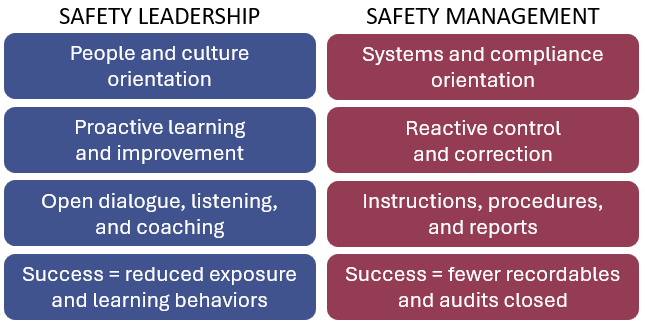
Safety management builds the systems that control risk.
- People and culture orientation
- Proactive learning and improvement
- Open dialogue, listening, and coaching
- Success = reduced exposure and learning
Safety leadership shapes the beliefs, conversations, and decisions that make those systems work under pressure.
- Systems and compliance orientation
- Reactive control and correction
- Instructions, procedures, and reports
- Success = fewer recordables and audits closed
You need both to prevent serious injuries and fatalities. Leadership sets the tone that makes management systems effective in real operations. For a deeper look at how safety leadership relates to general leadership, see the difference between leadership and safety leadership.
The primary focus of safety leadership
The primary focus is reducing exposure to serious injury and fatality risk by aligning people, decisions, and resources with that goal. In practice, you:
- Make safety a shared purpose, not a slogan, so teams feel responsible for one another.
- Balance production and protection by making risk visible in planning and resourcing.
- Build trust so people report concerns early and without fear of blame.
- Enable learning through high-quality conversations after successes, near misses, and incidents.
- Strengthen culture by reinforcing behaviors that prevent harm, not just results.
For practical examples of how this shows up, see what great safety leadership looks like.
The 4 keys of safety leadership you can apply today
- Model learning over blame – Treat mistakes and weak signals as information. Ask what made the right action hard, not who failed. Recognize reporting and problem-solving, and follow through on fixes so people see learning turn into improvement.
- Simplify safety – Remove friction from doing the right thing. Make critical controls and PPE easy to access, clarify the few rules that matter most, and replace long procedures with practical checklists and visuals where possible.
- Invite voice and dissent – Create space for questions before work begins and during the job. Ask workers what worries them, what feels rushed, and what would make the task safer. Reward speaking up, especially when it slows work to prevent harm.
- Align resources with priorities – Back words with decisions. Fund critical maintenance, staff high-risk tasks adequately, and sequence work to avoid conflicting goals. When tradeoffs arise, choose the option that reduces serious exposure and explain why.
To boil it down, review the essential attributes of safety leadership for a quick refresher.
Measuring and strengthening safety leadership
Leadership quality is measurable when you focus on behaviors and outcomes that precede injuries. Seek multi-source feedback, observe leader-worker interactions, and track leading indicators like quality of pre-job risk conversations and effectiveness of controls. Tools help you do this systematically. The Safety Leadership 360 provides evidence-based feedback on behaviors such as safety vision, credibility, and inviting dialogue. The Safety Loop Model connects leadership, culture, systems, and data so you can reduce exposure across the organization. To build skill quickly, consider attending one of our upcoming Masterclasses.
FAQs
* Developed with the support of AI and reviewed by Krause Bell Group Editorial Team