October 20, 2026
Zero Tolerance: Does It Make Organizations Safer?
Recently, while conducting a safety assessment, we had the opportunity to interview a COO who had just joined the company. During the interview, the COO said they were serious about safety and took a no-nonsense approach. The first thing they planned to do was implement a zero-tolerance policy. The first violation of a life-critical rule, they said, would lead to time off or, better yet, termination.
In the authors’ sixty years of working with hundreds of organizations, we have not seen a zero-tolerance policy that meaningfully reduced serious injuries and fatalities. We have seen incidents go unreported and leaders wrestle with whether to enforce a policy they know is counterproductive. Ideally, policies establish standards, and leaders apply judgment. When policies eliminate discretion, they can also eliminate what organizations hire leaders to provide: thoughtful judgment in complex situations.
Research on zero-tolerance policies is limited, and the authors were unable to locate a single article demonstrating a causal link between a zero-tolerance policy and a statistically significant reduction in injuries. We did locate decades of research demonstrating that punitive safety climates and fear of discipline discourage the reporting of injuries, errors, and near misses. Zero-tolerance policies may improve compliance, but they also create a significant risk of stifling learning.
What is a Zero-Tolerance Policy?
A zero-tolerance policy states that certain behaviors or violations will result in a predetermined consequence, often disciplinary action or termination, regardless of the circumstances.
Simply put, zero tolerance means that if a rule is violated, discipline always follows. There are no exceptions.
In the authors’ experience, few organizations operate with true zero tolerance. When faced with a poor policy, leaders find ways around it by applying sound judgment. These leaders distinguish between a mistake, a variation, and a violation.
- Mistake: A mistake is a decision or action based on incorrect knowledge, understanding, or judgment. For example, an employee who has been told that a machine has only one energy source locks out the electrical disconnect but is unaware of stored hydraulic energy.
- Variation: A variation is the difference between work as imagined and work as done. Workers find ways to complete the work when conditions change, a procedure does not fit, equipment misbehaves, or resources are unavailable. For example, an experienced technician does not follow the written lockout process because the equipment configuration has been modified and the procedure no longer works.
- Violation: A violation occurs when someone knowingly disregards a rule, procedure, or required control even though they have the knowledge, time, and resources to perform the task safely. For example, a technician skips lockout entirely because the repair is expected to take minutes.
To an outside observer, all three situations may look the same: each violates the lockout and de-energization policy.
Good leaders strive to understand the context in which a person makes decisions. When mistakes, variations, and violations are punished equally, the likely outcome is a failure to learn because people withdraw into a protective shell.
The Origins of Zero Tolerance Policies
Zero tolerance policies did not originate in occupational safety. The concept emerged during the 1980s in U.S. law enforcement and government programs designed to combat drug trafficking. It later expanded into public policy, schools, and criminal justice, where predetermined consequences were applied regardless of the circumstances.
During the 1990s and early 2000s, organizations adopted similar approaches in workplace safety. The philosophy was simple: establish clear rules and severe consequences for violations in the belief that compliance would prevent injuries.
Are There Advantages to Zero Tolerance Policies?
Zero-tolerance policies establish clear boundaries for unacceptable behavior and remove ambiguity from organizational expectations. They can reinforce leadership’s commitment to safety if leadership addresses barriers to safe work, risk amplifiers, and ineffective systems. They can discourage deliberate misconduct and violations.
There are situations where strict consequences are appropriate, including:
- Working under the influence of drugs or alcohol
- Workplace violence
- Intentionally removing or bypassing life-critical safeguards
- Deliberately disregarding established life-saving rules
The challenge is whether the organization will take the time and make the effort to understand the context of the decision. What appears deliberate on the surface may prove otherwise after investigation.
What Are the Disadvantages of Zero Tolerance Policies?
Zero tolerance policies treat every event the same, regardless of why it occurred. Human error, poor decision-making, and misconduct are different and require different responses.
When every mistake receives the same punishment, employees quickly learn that admitting errors carries significant personal risk. As a result, they choose not to report near misses, unsafe conditions, or their own mistakes. This creates a dangerous paradox: the organization appears safer because fewer incidents are reported, while valuable opportunities to identify and control hazards are lost.
In this environment, safety becomes focused on self-protection rather than looking out for others. Safety excellence requires a “safety of others” mindset.
Zero-tolerance policies can shift investigations toward finding fault rather than understanding why the system encourages a person to decide the best choice is one that puts their safety at risk. Safety science recognizes that risk amplifiers and ineffective controls like equipment design and reliability, workload, staffing, urgency pressure, inadequate training and procedures, and inconsistent or absent supervision all influence worker decisions. Focusing narrowly on the worker’s decision often overlooks these important contributors.
A Better Alternative: Accountability with Learning
Organizations such as Shell, BHP, and Rio Tinto, along with organizations in the aviation and healthcare sectors, have moved away from blanket zero-tolerance policies. Their approaches have been influenced by the principles of High Reliability Organizations (HRO), Human and Organizational Performance (HOP), and Just Culture.
Instead, they differentiate between human error, at-risk behavior, and reckless or intentional misconduct:
| How Accountability is Managed | |
| Human Error | Human error is viewed as an opportunity to improve the system. |
| At-Risk Behavior | At-risk behavior is seen as an opportunity for coaching and for understanding why the behavior made sense at the time. |
| Reckless Or Intentional Misconduct | Reckless or intentional disregard is managed through the disciplinary policy. |
This approach maintains accountability while preserving trust, reporting, and organizational learning.
A Different Way to Think About Zero Tolerance
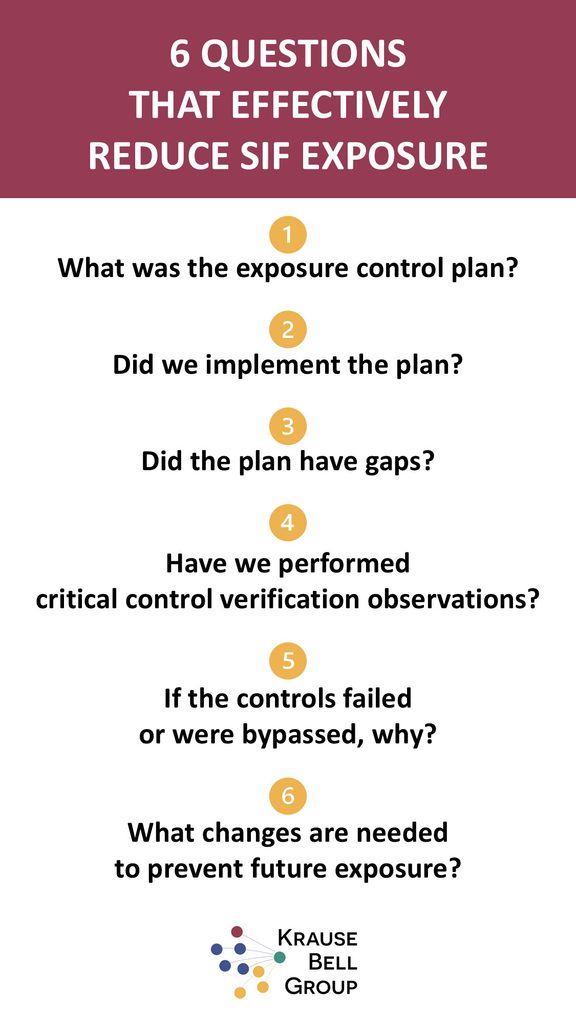
A better approach that achieves sustainable results is to adopt an organizational philosophy in which uncontrolled exposures with Serious Injury and Fatality potential (SIFp) are unacceptable. This standard applies across all levels, can be integrated into all systems, and focuses leaders on different questions about exposure and exposure control:
- What was the exposure control plan?
- Did we implement the plan?
- Did the plan have gaps?
- Have we performed critical control verification observations?
- If the controls failed or were bypassed, why?
- What changes are needed to prevent future exposure?
These questions focus on eliminating the conditions that allow serious injury and fatality exposures to occur while still holding individuals accountable for reckless choices.
Conclusion: For a Safer Workplace, Rethink Your Zero Tolerance Policy
Zero-tolerance policies can send a clear message that safety matters, but clarity alone does not create a safer workplace. A policy that forces supervisors to choose between doing the right thing and following the policy is a poor policy. Good policies support sound leadership judgment. Policies establish standards, and leaders apply judgment. When policies eliminate discretion, they can also eliminate what organizations hire leaders to provide: thoughtful judgment in complex situations.
Organizations become safer when leaders focus on understanding the context in which people make decisions. Good people make mistakes, and they sometimes feel they must choose between two bad options. Leadership means helping people make the right decision and avoiding situations in which every available choice feels wrong. Organizations become safer when employees report hazards, admit mistakes, and learn from near misses.
Clear expectations and accountability remain essential. However, the strongest safety cultures distinguish between error and reckless behavior.
Search for articles
Share this post: