October 1, 2026
Arc Flash Fatality Prevention
Arc flash fatality prevention starts long before a worker opens a panel or begins testing energized equipment. Fatal outcomes are rarely caused by one mistake alone. They usually happen when hazardous exposure, weak work controls, poor decisions, and an under-recognized electrical risk line up at the same time.
If you want to reduce the chance of a catastrophic event, you need more than awareness. You need a consistent way to recognize exposure, challenge unnecessary energized work, strengthen field decisions, and make sure protective systems actually work under real operating conditions.
This guide explains how arc flash events become fatal, what controls matter most, where OSHA requirements and NFPA 70E fit in, and how you can reduce serious injury and fatality exposure through better planning, supervision, and work execution.
Why Arc Flash Incidents can Become Fatal
An arc flash is a sudden release of electrical energy through the air caused by a fault between conductors, or between a conductor and ground. The event can produce extreme heat, intense light, pressure, molten metal, and toxic smoke within a fraction of a second. In a severe case, the worker is exposed not just to one hazard, but to several at once.
Fatalities can result from full-thickness burns, blast trauma, inhalation injury, ignition of clothing, secondary falls, or delayed medical complications after the event. The danger is not limited to high voltage systems. Low voltage equipment can also create high incident energy under the right fault conditions, especially when the available fault current is high and protective devices do not clear the fault fast enough.
- Extreme thermal energy can cause life-threatening burns in seconds
- Arc blast pressure can throw a worker or create blunt-force trauma
- Molten metal and shrapnel can cause penetrating injuries
- Superheated air and vaporized metal can damage the respiratory system
- Delayed rescue or poor emergency response can worsen survivability
What Causes Fatal Arc Flash Exposure
Most serious events trace back to a mix of technical conditions and human decisions. Equipment condition matters, but so do planning quality, task design, production pressure, supervision, and whether the worker had a realistic path to stop the job or de-energize the system. That is why arc flash fatality prevention should be treated as a serious injury and fatality prevention issue, not only as a compliance exercise.
Common Initiating Conditions
- Loose connections, damaged insulation, contamination, or equipment failure
- Dropped tools, incorrect test instruments, or contact with exposed energized parts
- Improper switching, troubleshooting, or racking procedures
- Defeated interlocks, missing covers, or degraded protective devices
- Inadequate maintenance that changes fault clearing time
Work Practice Failures that Raise Fatality Risk
- Performing energized work when de-energizing was feasible
- Starting a task without a current risk assessment
- Using PPE that does not match the task or incident energy
- Assuming equipment condition is acceptable without verification
- Weak pre-job discussions and poor hazard communication
- Supervisory decisions that prioritize speed over control
How can Arc Flash be Prevented?
The best answer is simple: eliminate exposure whenever possible. The most effective control is to place equipment in an electrically safe work condition before inspection, repair, adjustment, or maintenance. If exposure cannot be eliminated, the next priority is to reduce both the likelihood of an event and the severity of the outcome through layered controls.
Effective arc flash prevention combines engineering controls, administrative controls, protective equipment, and disciplined decision-making in the field. A prevention strategy is strongest when it does not rely on one barrier alone.
1. De-energize Whenever The Task Allows It
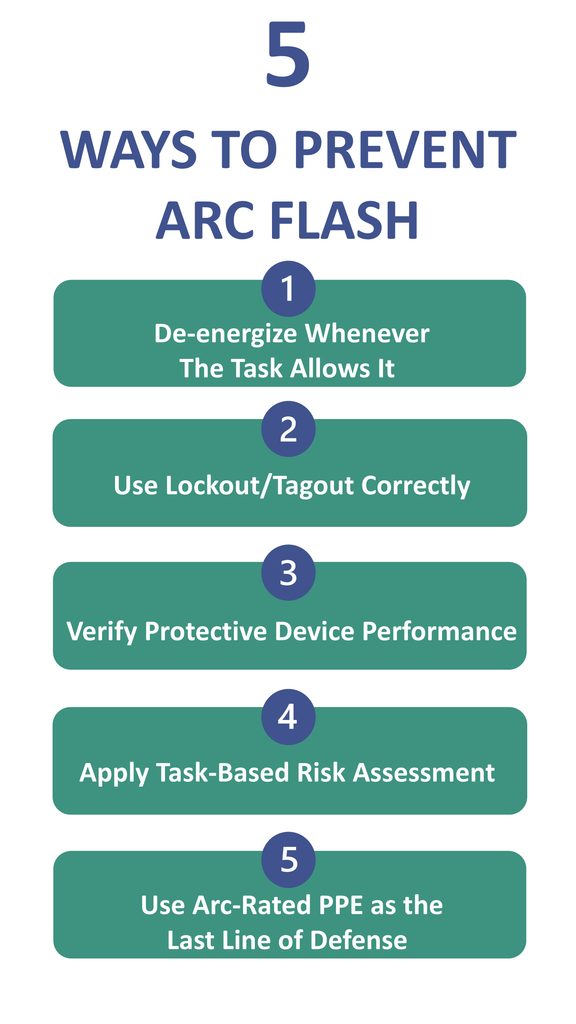
If the equipment can be placed in a safe state, that option should be challenged first, not last. Many fatal events occur during work that became normalized as routine energized activity even though better planning could have removed the exposure.
2. Use Lockout/Tagout Correctly
LOTO helps prevent unexpected energization and supports verification of an electrically safe work condition. It should include isolation of all energy sources, application of locks and tags, release of stored energy where applicable, and test-before-touch verification.
3. Verify Protective Device Performance
Breakers, relays, and fuses influence arc duration. If they are poorly maintained, incorrectly set, or unable to clear faults as expected, incident energy can increase sharply. Prevention depends on the actual condition of the protection system, not the assumption that it will work.
4. Apply Task-Based Risk Assessment
Arc flash risk is not the same for every job. Opening an enclosure, voltage testing, troubleshooting, switching, infrared inspection, and racking can expose workers in different ways. A task-based assessment helps you define boundaries, controls, PPE, and go or no-go decisions before work begins.
5. Use Arc-Rated PPE as the Last Line of Defense
PPE does not prevent the electrical fault. It reduces injury severity if an event occurs. Workers need the right arc-rated clothing and face, hand, eye, and hearing protection for the task and the predicted incident energy.
Core Controls that Matter Most in Arc Flash Fatality Prevention
The highest-value controls are the ones that either remove the exposure entirely or interrupt the chain that turns a manageable risk into a fatal event.
| Control | Primary Purpose | Impact On Fatality Risk |
| De-Energization | Eliminates worker exposure to energized parts | Highest impact |
| LOTO and Verification | Prevents unexpected re-energization and confirms safe condition | Very high impact |
| Protective Device Maintenance | Reduces clearing time and incident energy | Very high impact |
| Task-Based Planning | Aligns controls to the exact exposure | High impact |
| Qualified Worker Training | Reduces error and improves hazard recognition | High impact |
| Arc-Rated PPE | Limits burn severity during an event | Important but secondary to elimination |
The Role of OSHA and NFPA 70E
If you are asking, “What are the OSHA requirements for arc flash?” the practical answer is that OSHA expects employers to assess electrical hazards, protect workers from recognized dangers, and provide appropriate work practices, training, and protective equipment. NFPA 70E is widely used as the operational framework for electrical safe work practices, including arc flash risk assessment, boundaries, PPE selection, and establishing an electrically safe work condition.
For employers, compliance alone is not enough if real exposure remains poorly controlled. A fatality prevention approach looks beyond whether a rule exists and asks whether the organization can consistently make the right decision under pressure in the field.
- Identify electrical hazards before work begins
- Assess shock and arc flash risk for the task
- Establish safe work practices and boundaries
- Train qualified and affected workers
- Provide PPE matched to the exposure
- Maintain equipment and protective systems
What is the 2 Second Rule for Arc Flash?
The 2 second rule is often used in arc flash analysis as a practical cap on arc duration in certain scenarios, based on the assumption that a worker may be able to move away from the event in about two seconds. It is not a universal safety rule, and it should never be treated as permission to accept avoidable energized exposure. Whether it is appropriate depends on the equipment, task, worker position, enclosure, system conditions, and methodology being used.
For prevention, the main takeaway is this: do not rely on escape assumptions to manage fatal risk. If a task can be redesigned, deferred, isolated, or de-energized, those actions are stronger controls than assuming a worker can react fast enough during an event.
Training and Decision-Making Reduce Human Error
Training matters because many arc flash events involve a preventable decision error before the fault ever occurs. Workers, supervisors, and planners need more than technical knowledge. They need to know when to stop, when to escalate, when to challenge the plan, and how to recognize serious exposure early.
For organizations focused on serious injury and fatality prevention, arc flash should be addressed within a broader system of exposure recognition, leadership expectations, and operational discipline. That means not only teaching procedures, but also strengthening the quality of decisions around energized work, scope changes, line-of-fire exposure, and work authorization.
Training Topics that Support Prevention
- Hazard recognition for arc flash and shock exposure
- Establishing an electrically safe work condition
- LOTO application and verification steps
- Task-based risk assessment and job planning
- PPE selection limits and proper use
- Stop-work authority and escalation expectations
- Post-incident learning and precursor reporting
How Leadership Influences Arc Flash Fatality Prevention
Serious events are often linked to leadership decisions made well before the task starts. Staffing, schedules, maintenance deferrals, production demands, contractor alignment, and tolerance for routine energized work all shape exposure. If you want a lower fatality risk profile, leaders need visibility into where serious exposure exists in daily operations and how systems are reinforcing it.
This is where a broader serious injury and fatality prevention lens becomes valuable. Instead of only asking whether workers followed procedure, you ask deeper questions: Where does energized work become normalized? Which work groups carry the highest exposure? Which planning failures repeat? Which decisions create pressure to accept elevated risk?
A stronger prevention model includes:
- Identifying recurring arc flash exposure in routine and non-routine work
- Reviewing leadership decisions that increase exposure potential
- Strengthening planning, authorization, and supervision at the point of work
- Using incident and precursor data to target recurring weak signals
- Embedding learning into operations rather than treating it as a one-time campaign
What First Aid is Needed after an Arc Flash?
After an arc flash, emergency response should focus on scene safety first. Do not approach until the area is safe and the electrical hazard is controlled. Once safe, activate emergency medical response immediately. Arc flash injuries can include major burns, blast trauma, airway injury, cardiac complications, and hidden internal damage, so rapid professional care is critical.
Basic first aid priorities include:
- Ensure the source of danger is isolated before touching the injured person
- Call emergency services without delay
- Monitor airway, breathing, and circulation
- Cool minor burns with cool water only if appropriate and without delaying emergency response
- Do not remove melted clothing stuck to the skin
- Cover burns with a clean, dry dressing
- Treat for shock and keep the person warm
- Watch for respiratory distress, especially after smoke or vapor inhalation
First aid is not a substitute for emergency medical evaluation. Even when injuries appear limited, arc flash exposure can involve complications that are not immediately visible.
Practical Signs your Current Program may be Missing Fatality Exposure
- Energized work is common but rarely challenged
- Job planning focuses on production steps more than hazard controls
- Workers rely heavily on PPE while equipment condition is uncertain
- Protective device settings and maintenance records are outdated
- Near misses and precursor events are not analyzed for serious exposure potential
- Supervisors approve high-risk work without a structured review of alternatives
- Training is periodic, but field reinforcement is weak
FAQ about Arc Flash Fatality Prevention
Reducing Arc Flash Risk Means Reducing Serious Exposure Before The Job Starts
Arc flash fatality prevention is most effective when you stop treating it as only a technical hazard and start managing it as a serious exposure pathway. That means identifying where the highest-risk work lives, reducing unnecessary energized tasks, improving protective reliability, and strengthening the leadership and field decisions that shape daily work. When your systems, supervision, and work planning are aligned, the chance of a catastrophic electrical event drops significantly.
For organizations that want to improve prevention at the serious injury and fatality level, the biggest gains often come from making exposure visible, learning from verifying critical controls and building safer decisions into routine operations.
* Developed with the support of AI and reviewed by Krause Bell Group Editorial Team