May 15, 2026
How to Build a Critical Control Register
A critical control register helps you prevent serious injuries and fatalities by listing the few controls that must not fail for SIF exposure to be eliminated or reduced to an acceptable level.
Unlike broad risk lists, it focuses attention, ownership, and assurance on the controls that matter most. Use the guide below to define scope, choose the right fields, populate consistently, and monitor performance so leaders can make better safety decisions, faster.
What is a Critical Control Register?
A critical control register is a structured list of controls that are essential to prevent a high-consequence event, often informed by bowtie analysis of SIF hazards. Each entry describes the control’s objective, performance standard, verification method and frequency, owner, current status, and escalation path when the control is not effective. Where a risk register catalogs risks, a critical control register catalogs assurance for the handful of controls that break the causal chain to a SIF outcome. Done well, it becomes a living system for safety leadership – clarifying where to allocate attention, budget, and follow-up. For how this fits within a broader SIF prevention approach, see Critical Risk Management and SIF Prevention.
Critical Control Register vs. Risk Register
A risk register tracks threats, likelihood, consequence, and responses across the enterprise. A critical control register zooms in on prevention – it lists controls with performance requirements and assurance activities tied to specific SIF hazards. The two work together: the risk register identifies where SIF potential exists and prioritizes treatment, while the critical control register confirms the few must-work controls are designed, implemented, verified, and escalated when degraded. In practice, link risks to their critical controls so incident learning and audits flow both ways.
What to Include in Your Critical Control Register
Capture fields that describe the control, how it must perform, who owns it, and how you will know it works. The table below offers a practical starting set you can adapt by site or process.
| Field | Purpose |
| Control ID | Unique, persistent identifier for traceability and version control |
| Hazard and Top Event | Bowtie anchor – the SIF hazard and the moment control must prevent |
| Control Name and Objective | Concise title plus what the control must achieve |
| Control Type | Engineering, procedural, administrative, PPE – prefer hard controls |
| Performance Standard | Measurable requirement – condition, capacity, specification, tolerance |
| Verification Method | How you test it – inspection, functional test, sampling, monitoring |
| Verification Frequency | How often – daily, per shift, before use, monthly, risk-based |
| Owner and Secondary Owner | Accountable leader and operational custodian or backup |
| Status | Effective, degraded, failed, overdue, planned – with date stamps |
| Escalation Path | Who to notify and action timeframe when degraded or failed |
| Evidence Location | Where records live – system link, logbook, photo, work order |
| Dependencies | Upstream conditions or interfacing systems the control relies on |
| Residual SIF Exposure | Exposure after the control operates as designed, for prioritization |
| Last Test and Next Due | Timestamped verification cycle to avoid drift |
| Notes and Learning | Recent incidents, near misses, changes, lessons to share |
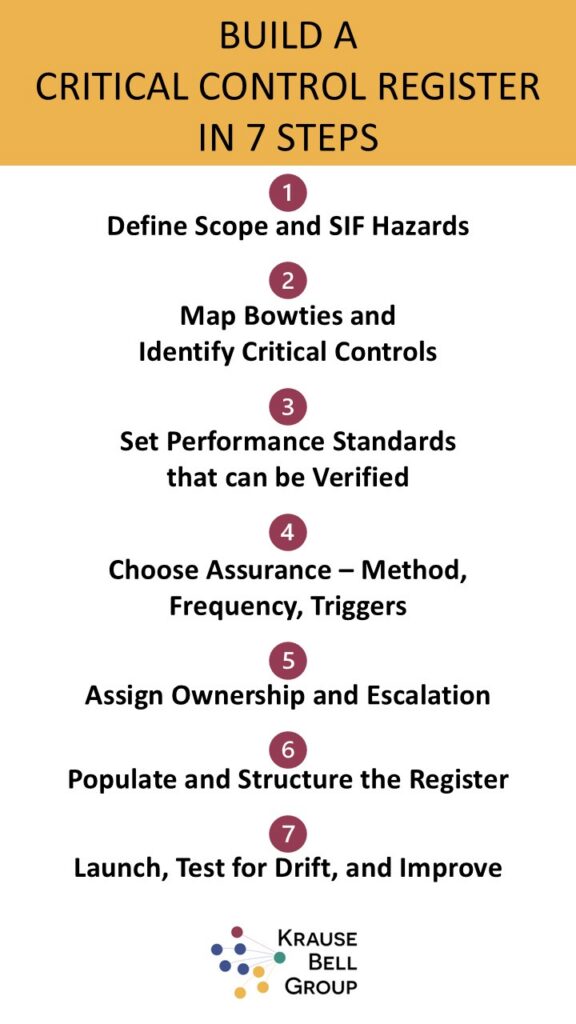
How to Build Your Critical Control Register – 7 Steps
1. Define Scope and SIF Hazards
Start where consequence is greatest. Select operations with SIF potential – confined space entry, working at height, energized isolation, lifting, mobile equipment, process safety barriers. Use incident data, near misses, and workforce insights to validate where exposure is real, not just theoretical. Document the scope so teams know which assets, permits, and activities are in and out. If you need a clear definition of precursors, see What is a SIF precursor?. For systematic identification of high-risk scenarios and control needs, see How to Identify SIF Precursors on Your Job Sites.
2. Map Bowties and Identify Critical Controls
Build or update bowtie diagrams for each scoped hazard. List threats on the left and existing controls that prevent the top event. A control is critical if its failure significantly increases the probability of a SIF outcome. Prioritize hard engineering and physical isolation controls over administrative ones, and capture recovery controls that meaningfully reduce consequence if prevention fails. Before finalizing, use the Risk Management Practical Playbook to translate bowties into clear controls, performance standards, and assurance.
3. Set Performance Standards that can be Verified
Translate each critical control into measurable performance requirements. Replace vague words like adequate with specifics such as pressure relief valve set at 150 psi, tested to open within 5 psi variance. Define acceptance criteria, environmental limits, qualified personnel required, and any enabling conditions. If you cannot verify it, you cannot assure it.
4. Choose Assurance – Method, Frequency, Triggers
Select how you will know the control works: functional test, interlock challenge, torque check, permit audit, sensor output trend. Set frequency by consequence, degradation rate, and exposure – more exposure or faster degradation means more frequent checks. Add event-based triggers like before energization or after maintenance. Define sampling size where full testing is impractical. For practical methods to set performance requirements and verification frequencies, see Leading Indicators for SIF Prevention.
5. Assign Ownership and Escalation
Nominate a control owner accountable for performance and a secondary owner for day-to-day execution. Clarify responsibilities – scheduling verifications, maintaining evidence, updating status, acting on degradation. Document an escalation path with time limits. For example, failed fall arrest anchor – stop work, notify site lead within 30 minutes, corrective work order in 24 hours, leadership review weekly until closed. For governance clarity on roles, escalation, and accountability, define these responsibilities in your safety management system and communicate them widely.
6. Populate and Structure the Register
Configure your column set, numbering scheme, and taxonomies before you start entering data. Use consistent naming patterns to avoid duplicates and enable roll-up reporting. Group by hazard category, process area, site, and control type so leaders can search by how they manage work. Add links to related risks, procedures, maintenance tasks, and training so evidence is one click away. If contractor work features in your scope, clearly define owner and verifier responsibilities around contractor-related critical controls.
7. Launch, Test for Drift, and Improve
Run a short pilot at one site or hazard category to validate fields, workflow, and dashboards. Check for overdue verifications, inconsistent status labels, and missing evidence – common signals of control drift. Close gaps, then scale across sites. Establish a cadence to review trends, incident learnings, and change impacts so the register remains living and connected to real work.
Example Critical Control Register Entries
Use concise, testable language. Below are illustrative entries you can adapt.
| Hazard | Critical Control | Performance Standard | Verification | Frequency | Owner | Escalation |
| Working at height | Certified anchor points | Anchors rated 22 kN, no corrosion, tag in date | Visual plus pull test to 6 kN | Quarterly | Maintenance Lead | Degraded – stop work, notify Site Manager in 30 min |
| Confined space | Forced ventilation and gas testing | O2 19.5-23.5 percent, LEL 0 percent, H2S 0 ppm | Continuous monitor with alarm, log every 15 min | Before and during entry | Entry Supervisor | Alarm – evacuate, call Emergency Lead immediately |
| Stored energy | LOTO isolation verification | Zero energy confirmed with try-out per asset procedure | Witnessed try-out and sign-off | Per job | Area Manager | Failed try-out – halt job, authorize rework within 24 h |
Structure, Governance, and Monitoring
Decide whether to maintain one enterprise register with site-level views or separate site registers with a shared taxonomy. Either way, use consistent IDs, version control, and change logs. Approve additions or edits through a defined workflow that includes the control owner and a safety leader. Apply the three lines model – operators verify, safety provides oversight, and internal audit tests the system independence.
Monitoring turns the register into leadership intelligence. Track leading indicators like on-time verification rate, test pass rate, time to close degraded controls, and overdue counts by owner.
Add lagging context from incidents and near misses linked to controls. Use simple dashboards to highlight where assurance is strong, drifting, or failing so you can reallocate attention and resources quickly.
See Dashboards for Serious Injury and Fatality Prevention for examples of KPI design and visualization that support SIF control assurance.
Common Pitfalls to Avoid
- Too many controls – if everything is critical, nothing is. Focus on the few that prevent SIF outcomes.
- Vague standards – untestable criteria create false assurance. Make requirements measurable.
- Weak ownership – unnamed or rotating owners lead to drift. Assign accountable leaders.
- No escalation – degraded controls linger without time-bound actions. Define triggers and timelines.
- Evidence gaps – missing records undermine trust. Link verification to where evidence lives.
- Spreadsheet sprawl – version conflicts and stale data. Centralize with access control and audit trails.
- Static register – ignoring incident learning or changes. Review and update on a set cadence.
FAQs
* Developed with the support of AI and reviewed by Krause Bell Group Editorial Team