May 8, 2026
Define and Code SIF and SIF Potential
Consistent definitions and coding help you see and remove the exposures that most often lead to Serious Injuries and Fatalities. Use this guide to define and code SIF and SIF potential the same way across sites, so your data drives better prevention. See SIF Maturity for how organizations use SIF/SIFp data effectively. At Krause Bell Group, we help leaders turn this clarity into safer decisions.
Definitions: SIF and SIF Potential
Serious Injury and Fatality, or SIF, refers to a work event resulting in a fatality or a life-altering injury. Life-altering injuries typically include permanent impairment such as amputation, paralysis, loss of an eye, skull fracture, severe traumatic brain injury, third degree burns, or any injury that permanently limits quality of life or work capacity. For foundational context, see What is Serious Injury and Fatality (SIF) Prevention?
SIF potential, often written as SIFp or PSIF, refers to an event or exposure that did not result in a SIF, but had a reasonable likelihood to do so if conditions had been slightly different. Reasonable likelihood means credible, not remote. An easy rule of thumb is that if two people need to discuss it for longer than 1 minute, it probably is not a SIFp. Many near misses and some recordable injuries can carry SIF potential when the credible worst case meets the SIF threshold above. Refer to SIF precursor criteria to sharpen recognition and coding.
How to Code SIF and SIF Potential
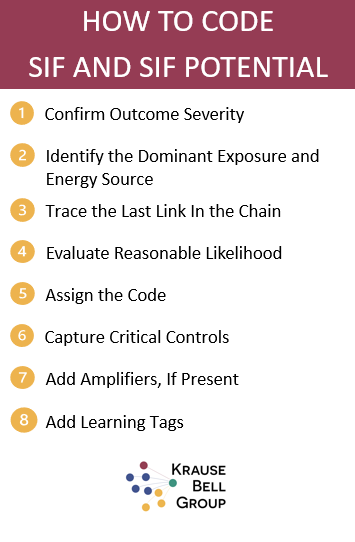
- Confirm Outcome Severity. If the actual outcome meets the SIF threshold, code as SIF Actual. If not, continue to evaluate potential
- Identify the Dominant Exposure and Energy Source. Select the single exposure that most directly put the person in harm’s way, such as working at height, motorized vehicle interaction, electrical contact, line-of-fire from pressurized systems, struck by moving object, caught in or between, confined space, fire or explosion, chemical release, or excavation and trenching.
- Trace the Last Link In the Chain. Describe the immediate mechanism that would deliver the serious harm if conditions shifted slightly, for example fall to lower level, unguarded contact with 480V, load drop within line-of-fire, vehicle-pedestrian interface, blast or toxic inhalation.
- Evaluate Reasonable Likelihood. Consider energy magnitude, distance and direction, body position, frequency and duration of exposure, number of people exposed, and whether critical controls were missing, failed, or bypassed. Ask if a small change in timing or position could credibly have produced a SIF outcome.
- Assign the Code. SIF Actual when the outcome is fatal or life-altering. SIF Potential when the credible worst case meets SIF severity with reasonable likelihood. Not SIF Potential when serious harm would be remote or not credible given the energy and controls.
- Capture Critical Controls. Note the specific controls that should prevent or mitigate the credible SIF outcome, and whether they were in place and effective, in place but ineffective, or absent. This is essential for learning and prevention. For reporting structure and metrics, see Dashboards for SIF prevention.
- Add Amplifiers, If Present. An amplifier is a change in the work environment that increases the potential for risk. Think of elements such as – but not limited to – fatigue, shift change, weather conditions or longer working hours. These are important to note to get a deeper understanding of when the potential for a SIF event increases, specific to a certain high-risk activity.
- Add Learning Tags. Record contextual factors that help you learn at scale, such as decision-making under production pressure, supervision and planning, procedure usability, or contractor interface. For practical insights and common pitfalls, see Learning to Prevent Serious Injuries and Fatalities (SIFs).
Exposure Categories Often Linked to SIFs
- Working at height or over edges with fall potential
- Motorized vehicle and mobile equipment interactions on foot or in-vehicle
- Line-of-fire from moving loads, suspended loads, or stored energy release
- Caught in or between rotating, pinch, or crush points
- Electrical contact or arc flash above hazardous energy thresholds
- Confined space entry with atmospheric or engulfment hazards
- Pressure systems and high-energy pneumatic or hydraulic releases
- Fire, explosion, or flammable atmospheres
- Hazardous chemicals with acute toxicity or corrosivity
- Excavation, trenching, and ground instability
Note that ergonomic risk factors rarely meet SIF potential unless a separate high-energy source is credibly involved. For example, a strain while pushing a cart is not SIF potential, but being struck by a moving forklift is.
Short Coding Examples
- Paper cut while handling office documents. Low energy, no credible path to life-altering injury. Code as Not SIF Potential.
- Angle grinder wheel shatters near face, no injury. High rotational energy with credible eye or skull trauma if fragments struck. Code as SIF Potential, exposure category struck by moving object, last link projectile to head.
- Forklift clips pedestrian’s thigh at low speed causing a bruise. Motorized vehicle energy with a credible crush or run-over scenario. Code as SIF Potential, capture controls like traffic separation and spotter use.
Pitfalls to Avoid
- Judging by injury, not exposure. Always code potential from the credible worst case, not the actual outcome.
- Calling everything potential. Reasonable likelihood requires credible energy and a plausible path to serious harm.
- Mixing exposures. Pick the dominant exposure tied to the last link in the chain to avoid double counting.
- Overlooking vehicle energy. Do not code a vehicle event as ergonomic just because the injury was a strain.
- Skipping control evaluation. Document which critical controls failed or were missing so you can fix what matters.
- Not revisiting with new facts. Update the code if investigation reveals different energy, exposure, or controls.
FAQs
A SIF injury is a life-altering injury such as amputation, paralysis, loss of vision, severe brain injury, major burns, or similar permanent impairment, as well as any fatality. If you need a quick reference to define and code SIF and SIF potential consistently, bookmark this guide and use it to align investigations, reviews, and leadership learning across your sites. When you are ready to go deeper, Krause Bell Group helps teams integrate clear coding with better decisions to eliminate SIF exposure.
* Developed with the support of AI and reviewed by Krause Bell Group Editorial Team