September 2, 2026
Management of Change SIF Prevention
When work changes, serious risk changes with it. New contractors, modified equipment, revised procedures, staffing gaps, production pressure, temporary workarounds, and schedule compression can all increase exposure to serious injuries and fatalities long before traditional safety metrics show a problem. That is why management of change SIF prevention matters. It gives you a structured way to identify how change affects critical risk management, verify that controls still work, and make better decisions before exposure turns into an actual SIF event or a pSIF.
If your organization already has a Management of Change process, the real question is whether it is strong enough to surface SIF exposure, not just document operational updates. Effective management of change SIF prevention connects change decisions to high-consequence risk, field conditions, leadership accountability, and the quality of critical controls in live operations.
Why Management of Change is Central to SIF Prevention
Many organizations treat change as an administrative workflow. That is risky. A change in people, process, equipment, materials, contractors, planning, or operating conditions can alter the pathways that lead to serious injury and fatality. If those pathways are not examined directly, low incident rates can create false confidence while catastrophic exposure grows in the background.
SIF prevention requires a different lens. Instead of asking only whether work can continue, you need to ask whether the change increases exposure to high-energy hazards, weakens barriers, introduces new failure modes, or shifts decision-making under pressure. In other words, management of change is not just about controlling variation. It is about understanding how variation affects the conditions that can produce life-altering harm.
This is especially important during:
- Contractor mobilization or demobilization
- Shutdowns, turnarounds, and startups
- Process or equipment modifications
- Temporary bypasses and workarounds
- Staffing or supervision changes
- Production increases and schedule compression
- New work methods or altered task sequencing
- Changes in site conditions, environment, or layout
What SIF and pSIF Mean in a Change Environment
A SIF is a serious injury or fatality event, including incidents with life-altering or fatal outcomes. A pSIF, or potential serious injury and fatality event, is an incident, near miss, or exposure that could reasonably have resulted in a serious injury or fatality under slightly different circumstances.
That distinction matters in Management of Change. Actual SIF events are rare, but pSIFs are early signals that a change has introduced weak controls, unstable conditions, or flawed assumptions. If a temporary isolation is misunderstood, a vehicle route is improvised, a permit step is skipped, or a contractor begins high-risk work without full hazard recognition, you may not see a recordable injury. But you may be seeing pSIF potential.
In practice, a strong MOC process should help you identify SIF precursors:
- New exposure created by change
- Existing exposure made worse by change
- Critical controls that no longer match the real work
- Decision points where assumptions can fail
- Precursors that suggest a credible SIF pathway
Why Traditional Safety Metrics are Not Enough During Change
TRIR, recordable rates, and monthly incident summaries can help you understand historical injury performance, but they do not reliably show whether a recent change has created catastrophic exposure. A site can report low injury frequency while still carrying serious risk related to energy isolation, mobile equipment interaction, work at height, dropped objects, line-of-fire exposure, confined space entry, or contractor coordination.
This gap becomes larger during change because the conditions are less stable. Work may be non-routine. Teams may be unfamiliar with each other. Planning assumptions may be untested. Temporary fixes may stay in place longer than intended. Supervisors may be stretched across multiple priorities. In that environment, standard lagging indicators tell you very little about whether controls are still effective where risk is highest.
For management of change SIF prevention, the more useful question is not “How many injuries happened last month?” but “What changed, how did that change affect SIF exposure, and what evidence do we have that critical controls still hold?”
What a Strong Management of Change Process Should Cover for SIF Prevention
An effective MOC process for SIF prevention goes beyond approval signatures and procedural updates. It should create a disciplined review of how change affects serious risk and how that risk is managed before work begins and while work is underway.
Core Elements of an MOC Process for SIF Prevention
- Clear triggers for when formal MOC is required
- Specific review of SIF exposure and pSIF potential
- Identification of critical controls tied to the changed work
- Verification that controls are available, understood, and usable
- Role clarity for operations, EHS, engineering, and contractors
- Field validation before execution and after conditions shift
- Escalation rules when assumptions or safeguards fail
- Post-change learning to capture weak signals and recurring precursors
Changes that Should Trigger a SIF-Focused Review
Not every change needs the same level of analysis, but some changes should immediately trigger a more formal review because they can materially affect catastrophic risk.
| Change Type | Why It Matters For SIF Prevention |
| Equipment or process modification | Can alter energy sources, interfaces, guarding, access, or failure modes |
| Temporary repair or workaround | Often weakens barriers and normalizes deviance if left in place |
| Contractor changes | May introduce gaps in onboarding, supervision, hazard recognition, or stop-work use |
| Staffing or leadership changes | Can reduce experience, disrupt communication, or blur accountability for critical risk |
| Schedule compression or production pressure | Increases the chance of shortcuts, rushed decisions, and incomplete control verification |
| Procedure or task-sequence changes | May create new line-of-fire, isolation, or coordination hazards in execution |
How to Evaluate SIF Exposure During Change
A useful MOC review should not stop at “what is changing?” It should move quickly into “what could now cause serious harm?” That means looking at the changed work through the lens of credible consequence, exposure pathways, and control reliability.
Questions that Help Surface SIF Risk
- Does this change affect contact with high-energy hazards?
- Could the changed condition lead to a fatal or life-altering outcome if controls fail?
- Which critical controls are supposed to prevent that outcome?
- Are those controls still valid under the new conditions?
- Who has verified the controls in the field, not just on paper?
- What assumptions are we making about competence, timing, communication, or equipment condition?
- What is temporary, and how do we prevent temporary from becoming normal?
- What pSIF signals would tell us the change is not as well controlled as expected?
Common SIF Precursors that Appear During Change
Most serious events are not random. They are often preceded by weak signals and recurring precursor conditions. In a change environment, the following signs deserve immediate attention:
- Unclear ownership of isolation, permitting, or verification
- Different teams working from different assumptions
- Critical controls present on paper but not confirmed in the field
- Non-routine work treated like routine work
- Temporary routes, access points, or barriers without review
- Contractors starting work with limited site-specific hazard understanding
- Production goals overriding pause, review, or stop-work decisions
- Repeated deviations that no longer trigger concern
Critical Controls in Management of Change SIF Prevention
SIF prevention depends on critical controls that interrupt the pathway to catastrophic harm. During change, those controls are more vulnerable because they may no longer fit the altered conditions, or because people assume the existing system still protects them without rechecking the details.
That is why you should identify the controls that matter most for the changed work and verify more than their existence. You need to verify their quality, usability, timing, and reliability. A permit that is technically complete but misunderstood by the work team is not an effective control. A barrier that is installed but bypassed is not an effective control. A supervisor who is accountable in theory but absent at the decision point is not an effective control.
What Strong Control Verification Looks Like
- The control is directly linked to a credible SIF pathway
- The control is specific to the changed condition, not generic
- The work team understands when and how the control applies
- The control is checked in the field before exposure begins
- There is a clear response if the control cannot be maintained
- Verification is documented in a way that supports decision-making, not bureaucracy
The Role of Leadership and Decision-Making in MOC and SIF Prevention
Management of Change often fails not because the organization lacks forms, but because decision quality weakens under pressure. Leaders may accept incomplete information, tolerate temporary deviations, assume controls are understood, or prioritize continuity over exposure reduction. In high-risk operations, those decisions can shape whether a change remains controlled or drifts toward a pSIF or actual SIF event.
This is where leadership discipline becomes central. Senior leaders, operational leaders, and frontline supervisors do not need to inspect every detail personally, but they do need to create a system where high-consequence risk is visible, discussable, and actionable. That includes asking better questions, requiring evidence of control verification, and treating unresolved exposure as a business issue, not just a safety issue.
Leadership Questions Worth Asking During Change
- What serious risk is changing here?
- Where could this decision increase SIF exposure?
- What are the critical controls, and who verified them?
- What contractor or interface risks are being introduced?
- What assumptions could fail once work starts?
- What would cause us to pause or stop the work?
- How will we know quickly if the change is creating pSIF conditions?
How Contractor Safety Connects to Management of Change SIF Prevention
Contractor involvement is one of the clearest reasons a formal Management of Change process matters. New firms, new crews, altered scopes, compressed schedules, and mixed supervision can all change exposure quickly. Even when contractor companies are technically qualified, the operational reality may include different assumptions about permits, energy isolation, traffic management, role boundaries, or stop-work expectations.
For that reason, contractor safety should be integrated into MOC reviews whenever the change affects who is doing the work, how the work is being supervised, or how responsibilities are shared across organizations. Strong contractor safety management helps you anticipate change rather than respond to it after a near miss. It also helps reduce the common gap between written expectations and field execution.
Contractor-Related MOC Checks that Add Value
- Scope clarity for changed work
- Site-specific SIF exposure briefing
- Clear ownership for permits and verification
- Alignment on stop-work authority
- Review of simultaneous operations and interface risks
- Confirmation of supervisor availability and competence
- Check that onboarding reflects the actual changed conditions
A Practical Framework for Managing Change with a SIF Lens
A simple way to strengthen management of change SIF prevention is to treat change as a risk decision cycle rather than a one-time approval event. The structure below aligns with a practical plan-do-check-act rhythm while keeping focus on high-consequence exposure.
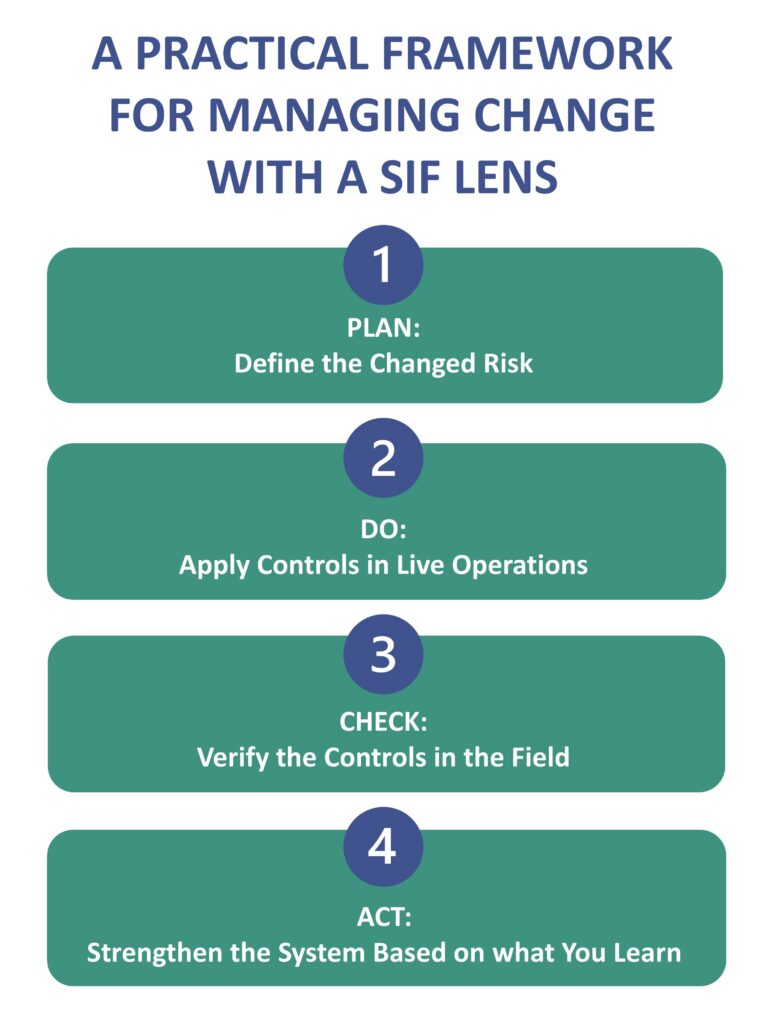
Plan – Define the Changed Risk
Describe what is changing, where exposure could increase, which SIF pathways are credible, and what critical controls are required. This is also the point to clarify accountability, contractor interfaces, and escalation triggers.
Do – Apply Controls in Live Operations
Translate the review into actual work conditions. Confirm permits, planning, isolation, supervision, communication, and field readiness. Make sure the team understands the changed conditions instead of assuming standard practice still fits.
Check – Verify the Controls in the Field
Look for evidence that the controls are functioning in real work, not only in documentation. Review pSIF indicators, precursor reports, deviations, and workarounds that suggest the change is producing more risk than expected.
Act – Strengthen the System Based on what You Learn
Use the learning from the change to improve future MOC decisions, update standards, clarify roles, and remove recurring exposure pools. The goal is not just to close an action item, but to improve the quality of decisions around critical risk.
Metrics that Help You Manage MOC-Related SIF Risk
Metrics are useful only if they help you see and control material exposure. For management of change SIF prevention, that usually means combining a few lagging indicators with more decision-relevant leading indicators.
Useful Metrics to Track
| Metric | What It Tells You |
| Number of MOC reviews involving high-consequence risk | Whether material changes are being formally recognized |
| pSIF events linked to changed conditions | Whether change is producing weak signals of serious exposure |
| Critical control verification rate | Whether controls are being checked where the work actually happens |
| Repeat deviations or workarounds after change | Whether temporary conditions are becoming normalized |
| Time to close high-risk corrective actions | How quickly the organization responds to unresolved exposure |
| Leadership field verification on changed work | Whether leadership attention is reaching critical operations |
The point is not to create more reporting. The point is to build visibility into where change is increasing exposure and whether the organization is responding effectively.
Common Reasons MOC Fails to Prevent SIF Exposure
Even mature organizations can struggle if Management of Change is handled as a compliance exercise instead of a risk-control discipline. Several patterns show up again and again:
- Changes are categorized too narrowly and avoid formal review
- The review focuses on process impact but not credible harm pathways
- Critical controls are listed but not field-verified
- Contractor interfaces are assumed rather than clarified
- Temporary conditions remain in place longer than planned
- Ownership is diffuse when conditions shift after approval
- Learning from pSIFs and precursor trends never feeds back into the MOC system
If these patterns are familiar, the issue is usually not a lack of concern. It is that the operating system does not consistently connect change decisions to SIF exposure, decision quality, and accountability.
How Krause Bell Group Approaches SIF Prevention in Changing Conditions
Krause Bell Group supports organizations in high-risk industries with a consulting approach centered on SIF reduction, leadership decision-making, culture change, and exposure visibility. Rather than treating SIF prevention as a narrow compliance program, the focus is on helping you understand where serious exposure exists, how decisions influence that exposure, and what changes are needed in leadership systems and operational routines.
This approach aligns closely with Management of Change challenges. During periods of operational change, organizations often need better alignment, clearer visibility into SIF precursors, stronger recognition of exposure in the field, and better links between decisions and risk. Krause Bell Group’s work in areas such as contractor safety, safety strategy, leadership development, and the SIF reduction mechanism supports that broader objective: reducing serious exposure by improving how the organization sees, discusses, and manages critical risk.
FAQ About Management of Change SIF Prevention
* Developed with the support of AI and reviewed by Krause Bell Group Editorial Team