July 24, 2026
Operational Risk Management for Executives
Operational risk management for executives is not about reviewing a list of controls once a quarter. It is about making better leadership decisions before process failures, contractor issues, system breakdowns, human error, or weak escalation turn into serious operational, financial, or reputational damage. When you lead at executive level, your role is to set direction, define risk appetite, create accountability, and make sure risk management supports performance instead of slowing it down.
For many organizations, the real challenge is not knowing that operational risk exists. It is knowing which risks matter most, who owns them, how they are reported, and whether leadership decisions are reducing exposure or quietly increasing it. That is why operational risk management has become a boardroom issue, especially in complex, high-risk, and highly regulated environments.
Why Operational Risk Management Matters at Executive Level
Operational risk is often described as the risk of loss resulting from failed or inadequate processes, people, systems, or external events. For executives, that definition is useful but incomplete. In practice, operational risk affects execution, resilience, growth, and trust. It influences whether strategy can actually be delivered safely and consistently.
At executive level, operational risk management matters because small weaknesses can compound quickly. A missed escalation, unclear accountability, outdated procedure, weak contractor oversight, or poor decision under pressure can create much larger consequences than the original issue suggests. In higher-risk industries, the consequences may include production loss, regulatory action, serious incidents, fatalities, business interruption, supply disruption, or long-term brand damage.
Strong executive oversight improves more than risk reduction. It supports better capital allocation, stronger operational discipline, clearer prioritization, and faster decisions when conditions change. It also helps you distinguish between noise and material exposure, which is essential when leadership teams are flooded with metrics, audits, and compliance data.
What Operational Risk Management Means for Executives
Operational risk management for executives is the structured oversight of risks that arise through day-to-day operations and leadership decisions. It includes identifying exposures, assessing likelihood and impact, deciding how much risk is acceptable, assigning ownership, monitoring indicators, and responding before risks become losses.
Unlike a purely technical or compliance-led view, the executive perspective is broader. You are not only asking whether a control exists. You are asking whether the organization is set up to make sound decisions under normal conditions and under pressure.
Typical sources of operational risk include:
- Human error and decision failure
- Weak supervision or unclear roles
- Breakdowns in critical processes
- Technology failures and cybersecurity events
- Third-party and contractor risk
- Data quality issues and weak reporting
- Regulatory noncompliance
- Supply chain disruption
- Culture issues that discourage escalation
- External events such as weather, geopolitics, or infrastructure failure
Executives should also understand that operational risk is not just an operations function issue. It cuts across finance, legal, IT, production, procurement, HR, safety, and strategy. If those functions operate in silos, risk signals get missed or downgraded until they become harder and more expensive to manage.
Operational Risk Management vs. Enterprise Risk Management
Executives often ask where operational risk management sits relative to enterprise risk management. The simplest answer is that operational risk management is usually a core part of enterprise risk management, but it focuses more directly on the failures and disruptions that affect how the business actually runs.
Enterprise risk management looks across the full risk landscape, including strategic, financial, market, compliance, reputational, and operational exposures. Operational risk management goes deeper into execution risk, such as process design, system reliability, workforce capability, contractor performance, and control effectiveness.
This distinction matters because many executive teams are comfortable discussing strategic risk in abstract terms but have less visibility into the operational conditions that can derail strategy. If your ERM framework stays too high level, operational risk remains under-managed even though it is often where the most immediate losses occur.
The Executive Role in Operational Risk Management
Executives do not need to own every risk register entry, but they do need to shape the environment in which operational risks are identified, escalated, and addressed. Your influence shows up in governance, resource allocation, performance expectations, and the quality of decision making throughout the organization.
At a practical level, executive responsibility includes:
- Setting and communicating risk appetite and tolerance
- Defining what must be escalated and when
- Clarifying accountability across functions and sites
- Making sure reporting highlights material risk, not just activity volume
- Challenging false assurance created by low lagging metrics alone
- Balancing operational performance with resilience and safety
- Ensuring critical risks are discussed in business decisions, not after them
In many organizations, operational risk management weakens when executives unintentionally reward output, speed, or short-term efficiency at the expense of discipline. That is why leadership behavior matters as much as policy design. What leaders question, tolerate, fund, and follow up on becomes the operating standard.
The 5 Steps of Operational Risk Management
Many leaders search for the 5 steps of operational risk management because they need a process that is simple enough to govern and strong enough to scale. A practical executive-level model includes five core steps.
1. Identify Operational Risks
Start by identifying where the business is vulnerable. Focus on critical operations, high-consequence tasks, contractor interfaces, technology dependencies, leadership decisions, and known failure points. Use incident history, site feedback, audits, scenario reviews, and frontline input to identify real exposure rather than theoretical risk only.
2. Assess Likelihood and Impact
Determine how likely a risk is and how severe the outcome could be. Include operational disruption, financial loss, legal exposure, customer impact, and potential for serious incidents. A risk matrix can help, but executives should also ask whether low-frequency risks carry high consequence and therefore deserve disproportionate attention.
3. Prioritize and Decide Treatment
Not every operational risk deserves the same response. Prioritize based on materiality. Then choose a treatment path: avoid, reduce, transfer, or accept the risk. This is where leadership judgment matters. Accepting a risk without clear rationale, ownership, and monitoring is not risk management.
4. Monitor Key Indicators and Control Performance
Operational risks change with staffing, production pressure, contractor mix, technology changes, and external conditions. Use key risk indicators, control checks, and management review routines to monitor drift. If conditions change, the risk decision may need to change as well.
5. Report, Learn, and Improve
Effective reporting helps executives see patterns, emerging threats, repeated decision failures, and systemic weaknesses. The process should lead to learning, not just documentation. Review whether controls worked, whether escalation happened early enough, and whether leadership decisions contributed to the outcome.
What are the 4 Pillars of Operational Risk Management?
The 4 pillars of operational risk management can be framed in different ways, but for executives, the most useful model includes governance, risk insight, control discipline, and organizational learning.
- Governance – clear ownership, decision rights, escalation rules, and executive oversight
- Risk Insight – accurate visibility into exposures, trends, scenarios, and leading indicators
- Control Discipline – reliable processes, trained people, effective controls, and verified execution
- Organizational Learning – learning from incidents, weak signals, near misses, and changing conditions
If one pillar is weak, the system becomes unstable. For example, strong controls without learning create rigidity. Good reporting without governance creates awareness but little action. Executive teams should test all four pillars, not just the maturity of documentation.
What are the 7 Operational Risks Executives Should Watch Closely?
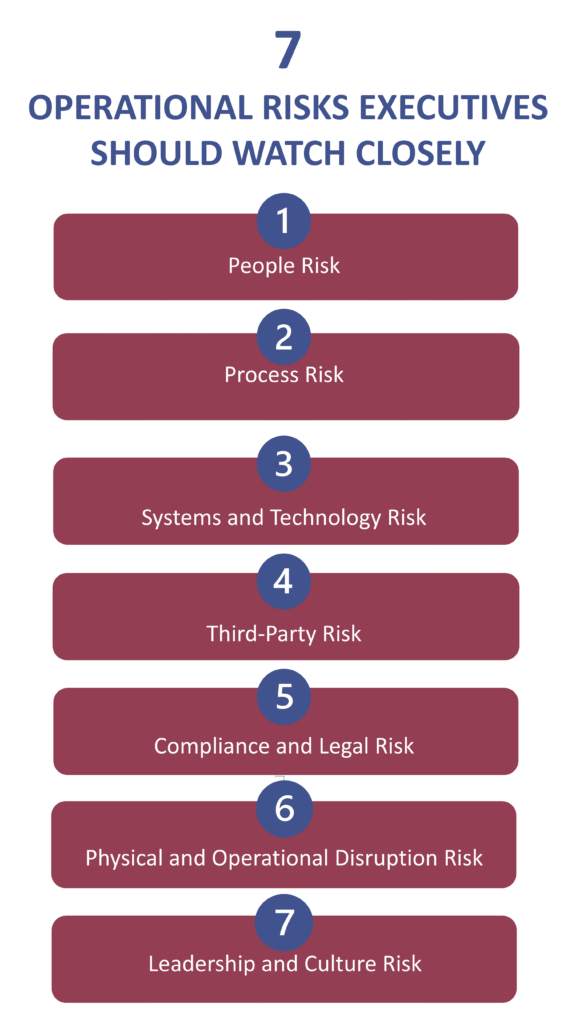
There is no universal list of the 7 operational risks, because exposure depends on industry, operating model, and risk profile. Still, most executive teams should maintain visibility on seven broad categories:
- People risk – capability gaps, fatigue, supervision failures, turnover, human error
- Process risk – poor design, workarounds, inconsistent execution, weak handoffs
- Systems and technology risk – outages, integration failures, cyber threats, bad data
- Third-party risk – contractor performance, vendor failure, weak oversight, supply disruption
- Compliance and legal risk – regulatory breaches, documentation failures, control lapses
- Physical and operational disruption risk – equipment failure, site events, logistics breakdown, business interruption
- Leadership and culture risk – poor decisions, weak escalation, normalized deviation, conflicting priorities
For organizations with high-consequence operations, leadership and culture risk deserves special attention. It often amplifies every other category and explains why known hazards remain unmanaged until a major event occurs.
Common Challenges Executives Face in Operational Risk Management
Most organizations do not struggle because they lack a framework on paper. They struggle because execution is fragmented, reactive, and disconnected from business reality.
Common executive-level challenges include:
- Risk ownership is vague across functions, business units, or sites
- Reporting emphasizes volume of activity instead of exposure and consequence
- Teams rely too heavily on lagging indicators
- Control confidence is assumed rather than tested
- Risk discussions happen after strategic decisions are made
- Material operational risks are buried under low-value compliance tasks
- Important signals do not get escalated because culture discourages challenge
- Technology tools produce data, but not clarity
- Third-party and contractor risks sit outside core governance
- Leaders underestimate how their own decisions shape exposure
Another recurring problem is misalignment between risk appetite and operational reality. An executive team may state that safety, reliability, and resilience are priorities, while local leaders experience pressure to maintain output at any cost. When incentives and decisions conflict with stated values, operational risk increases even if policy language sounds strong.
This is why effective operational risk management requires more than a control library. It requires leadership alignment, decision discipline, and a culture where concerns can move upward early enough to matter.
Risk Appetite, Risk Tolerance, and Executive Decision Making
Executives should be able to answer three basic questions: What level of operational risk are we willing to accept, where is that threshold different across activities, and how do we know when we are drifting beyond it?
Risk appetite sets the broad direction. Risk tolerance defines acceptable variation within that direction. In operational terms, this may apply to contractor exposure, staffing levels, maintenance deferral, system downtime, control failures, or serious incident potential. If these limits are not translated into operating decisions, they remain abstract governance language.
Good Safe Decision Making® initiatives test choices against consequence, not just probability. Low-frequency, high-severity risks often deserve stronger controls and closer oversight than their statistical occurrence suggests. This is especially true where a single event could cause fatality, environmental harm, major interruption, or severe reputational damage.
Key Risk Indicators Executives Should Monitor
Key risk indicators help executives move from hindsight to foresight. The right KRIs provide early warning that exposure is increasing, control effectiveness is weakening, or operating conditions are shifting.
Useful executive KRIs often include:
- Critical control failures or overdue corrective actions
- Repeat incidents, serious near misses, or escalation delays
- Contractor incident rates and oversight gaps
- Maintenance backlog on high-criticality assets
- System downtime or cyber control exceptions
- Training completion on critical tasks and decision roles
- Turnover or vacancy in safety-critical positions
- Audit findings that repeat across sites or functions
- Unplanned production disruption tied to known risk conditions
KRIs are most useful when paired with context. A dashboard alone does not tell you whether a risk is emerging because of workload, capability, leadership choices, or process design. Executives should ask what is changing, why it is changing, and what decision is needed now.
An executive safety dashboard can help leadership teams monitor these signals more clearly when it is designed to support action rather than passive reporting.
How to Build a Stronger Operational Risk Management Framework
An effective operational risk management framework should be right sized for your business, but several principles apply across industries.
Align Governance with the Way the Business Actually Operates
If risk governance ignores how work is really done, it will fail under pressure. Map accountability across operations, support functions, and third parties. Make escalation rules specific enough to act on. Clarify who decides, who advises, and who verifies.
Focus on Material Risk, Not Checklist Overload
Executives need visibility on the small number of risks that can meaningfully harm the business. Reduce noise where possible. A mature framework does not collect more data than needed. It improves signal quality and decision quality.
Integrate Leadership, Culture, and Operational Systems
Operational risk is shaped by leadership decisions and daily habits, not only documented procedures. If production pressure, weak supervision, or inconsistent standards undermine the system, formal controls will not be enough. Strong frameworks connect systems, leadership practices, and culture.
Use Technology to Improve Action, Not Only Reporting
Automation and digital tools can improve consistency, visibility, and trend detection. But they should support faster recognition of material exposure and better action at the right level. More dashboards do not equal better risk management unless they change behavior.
Build Learning Into the Framework
Incident review, serious near miss analysis, and operational learning should feed directly into leadership practice, system redesign, and resource decisions. If the organization documents lessons but does not change decisions, the same risk patterns usually return.
Operational Resilience, Safety, and Serious Incident Prevention
For many executive teams, operational risk management is inseparable from operational resilience and serious incident prevention. In high-risk environments, the cost of weak decisions is not limited to downtime or compliance findings. It can include life-altering events.
That is why executive oversight should include more than broad enterprise reporting. It should examine how leadership decisions influence exposure in the field, how culture affects escalation, and whether critical controls and other critical risks are being normalized. A resilient organization does not only recover well, it identifies and manages the decisions and conditions that make major events more likely.
This leadership-centered view is especially important when serious injury and fatality potential exists. In those settings, executives need confidence that risk management is not merely administrative. It must shape priorities, field execution, and decision quality at every level.
What are the 5 P’s of Risk Management?
The 5 P’s of risk management are presented in different ways across industries, but an executive-friendly version is people, process, plant, partners, and performance.
- People – competence, supervision, decision quality, and behavior
- Process – procedures, workflows, handoffs, and control steps
- Plant – assets, equipment, systems, and physical conditions
- Partners – contractors, vendors, suppliers, and external dependencies
- Performance – metrics, KPIs, KRIs, outcomes, and learning loops
This model is useful because it keeps executives from reducing operational risk to one function. Exposure often sits at the intersection of these five areas, especially when organizations are changing rapidly or relying heavily on contractors and complex systems.
Executive Questions that Improve Operational Risk Oversight
One of the fastest ways to improve operational risk management is to improve the questions leaders ask. Strong executive questions expose weak assumptions, surface hidden tradeoffs, and test whether the organization is learning.
- What are our highest-consequence operational risks right now?
- Where do we have more confidence than evidence?
- Which risks are increasing because of recent business changes?
- What are we not hearing soon enough from sites or frontline teams?
- Where are contractors or third parties creating hidden exposure?
- Which KRIs show drift before an incident occurs?
- How do our incentives influence operational decisions?
- What serious scenarios have we normalized because they have not happened recently?
These questions help shift operational risk management from passive review to active executive leadership.
How Krause Bell Group Supports Executive-Level Operational Risk Management
Krause Bell Group approaches operational risk through leadership, decision making, culture, and operational exposure, not through compliance language alone. That perspective matters for executives because operational risk rarely comes from one isolated failure. It emerges from the interaction between leadership decisions, systems, culture, and field conditions.
Our work in safety strategy development, leadership development, culture change, effective decision making, and critical risk management aligns directly with the risks executives are expected to govern. Approaches such as the Safe Decision Making® methodology and the Safety Loop support a more practical view of how leadership decisions and organizational conditions influence risk exposure over time.
For executive teams that want stronger oversight, better decision quality, and a clearer path from governance to operational reality, that kind of integrated approach can be more useful than a framework that measures activity without changing outcomes.
FAQ About Operational Risk Management for Executives
* Developed with the support of AI and reviewed by Krause Bell Group Editorial Team