May 11, 2026
Critical Controls For Preventing Sifs: What Works And Why
Serious Incident and Fatality events are rare but catastrophic. You prevent them by designing, selecting, and verifying a small set of critical controls that never fail when you need them. This guide gives you practical, field tested controls for high SIF potential tasks, explains how to spot potential SIFs before they hurt people, and shows the leadership habits that make critical controls reliable every day. For foundational concepts, see Serious Injury and Fatality (SIF) Prevention.
What Are SIF Exposures and Why They Deserve Special Focus
SIF stands for Serious Injuries and Fatalities. In practice, you are managing SIF exposures, not just outcomes. A SIF exposure is any task or situation with credible potential for life threatening or life-altering harm, such as an unprotected edge at height, a confined space with a toxic atmosphere, or an energized piece of equipment that can move unexpectedly.
These events are low probability but very high consequence, which means general injury metrics like recordable rates do not predict them well. The human impact is profound, and the business impact is severe, from operational disruption to legal and reputational cost. The good news is that SIF exposures are identifiable and preventable with a disciplined focus on a few critical controls that directly block the hazard path and that are verified for effectiveness before work starts.
Potential SIFs and Why They Matter
Potential SIFs are incidents, near misses, or conditions that could reasonably have resulted in a serious injury or fatality if one or two factors had been different. Treating pSIFs as learning gold accelerates prevention. When you classify and investigate pSIFs, you uncover weak or missing controls, patterns in decision making, and system gaps that will not show up in minor injury data. This shifts attention from lagging indicators to proactive risk reduction.
From Risk Assessment To Reliable Critical Controls
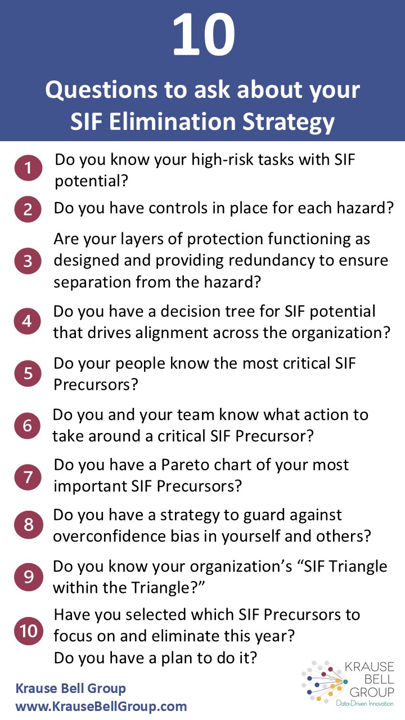
A robust risk assessment turns hazards into well-chosen controls. Start by identifying the specific hazard, the credible worst case, who could be harmed, and the exposure frequency. Evaluate existing controls and set the target risk using ALARP principles. Select controls using a hierarchy that favors elimination, substitution, and engineered barriers over administrative steps and personal protective equipment. Write the control requirement so it is observable and binary, describe how it will be verified before and during work, and define who is accountable. Close the loop with a simple Plan Do Check Act rhythm. Plan by assessing capacity and preparing procedures and equipment. Do by implementing the controls and authorizing the job only when verification passes. Check by monitoring performance and effectiveness through field checks and data review. Act by addressing weak signals, fixing systemic issues, and updating standards. For a concise overview of the building blocks, see 6 Components of SIF Prevention (Infographic). To test your governance and assurance, use the 10 Questions for Your SIF Elimination Plan.
Leadership That Makes Critical Controls Work
Critical controls are only as strong as the leadership system that sustains them. As a leader, you set clarity on what is critical, you resource those controls first, and you verify them personally. Build routines where supervisors and workers jointly confirm critical controls before authorizing work and stop the job if verification fails. Use leading indicators that show control health, such as pass rates on pre task verification or time to fix failed verifications, not just injury counts, and visualize them with Dashboards for SIF Prevention. Encourage reporting of potential SIFs and near misses without blame so you see the weak signals. Krause Bell Group’s Safety Loop reinforces this integration of leadership, culture, systems, and data, while 7 Insights into Safety Leadership and Safe Decision Making® principles help you reduce cognitive bias, handle pressure, and make sound tradeoffs when risk and productivity collide.
High SIF Potential Scenarios and Proven Critical Controls
Working At Height
Most severe fall events begin with routine tasks at edges, on ladders, or temporary platforms. Your primary aim is to prevent the fall, not just arrest it. Design work to avoid working at height by bringing tasks to ground where practical. When exposure remains, install engineered guardrails and covers with strength and toe boards at all open edges and holes, ensuring covers are secured and labeled. Specify certified anchor points and engineered lifelines that match your loads and configurations. Choose fall restraint over fall arrest whenever possible so a worker cannot reach the edge. When arrest is unavoidable, define the full system requirement including harness type, connectors, energy absorbers, swing fall considerations, clearance calculations, and rescue plan. Require 100 percent tie off at all times where arrest systems are used and define how the tie off will be maintained across transitions, including moving between ladders and platforms. Control dropped object risk by securing tools, using lanyards, and establishing exclusion zones below. Verify each shift that guardrails are intact, anchors are certified, devices are inspected, and rescue equipment is present and competent rescuers are on site. Weather is not an afterthought. High winds, precipitation, and poor lighting change the risk profile, so define your stop work thresholds and who decides. Supervisors authorize work only after a visible check of these critical items and workers confirm compatibility of connectors and lines before leaving the ground.
Confined Space Entry
Confined spaces turn deadly fast when the atmosphere or energy states change, so your controls must make the space predictably safe and keep it that way. Begin with a clear inventory and classification, so crews know which spaces require permits and which hazards are credible. Before entry, isolate the space by locking out and tagging out connected energy sources, blanking and blinding lines, and physically disconnecting or double blocking and bleeding where required. Test the atmosphere from outside at multiple levels for oxygen, flammables, and toxics with calibrated instruments and continue to test during the job at a frequency matched to the hazard. Use forced ventilation to establish and maintain safe conditions, understanding that ventilation does not replace testing. Assign a trained attendant who remains outside, maintains continuous communication with entrants, and has authority to stop work and initiate rescue. Write and practice a rescue plan that does not rely on the attendant entering the space and that ensures rescue gear is on site, inspected, and crews know how to use it. Control access with permits that specify hazards, isolation points, test results, stop work criteria, and the names and roles of everyone involved. If conditions change, evacuate, re isolate, retest, and reauthorize. For contractor entries, apply the same standard, verify competence and equipment, and coordinate roles so no one assumes someone else is doing the critical checks.
Energy Isolation and Control
Unexpected movement, release of stored energy, and contact with live electrical parts are common threads in SIF events. A strong lockout tagout program is necessary but insufficient without rigorous verification. Start with clear equipment specific procedures that identify all energy sources, including electrical, pneumatic, hydraulic, mechanical, thermal, and gravity. Before work, shut down using normal controls, isolate all sources, dissipate or restrain stored energy using blocks, pins, vents, and bleeds, then verify zero energy with test instruments and a try start where safe. Standardize lock and tag identification to the person and the task, and define shift handover requirements so locks are never removed without an in person exchange or documented transfer. Control exceptions with a formal energized work authorization that requires risk assessment, additional barriers, and senior approval. For electrical work, define approach boundaries, use tested insulating tools, arc rated PPE as a last line of defense, and ensure a qualified person leads the job. Supervisors conduct point of work checks that focus on the few critical steps most prone to failure, such as missed secondary energy sources or inadequate blocking, and they stop the job when verification does not pass. Periodic audits sample real jobs, not just paperwork, and feed learning back into procedures and training.
Mobile Equipment and Pedestrian Interface
Low speed, high mass interactions between people and machines are a leading source of SIFs in plants, yards, and mines. Your first control is separation by design. Map traffic flows so people and equipment do not share the same space, and install physical barriers and designated walkways where they must be close. Control entry with gatekeeping and define one way systems and turning radii to remove blind conflicts. At fixed points such as loading bays, dumps, and intersections, set clear zones where pedestrians cannot enter and where operators stop, communicate, and proceed only on an agreed signal. Enhance visibility with high contrast markings, lighting, and clean sight lines, and position mirrors and cameras to eliminate blind spots. Where technology is appropriate, use proximity detection or collision avoidance that triggers alarms or slows equipment, but treat these as supports to separation, not a substitute. Set rules that remove high risk behaviors such as reversing without a spotter when line of sight is blocked or using mobile phones when operating. Require seat belts and speed controls, and maintain berms and edge protection at dumps and haul roads to stop over travel. Pre use checks verify brakes, alarms, tires, and critical systems before the first move of the shift, and supervisors observe real traffic interactions to confirm rules are followed. When conditions change due to weather, congestion, or lighting, pause and reset controls before continuing work.
FAQs
* Developed with the support of AI and reviewed by Krause Bell Group Editorial Team