February 20, 2026
Partnering with Contractors for People-Centered SIF Prevention
Part 3 in a Series about Involving and Engaging Contractors in SIF Prevention
Client–contractor relationships can be tricky. People tend to agree that when it works, it has a positive impact on safety, budget, quality, deadlines, and more—but making it work is messy.
The Challenge of Owner-Contractor Relationships
There’s no single reason why owner-contractor relationships can be challenging, but they may be a result of:
- Expectations that are not understood.
- Communications that drop off when things get busy.
- Lack of clarity around ownership and responsibility.
- Mismatched or unaligned cultures.
- Complicated power dynamics.
- Changes within the teams during the project.
- Leaders who manage the work, not the relationship.
- The challenge of getting and sharing good data.
- Different priorities across different team members.
These issues aren’t just theoretical, they consistently show up in daily life.
In 2022, 885 contractors were killed on the job in the US. That equates to 16% of all worker deaths.1 Additionally, in 2024, the US construction industry reported over 167,100 injuries.2 One long-term study estimates that over a 45-year career, a construction worker has a 75% chance of suffering a disabling injury.3
This isn’t a fluke, but the way things are—and have been—for a long time. Evidence shows that better relationships between clients and contractors can help change this, which means we need to stop treating this like a soft issue—it’s a serious one.
The Path Forward: Leadership That Builds Partnership
At the core, the focus must be on keeping people safe. The strongest owner–contractor relationships start with leadership not just from the owner, but from both sides.
The best leaders don’t rely on control, they guide through trust and set examples. They show what “good” looks like—and help people figure out how to get there. They don’t rely solely on checklists, but actively listen, build credibility, and establish real connections.
Of course, PPE, procedures, and engineering controls matter, but none of those things address or fix the culture or the relationships underneath, and that’s where risk often hides.
Preventing Serious Incidents and Fatalities (SIFs) takes more than just rules, it takes leaders who believe it is their job to create safer conditions and follow through on that belief.
Leaders as Relationship Builders
The best safety leaders understand something simple but often overlooked: people don’t follow rules—they follow other people.
Influence doesn’t come from having a title, but the most effective leaders tend to do five things consistently:
- They talk about what safety really means to them.
- They walk the talk—even when it’s inconvenient.
- They listen first, then speak.
- They stay curious, even when they’ve seen it all.
- They build real relationships with the people doing the work.
These leaders don’t see safety as a number or a dashboard, but instead recognize that it is something human for which they are personally responsible.
Building Strong Client–Contractor Relationships: A Practical Guide
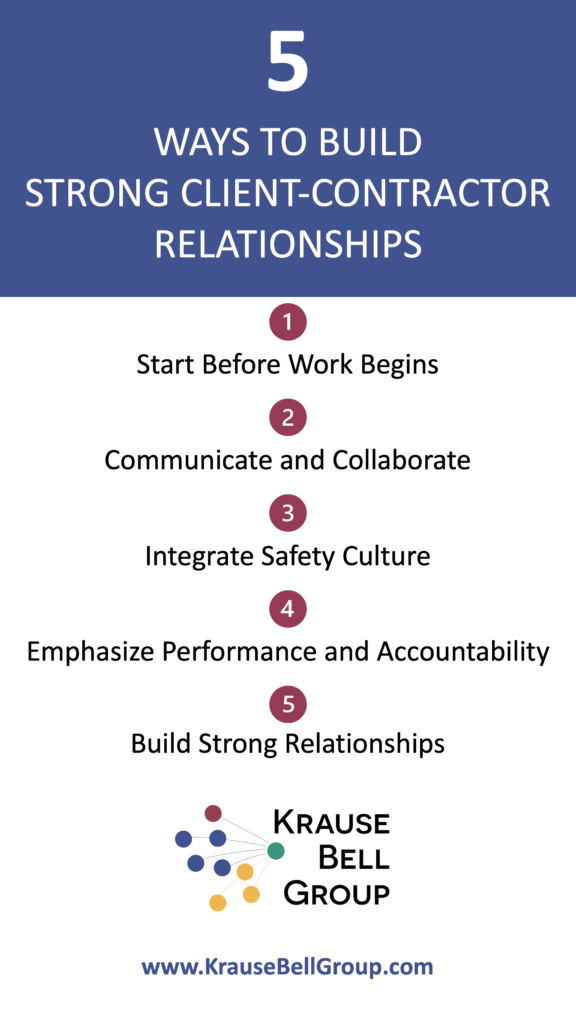
Over the years, we’ve seen that the strongest partnerships are built purposefully based on five fundamental principles:
1. Start Before Work Begins
- Clarify roles and responsibilities.
- Incorporate safety expectations into contracts and scopes of work—not just the language, but the intent.
- Choose contractors who don’t just check the boxes, but share your safety values.
- Take time with onboarding—explain how things really work on your site.
Why it matters: If you don’t set the tone early, you’ll spend the rest of the project playing catch-up, exposing the team to risk in the process.
2. Communicate and Collaborate
- Make time for regular check-ins—even when things get busy.
- Create space for honest, two-way conversations (and act on them).
- Don’t hold onto information—share what matters, when it matters.
- Bring contractors into the planning early whenever you can.
Why it matters: Surprises create risk. Work becomes safer the more people work together to achieve a shared goal.
3. Integrate Safety Culture
- Include contractors in safety strategies, initiatives, training, and audits.
- Eliminate two-tier safety systems. Standards should be the same for employees and contractors.
- Emphasize a shared commitment to the prevention of SIFs and continuous reduction of exposure to injuries.
- Recognize and reward safe behavior and positive contributions.
Why it matters: Partnership comes to life through inclusivity.
4. Emphasize Performance and Accountability
- Monitor performance using shared safety, quality, and delivery KPIs.
- Provide timely, constructive feedback.
- Apply expectations consistently across all team members and contractors.
- Address issues promptly.
- Communicate clearly, leveraging data and facts.
Why it matters: Clarity, fairness, and follow-through breed success.
5. Build Strong Relationships
- Don’t treat contractors like they are interchangeable—people remember how you treat them.
- Make space for contractor knowledge; they often see things you miss.
- Keep looking for ways to solve problems together, even when the project ends.
- Talk about culture early and check to ensure it is showing up in how people work.
Why it matters: Trust isn’t built in one big moment—it is determined by how you show up over time.
Why Strong Client–Contractor Relationships Make a Difference
Following these principles doesn’t just help the bottom line, but keeps people alive.
Whether you’re working with a short-term vendor or a major contractor, the relationship matters. If there is no trust, collaboration, and shared understanding of how safety works day-to-day, people get hurt.
Relationships can’t be viewed as something “nice to have.” They’re not just part of the work, but shape how work actually gets done, and whether people stay safe doing it.
To get better outcomes, you must build better partnerships. It’s that simple—and that hard. Not perfect ones. Just real ones.
Conclusion: The Importance of Partnering for People
Titles don’t make people listen—people do. We’ve seen that safety increases when leaders earn trust, stay grounded, and connect with the people doing the work.
We help leaders build the kind of influence that makes safety real because safety is about people, not just deliverables or timelines. Learn more about partnering with contractors in these additional articles or contact us for a consultation.
- Death on the Job: The Toll of Neglect. A National and State-by-State Profile of Worker Safety and Health in the United States. April 2024. https://aflcio.org/sites/default/files/2024-04/2411%20DOTJ%202024%20DIG%20NB%20REV.pdf ↩︎
- Bureau of Labor Statistics: The Number and Rate of Nonfatal Work Injuries and Illnesses in Private Industries, 2024. https://www.bls.gov/charts/injuries-and-illnesses/number-and-rate-of-nonfatal-work-injuries-and-illnesses-by-industry.htm ↩︎
- American Public Health Association: Nearly All Construction Workers Will Experience One Or More Work-Related Injuries Or Illnesses Over a Lifetime Plus a Greater Risk of Premature Death. October 2011. https://www.newswise.com/articles/nearly-all-construction-workers-will-experience-one-or-more-work-related-injuries-or-illnesses-over-a-lifetime-plus-a-greater-risk-of-premature-death ↩︎