November 26, 2026
Psychological Safety: The Missing Link in SIF Prevention?
When people hear the term psychological safety, they sometimes assume it means creating a comfortable workplace where people agree with one another, avoid conflict, and try to be nice.
That misses the point.
Psychological safety is a belief that one will not be punished or humiliated for speaking up with ideas, questions, concerns, or mistakes11. Specifically in safety-critical environments, that ability to speak up is much more than a workplace culture issue. It can determine whether an organization learns about its exposure to risk before—or after—something serious happens.
The central question is simple: Do people in your organization tell you what you need to know about risk?
Can I Require Accountability and Still Achieve Psychological Safety?
One of the most important misconceptions about psychological safety is that it means making people comfortable.
It does not.
Amy Edmondson’s framework pairs psychological safety with accountability and high performance standards. High psychological safety without sufficient accountability can create a “comfort zone”; combining psychological safety with high standards supports learning and performance. For safety leaders, that distinction is particularly important122.
The goal is to have both: high standards and high psychological safety.
That combination creates an environment where people are expected to perform while also being able to challenge, question, admit uncertainty, and learn. For safety leaders, this distinction is particularly important. We don’t want people to feel comfortable with unsafe performance. We want them to feel comfortable enough to talk openly about it.
Why Do Good People Stay Silent?
Speaking up involves interpersonal risk.
- Ask a question everyone else appears to know the answer to, and you risk looking ignorant.
- Admit a mistake, and you may appear incompetent.
- Challenge an established way of working, and you might be seen as negative or disruptive.
- Intervening when a colleague takes a shortcut can be harder still.
Employees quickly and silently evaluate whether saying something is worth the potential consequence – and act on that decision.
Organizations can unintentionally reinforce silence. An employee raises a concern and is dismissed. Someone proposes an idea and colleagues make fun of it because “we tried that years ago.” A hazard is reported repeatedly, but nothing happens.
Eventually, people learn which concerns are welcome, which mistakes can be safely discussed, and which subjects are better left alone. When employees repeatedly provide feedback through surveys but see no response or action, even participation itself can begin to decline.
This is why psychological safety isn’t created by telling people, “My door is always open.” It is created by what happens after someone walks through it.
The Connection Between Psychological Safety and SIF Prevention
This becomes particularly important in Serious Injury and Fatality (SIF) prevention. Leaders make decisions and demonstrate behaviors that influence systems, context, and culture. Those conditions, in turn, influence people’s exposure to risk.
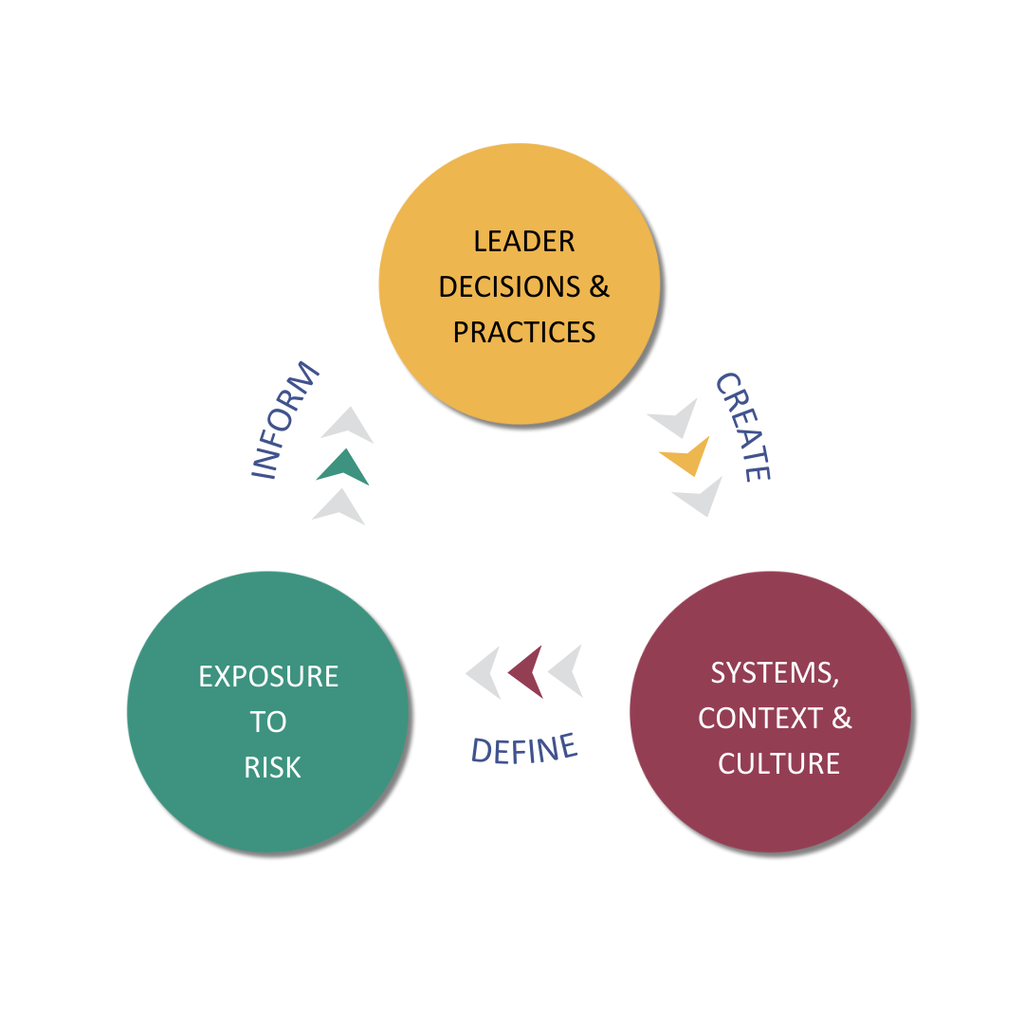
The Krause Bell Group Safety Loop evaluates each of these factors, illustrating how safety functions within an organization.
To improve, leaders need to understand how work is actually being performed. They need to know where procedures are difficult to follow, where trade-offs are being made, where conditions differ from what was planned, and where people are encountering exposure that may not be visible from the conference room.
That information has to flow upward. Psychological safety helps make that flow possible.
Consider a near miss involving a Life-Saving Rule. The employee involved may be the only person who knows it occurred. The organization needs that information because understanding why the deviation occurred could expose a weakness in a system, work process, or operating condition.
What happens if reporting the near miss automatically leads to punishment because a rule was breached? The organization may have reinforced the rule, but it may also have taught employees not to report the next near miss.
This is a dilemma leaders need to manage. Accountability matters. So does organizational learning. The objective is not to eliminate consequences, but to create conditions where people will provide the information the organization needs to understand and reduce exposure.
Leaders Create the Conditions for Candor
Psychological safety is a team characteristic, but leadership behavior has a disproportionate influence on whether it develops. One deceptively simple example is how leaders ask for input.
Imagine a leader who needs to make a difficult decision. The team gathers to discuss the options, and the leader begins by explaining what they think should happen.
Then the leader asks: “What does everyone else think?”
Technically, the leader has invited participation. In reality, they have already influenced the conversation.
A better approach is to reverse the order: ask others first and speak last. Ask the more junior members of the team for their perspective. Deliberately bring quieter people into the conversation rather than allowing the most vocal participant to determine its direction.
And when people do speak, pay close attention to your reaction.
When someone offers a different view, avoid the urge to respond with, “Yes, but…” This response suppresses valuable contributions almost instantly.
Instead, pause. Listen. Ask another question. Give yourself time to understand what the person is telling you before defending your own position.
Small leadership behaviors like these accumulate. Over time, they teach a team whether candor is genuinely valued or merely requested.
Four Things Leaders Can Do Differently
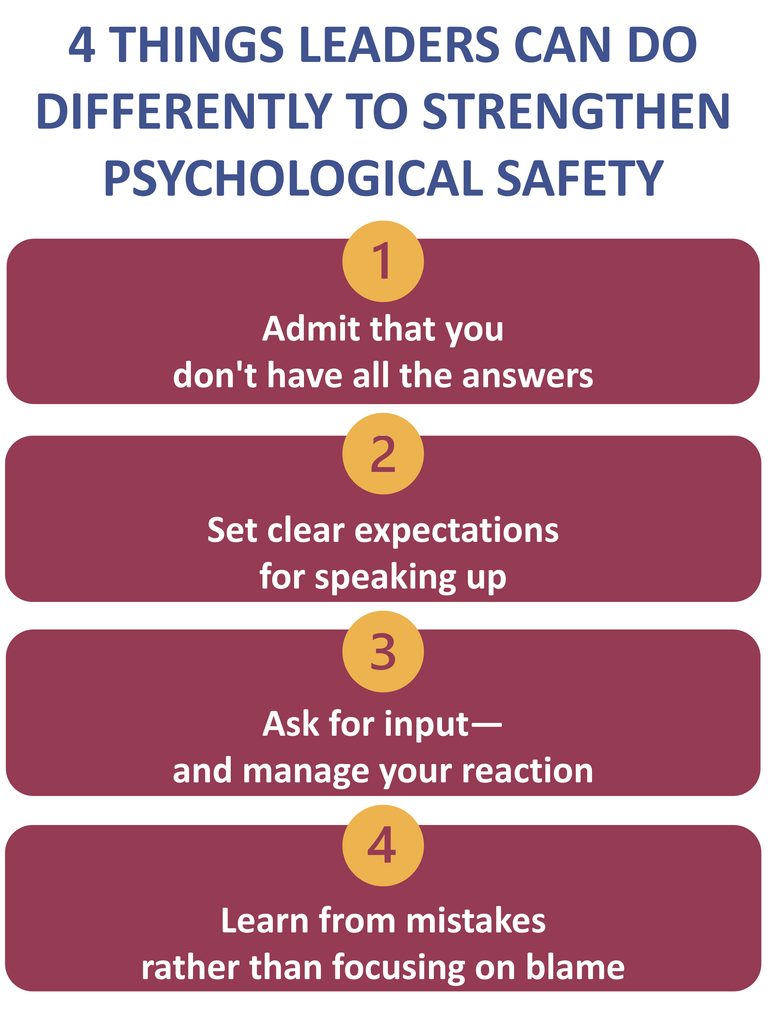
There are four practical behaviors leaders can use to strengthen psychological safety:
- Admit that you don’t have all the answers. Competence does not require pretending to know everything. When leaders acknowledge uncertainty and their own mistakes, they demonstrate that doing so is acceptable for others as well.
- Set clear expectations for speaking up. Don’t assume employees know you want dissenting views. Tell people that you expect them to raise concerns, share ideas, and discuss mistakes. Just as importantly, establish expectations around how to respond when someone does.
- Ask for input—and manage your reaction. Asking for input is only half of the equation. What happens next determines whether the employee will offer it again.
- Learn from mistakes rather than focusing on blame. Instead of beginning with “Who caused this?”, ask questions that help identify what combination of systems, context, culture, and decisions made the outcome more likely.
None of these practices means abandoning accountability. They mean using accountability in a way that also enables learning.
The Real Test of Psychological Safety
Ultimately, psychological safety is not demonstrated by what an organization says about speaking up. It is demonstrated by what happens when someone actually does.
- What happens when an employee reports a mistake?
- What happens when a supervisor challenges a decision?
- What happens when someone questions a procedure, reports a near miss, or says that the planned work cannot be performed safely under current conditions?
Those moments teach the organization far more than a poster, policy, or slogan ever could.
For leaders focused on preventing serious injuries and fatalities, that makes psychological safety particularly important. The objective isn’t simply to create an environment where people feel heard. It’s to create an organization where critical information about exposure can move to the people who can act on it—and where leaders use that information to learn, improve systems, and prevent the next serious event.
- https://learn.hms.harvard.edu/insights/all-insights/psychological-safety-and-accountability-secret-sauce-health-professions-education ↩︎
- https://www.talkabouttalk.com/amy-edmondson-175/ ↩︎