June 1, 2026
Safety Culture Assessment: How to Measure and Improve What Matters
A strong safety culture does not happen by accident. If you want fewer serious injuries and fatalities, better reporting, and more reliable execution, you need a clear, data-driven view of how people think, act, and make tradeoffs around risk. That is exactly what a safety culture assessment delivers.
What is a Safety Culture Assessment?
A safety culture assessment is a structured evaluation of how safety is valued and practiced in your organization. It examines three dimensions that shape outcomes: psychological factors (beliefs, perceptions, trust), behavioral factors (everyday actions, speaking up, reporting), and situational factors (leadership practices, systems, resources). The goal is to identify strengths and barriers to safe, reliable work, benchmark performance, and target improvements that reduce exposure to serious injury and fatality risk. Unlike a one-time audit, it blends quantitative and qualitative evidence so you can prioritize where to act with confidence.
Why it Matters
Culture is a leading indicator of performance. Organizations that measure and strengthen safety culture see clearer hazard recognition, earlier escalation of weak signals, higher-quality learning from events, and fewer high-consequence incidents. The benefits extend beyond safety: engagement improves, productivity rises, and costs tied to rework, downtime, and claims fall. Effective assessments also focus leaders on the behaviors that matter most for SIF prevention, such as listening to learn, inviting dialogue, and aligning systems with stated values. In short, you get a practical roadmap to shift mindsets and habits that drive safer results. Board members can steer assessments by starting with the four questions they should ask about safety culture.
How to Run a Safety Culture Assessment
Proven Steps
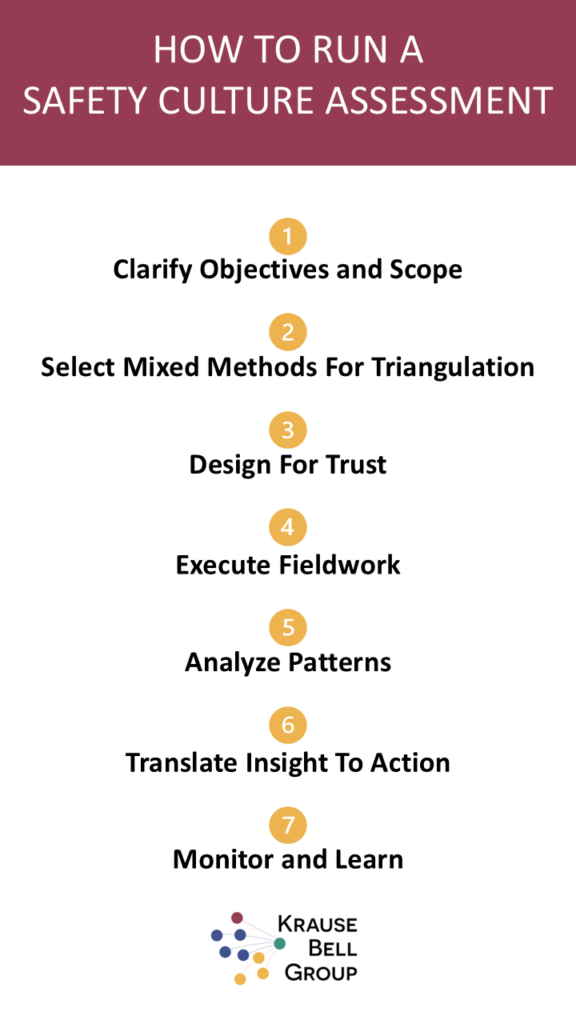
- Clarify objectives and scope – for example, SIF prevention, reporting quality, contractor management, or a safety culture risk assessment across multiple sites.
- Select mixed methods for triangulation: a safety culture assessment questionnaire, confidential interviews and focus groups, targeted observations, and review of incident and exposure data.
- Design for trust: clear communications, voluntary participation, anonymity, and representative sampling across roles, shifts, and contractors.
- Execute fieldwork: run the survey, facilitate dialogues, and observe real work to capture how procedures meet reality.
- Analyze patterns: segment by site, function, leadership level, and contractor status to find systemic strengths and friction points.
- Translate insight to action: prioritize a small set of high leverage moves, assign owners, set measures, and timebox experiments.
- Monitor and learn: track leading and lagging indicators, share progress, and adjust actions as conditions evolve.
Tools and Questionnaires That Help
Teams often combine a safety culture assessment tool with leadership and system diagnostics. When designing your questionnaire, align items with these safety culture survey criteria. If you are building or refining your instrument, see our framework for developing an organizational culture assessment tool for safety and the Organizational Culture Assessment Tool for Efficiency and Effectiveness for adaptable methods. A more direct way is to use the Krause Bell Group Culture Survey. To focus leadership impact, use the Safety Leadership 360 Tool to measure specific leader behaviors that prevent SIFs. To align culture, systems, and data for ongoing improvement, apply the Safety Loop Model. Together, these tools turn insights into repeatable performance gains.
FAQs
Next steps for leaders
If you are ready to pinpoint the few behaviors and system shifts that will reduce serious harm, explore the Culture Survey, the Safety Leadership 360 Tool and the Safety Loop Model. For deeper skill building, join our research-based webinars and the 7 Insights into Safety Leadership Masterclass.
* Developed with the support of AI and reviewed by Krause Bell Group Editorial Team