February 20, 2026
Working with Contractors for Sustainable SIF Prevention
Part 4 in a Series About Involving and Engaging Contractors in SIF Prevention
Every organization striving to eliminate Serious Incidents and Fatalities (SIFs) in a sustainable manner needs a continuous improvement process that is self-sustaining. Serious incidents and fatalities are too important to rely on an individual champion, an initiative that can change, or a priority that falls out of favor.
If your organization uses outside contractors, there are additional factors that must be considered in order to protect all workers involved in your business.
6 Steps to Sustainable SIF Reduction
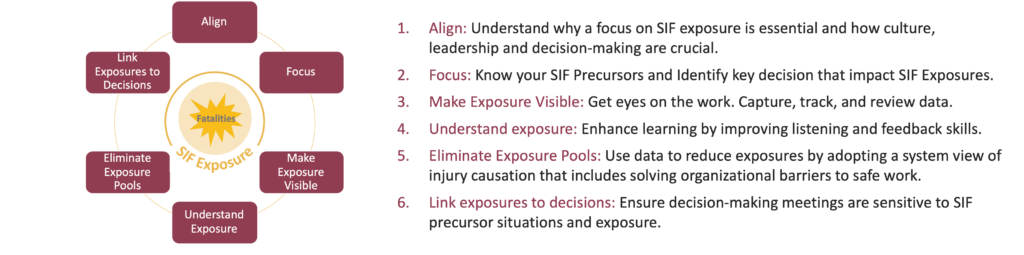
Krause Bell Group’s SIF Reduction Mechanism , illustrated below, is a methodology that brings together all the elements needed for sustained SIF elimination.
Putting Sustainable SIF Elimination into Action for Contractors
When we think about how to leverage the SIF Reduction Mechanism for contractors, we must start by acknowledging some broad truths:
- Many organizations rely on contractors to execute high-risk work due to their experience and expertise. This work often has high SIF potential.
- Contractors range from small “mom-and-pop” shops to large global firms.
- All parties are concerned about crossing boundaries between contractor and employee status.
- Training and culture are likely to be different in each organization.
What can you do as a leader if contractors on your site are performing work with serious injury or fatality potential and are exposed to SIF precursors? (Remember: SIF precursors occur in the presence of high-risk work, amplifiers, and missing, inadequate, or broken controls.)

Real-World Example
Here is an example of applying the SIF Reduction Mechanism in a contractor environment:
In this scenario, alignment starts with contractor selection, which should include early agreement on safety expectations from all parties, particularly regarding controlling SIF precursors. Once a contractor is selected, performance expectations should be documented, including scope, timeline, budget, and safety.
How to Apply the SIF Reduction Mechanism
1. Align
The Align step reinforces the shared goal of eliminating SIF potential for all workers. Collaboration between client-operator and contractor—and within the contractor organization—is essential. This is true regardless of the contractor’s size or whether the work is a one-off engagement or ongoing partnership. Without strong alignment, things get messy, and SIF reduction is put at risk.
2. Focus
The Focus step includes accurately identifying SIF precursors and is foundational to gaining control over SIF potential. This means evaluating high-risk work by both the client and contractor. Do they adequately control the hazard? Are they functioning as designed? Are they being used correctly? Are all users knowledgeable and competent? Do both clients and contractors know what to do if controls are missing, broken, or inadequate? Is there a mutual understanding of risk amplifiers such as weather, missing crew members, or scope changes? Most importantly, does everyone involved know what to do when amplifiers are present?
3. Make Exposure Visible
Even with today’s technology, nothing beats “getting eyes on the work” to Make Exposure Visible when the goal is SIF reduction. Developing a deep understanding of controls is a tricky, but critical component of understanding exposure. All the usual challenges apply: Are people willing to speak up and raise concerns? Add contractors into the mix, and these challenges multiply. Will speaking up jeopardize a job? A contract? Slow down work? Navigating these dynamics takes skill, yet accurate understanding of control status is essential. Leaders must understand which controls are working and which are not, ask tough questions, and address gaps to ensure humans are being separated from hazards.
4. Understand Exposure
In contractor SIF events, it’s common to hear client-operators say, “We don’t know the risks,” or “The contractors are the experts,” or “We verify what we can, but it’s not our area of expertise.” Both client-operators and contractors must Understand the Exposure. If it happens on their site, the client is ultimately responsible, even if they lack expertise in the specific work. This underscores the importance of partnership to protect everyone from harm. A strong work partnership also has additional benefits such as improved performance, less drama, better cost control, and a stronger work culture.
5. Eliminate Exposure Pools
With these insights comes a solid grasp of exposure. From a systems perspective, every organization—contractor or client—has an injury-producing system. If you look at past events, a pattern will emerge. This is your injury or SIF “run rate.” It shows how often your system produces injury events. The goal in SIF reduction is to understand this system and implement specific interventions to eliminate SIF precursors. That’s what it means to Eliminate Exposure Pools. Client and contractor collaboration is key—neither can do it alone. A nice side benefit: this often fosters strong, high-performing partnerships.
6. Link Exposures to Decisions
The final element, Link Exposures to Decisions, the loop is closed and drives continuous improvement. Applying Safe Decision Making® principles means making choices with the awareness of SIF precursor implications. These may be small (e.g., PPE changes) or large (e.g., removing a precursor). Conversely, decisions may introduce or worsen SIF precursors.
Conclusion: Making SIF Elimination Sustainable
For a SIF reduction system to be sustainable and not reliant on a single champion, organizations must build Safe Decision Making® capability where SIF risk is considered as routinely as financials or other key metrics. Ask any successful business leader—contractor or client—what they consider when making financial decisions, and they’ll give you detailed answers. SIF reduction requires similar fluency. The SIF Reduction Mechanism systematizes this effort, giving leaders—client and contractor alike—the levers they need to create safe, successful, and profitable work environments.
Learn more about partnering with contractors in these additional articles or contact us for a consultation.