October 15, 2026
You Have Stop-Work Authority…Why Don’t People Use It?
Ask employees in almost any organization whether they have the authority to stop work (Stop-Work Authority, Pause Work, All-Stop, or something similar) when something is unsafe, and the answer is usually yes. Ask these same employees for a show of hands of those who have used this authority, and few are raised. Organizations often suggest that not only does the person have the authority, but they also have the responsibility.
Ask supervisors and managers these same questions, and you will find similar answers.
So, employees, supervisors, and managers all recognize that everyone has the authority to stop a job for safety, but few ever exercise that authority. The key question is why this is the case and what can organizations do to truly enable stop-work authority for their teams?
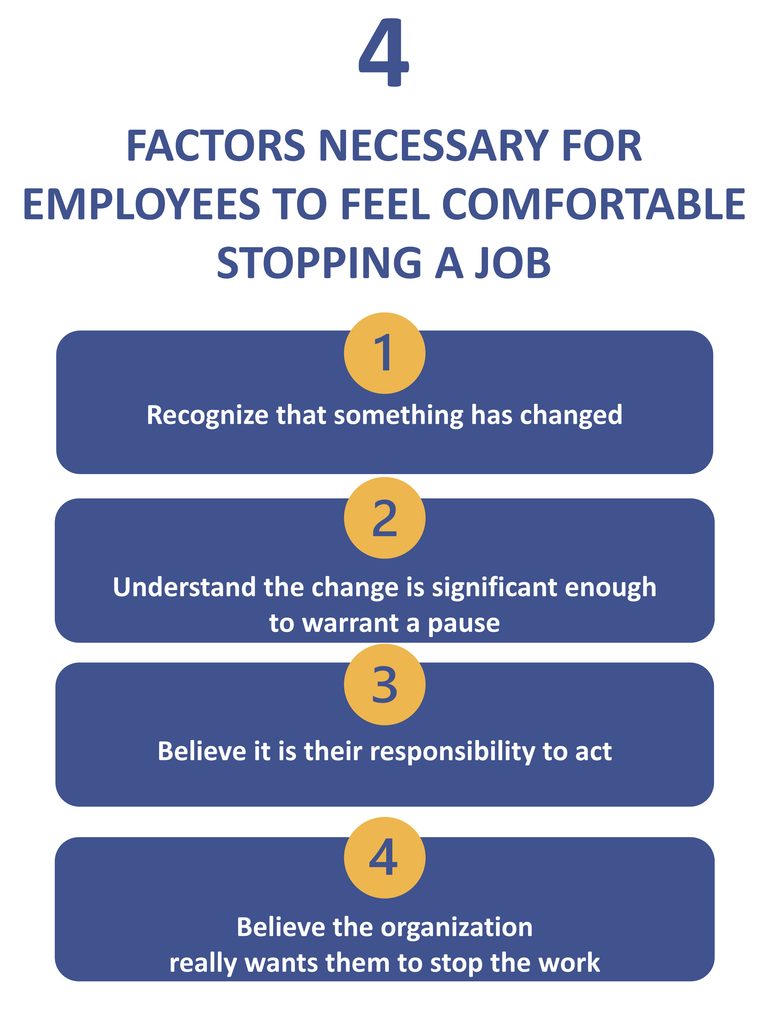
For an employee to stop a job, several things must go right. They must:
- Recognize that something has changed.
- Understand the change is significant enough to warrant a pause.
- Believe it is their responsibility to act.
- Believe the organization (their team, their supervisors, and management) really wants them to stop the work.
This is a complex set of perceptual, psychological, and social factors that work to keep a person from pausing. Failure at any one of these points can result in work continuing when it should not.
Did Something Change? Recognizing Hazards
As a job moves forward, any number of things can happen that change the level of exposure:
- The weather worsens.
- Equipment does not operate as expected.
- A new person joins the crew. The original work plan will no longer work.
- A contractor enters the area.
- A leader comes to the area and talks about the need to get the job finished.
- A different tool or piece of equipment is needed but is not readily available.
These changes do not necessarily mean the work is unsafe, but they do mean it is time to pause. Then judgment is applied to determine whether a meaningful change has occurred.
People performing work do not observe their surroundings as detached observers. They are trying to get something done. Their attention is naturally directed toward their task. That focus is helpful in getting the task completed, but it can result in people becoming so task-focused that they fail to recognize a change in exposure. In fact, the more cognitively taxing the task, the more sense-blind people can be to changing hazards in their surrounding environment.
For example, two years ago, a worker was fixing a complex set of rail switching equipment and did not hear the oncoming train on the adjacent track. Thankfully, no injury occurred, but it was a shocking example of attention blindness for that engineer.
Some hazards are also easier to recognize than others. A missing guard may be obvious. Stored energy, changing line-of-fire exposure, or a subtle change in how work is being performed may require imagination and anticipation rather than simply seeing a physical hazard. Telling employees to “stop if it’s unsafe” is not enough. We need to teach people what to look for.
Organizations typically have information that identifies the changes and situations that have led to serious exposures and incidents. This information can often be found in audit reports, incident reports, and observations. This information needs to be extracted and leveraged to teach employees about these trigger points.
Is this Change Enough to Stop the Job? Applying Judgement
Imagine an employee notices something has changed. Now another decision has begun: Is this important enough to stop the work? This is where stop-work authority becomes surprisingly complicated. The employee has now moved from recognizing the change to judging its relative importance.
The employee begins to think about the context: We have already done most of the job; it is okay to proceed. We have done it this way before and nothing bad has happened. Surely if I see this, the leader does too, and they are not stopping work. What if what I am concerned about turns out to be nothing?
Human decision-making can work against us here. Sunk cost can make us reluctant to abandon a work path after investing significant time and effort. Confirmation bias can cause us to pay more attention to information supporting the existing plan and discount information suggesting the plan should change.
For example, in one incident we are familiar with, a maintenance mechanic was tasked with replacing overhead light bulbs across a large manufacturing plant. He was near the end. As he came to one of the last light bulbs, he set up his ladder and climbed to the top, however, this light was close to an operating fan. The normal protocol was to climb back down and turn the fan off before resuming work, but with both sunk cost and confirmation bias at play, it was judged that he could still do it without contacting the fan. Unfortunately, he was wrong and ended with a serious injury.
Then there are risk amplifiers. Risk amplifiers are factors that increase the level of risk and increase the probability that a control will go unutilized, or a mistake will be made. Risk amplifiers can include the job being behind schedule, a customer anxiously waiting, a leader who has come to the job site and shared that for every hour the equipment is idle, it costs thousands of dollars, or the crew has been working long hours and just wants to finish.
These amplifiers do not directly tell someone to ignore safety, but they can change the way a person interprets risk. They make it more likely that people will accept an exposure they would not normally accept.
This is one reason organizations should not leave every pause-work decision entirely to individual judgment.
Is this Really my Job? What if I am Wrong?
This may be one of the biggest barriers. An employee sees something but is not sure. The person in charge has 20 years of experience. The rest of the crew seems comfortable. Nobody else is saying anything. So, the employee stays quiet. Never underestimate the power of potential embarrassment as a motivator for individual behavior. Additionally, diffusion of responsibility makes this even easier. If six people see the same thing, each can assume one of the other five will say something.
Then there is the social risk. What will everyone think if I stop the job and it turns out there wasn’t a problem?
This is where leaders have enormous influence.
Suppose an employee pauses a job. The crew looks at the situation and determines everything is adequately controlled. What happens next determines whether that employee, and everyone watching, pauses work again.
If the leader rolls their eyes and says, “See? There was nothing wrong,” the organization has just provided a powerful lesson: Do not stop the work unless you are certain.
Compare that with: “Good catch. Thanks for speaking up. We checked it out, and it appears the controls are adequate. Is everyone convinced it is okay to continue?” Same pause. Completely different lesson.
The goal should not be to have employees make perfect stop-work decisions. The goal should be to create an environment in which people are comfortable pausing before they know whether stopping was necessary. The smart leader knows they are making an investment. Maybe this singular pause work turned out to be nothing, but they are playing the long game, knowing that it will be the 14th pause work or the 31st pause work where they will catch something that could have been devastating. If they do not treat all pauses with the same level of positivity and value, they will never get to the 14th or the 31st pause.
What Leaders and Organizations can do to Enable Stop-Work Authority
The forces aligned to keep stop-work authority from being exercised are significant, but leaders and organizations can act. Specifically, there are four significant steps leaders can take:
- Pre-define pause decisions
- Role-model pausing work
- Recognize the behavior, not just the outcome
- Address the pressures that tell people to keep going
Pre-Define Pause Decisions
If there are certain changes or conditions that repeatedly precede serious incidents, do not ask employees to decide whether they are important enough to stop, but make the decision in advance.
|
UNIVERSAL PAUSE-WORK TRIGGERS |
Pause. Huddle up. Reassess the exposure. Decide whether the work can continue safely. |
Organizations should identify a short list of mandatory pause-work triggers. The exact triggers should reflect the organization’s work and its SIF exposures. Below is a set of universal triggers that can provide a starting point.
The important point is that certain situations should automatically result in a pause. This removes some of the burden from the individual. Instead of asking, “Is this bad enough for me to stop the job?” the employee only must recognize: “This is one of our pause-work triggers.”
If everything is adequately controlled after the pause, go back to work. A pause does not have to become a major event.
Leaders Need to Role-Model: Make Pausing Work a Responsibility of the Person-In-Charge’s Job
One problem with stop-work programs is that they put the emphasis on the workers. We would argue that the person in charge has greater responsibility. Part of leading work should be actively looking for opportunities to pause it.
That means periodically pausing and reflecting on the work:
- Have conditions changed?
- Is this job going as planned?
- Do we have the right tools and equipment to complete the job as planned?
- Do I feel rushed?
- Are the critical controls still in place?
- Am I uncomfortable about continuing?
Ideally, the leader will not only self-reflect but will also engage the crew in answering the self-reflection questions.
When the person in charge shares with the crew that they will occasionally pause to assess the state of the work, this creates a safety climate where it is understood that safety is the top priority. When the leader role models this action, it results in others self-reflecting, which will lead to more discussions about whether it is safe to continue.
Additionally, for intact work teams, beginning with the requirement that everyone exercise pause work authority at least once per week or month helps to make pausing a common part of the work routine and enables even junior members of the team to feel comfortable raising issues.
This Changes Pause Work from an Emergency Action to Being a Normal Part of Managing Work.
Recognize the Behavior, Not Just the Outcome
Organizations frequently recognize safety outcomes. We should spend more time recognizing safety decisions.
When someone pauses work, the person in charge should acknowledge it. Not just when the employee discovers a major hazard. Especially when they do not.
Why? Because we are not trying to achieve an outcome of 100% accuracy in the need to stop work. Instead, we are trying to build the behavior of recognizing change and voicing when a pause is needed.
Recognition needs to occur at multiple levels. Supervisors should reinforce it in the field. Managers and directors should ask about examples during site visits. Senior leaders should periodically highlight pause-work decisions, including ones that identified an exposure and others where the exposure was adequately controlled.
Organizations should consider tracking how often work is paused. Not because more stops automatically mean better safety, and certainly not to create a quota. The metric is useful because zero can be informative.
If one location never reports a pause in work month after month, the conclusion should not necessarily be that the crew is exceptionally safe. The better response may be: “Tell me why.” Are they not experiencing changes? Are they not recognizing them? Or have they learned that stopping work is not really encouraged? Has the location had any incidents where pause work should have been utilized?
Address the Pressures that Tell People to Keep Going
Finally, organizations need to look beyond the employees. Imagine telling someone: “If anything changes, stop the work.” Then imagine the environment surrounding that communication: “We have to finish this today.” “The customer is already upset.” “We’re behind schedule.” “That equipment is costing us $10,000 an hour.” “Just get it done.” Which message wins?
Organizations often look at an incident and ask why an employee did not exercise stop-work authority. We should also ask: What made continuing seem like a reasonable decision at the time? That question leads us toward the risk amplifiers surrounding the work. Production pressure, schedule pressure, fatigue, staffing, sunk cost, customer expectations, and leadership reactions can all influence whether someone pauses. Leaders need to be attuned to these factors and deal with them directly.
If schedule pressure is predictable, plan for it. If certain phases of a job consistently produce time pressure, identify them during planning. If incentives unintentionally reward speed at the expense of caution, change them. And when leaders communicate urgency, they should also make clear what should happen when urgency begins influencing risk acceptance.
Telling employees they have stop-work authority while maintaining conditions that discourage its use is not empowerment. It is contradiction.
From Stop-Work Authority to a Pause-Work Environment
Perhaps the biggest mistake is thinking of pause work as an authority. Authority is necessary, but it is not sufficient.
A successful pause-work environment requires several things to happen:
- People need to recognize changes in exposure.
- They need clear triggers that tell them when pausing is expected.
- The person in charge needs to actively look for opportunities to pause.
- Employees need to know they are expected to act even when they are not certain.
- Leaders need to positively reinforce the decision to pause.
- Organizations need to identify and reduce the risk amplifiers that quietly encourage people to keep going.
When these things happen, pausing work begins to lose its stigma. It stops meaning, “Something is wrong.” Instead, it means, “Something changed. Let’s make sure our plan still works.”
That is a vastly different way of thinking about stop-work authority.
That is the real objective. We do not want employees to ask themselves whether a situation is dangerous enough to justify stopping the work. We want employees and leaders to become comfortable saying: “Something has changed. Let’s pause.”
Search for articles
Share this post: