July 20, 2026
Leadership Behaviors That Shape Safety Culture
Safety culture is shaped less by what leaders say in presentations and more by what they do when priorities compete. If you want people to report hazards, stop unsafe work, follow critical controls, and make better decisions under pressure, leadership behavior has to make those actions normal. Policies matter, but daily signals from executives, managers, and frontline supervisors are what tell people how safety really works here.
The strongest safety cultures are built through visible leadership, consistent follow-through, active listening, fair accountability, and decisions that show safety is a value in practice, not just in language. When leaders model these behaviors consistently, you create trust, improve reporting, strengthen learning, and reduce the conditions that allow serious injuries and fatalities to develop.
How does Leadership Influence Safety Culture?
Leadership influences safety culture by setting the standard for what gets attention, what gets tolerated, and what gets rewarded. Employees watch leaders closely, especially when production pressure, deadlines, staffing issues, or operational disruptions create tension. In those moments, people learn whether safety is truly part of decision making or whether it gives way when work becomes difficult.
That influence shows up in simple but powerful ways. If leaders attend safety meetings, ask meaningful questions, wear required PPE, respond quickly to concerns, and treat near-misses as learning opportunities, people see that safety matters. If leaders ignore weak signals, rush risk reviews, or only discuss safety after incidents, the message is just as clear.
A strong safety culture grows when leadership behavior supports three outcomes: trust, clarity, and consistency. Trust makes people willing to speak up. Clarity helps teams understand what good looks like. Consistency turns safe behavior into the normal way work gets done.
The Leadership Behaviors that Shape Safety Culture Most
Not every leadership behavior has the same impact. The most effective ones are the behaviors that employees can see, experience, and test in real work. These are the actions that shape how people think about risk, responsibility, and accountability.
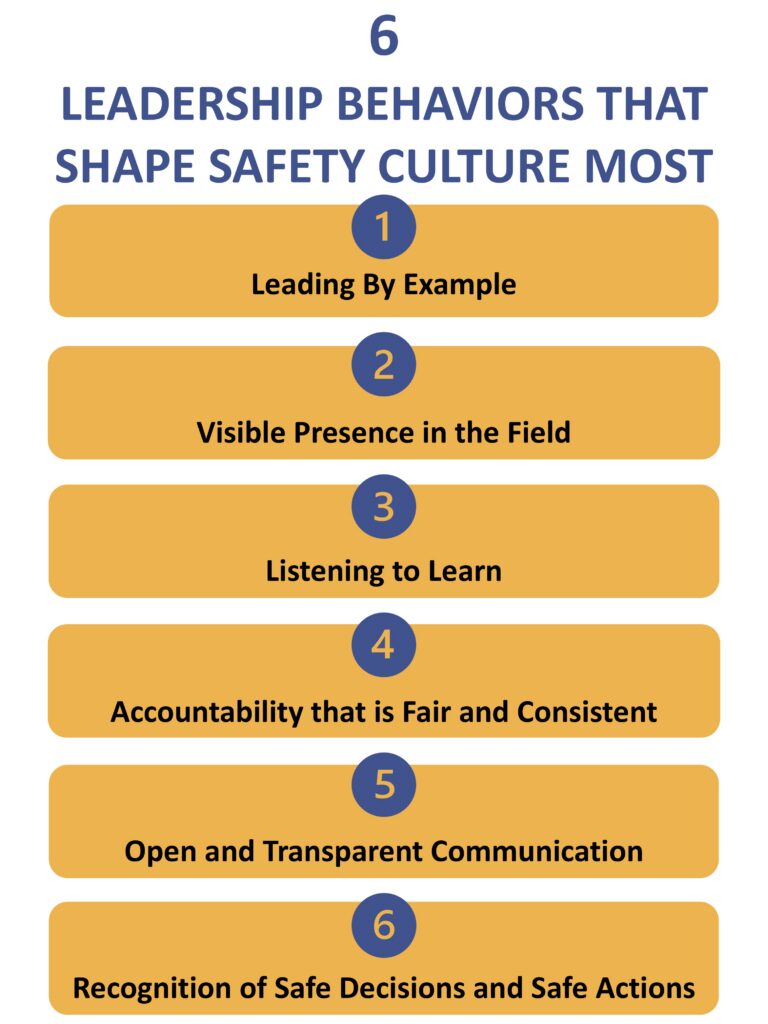
1. Leading By Example
Leading by example remains one of the clearest answers to the question, “Which behavior supports a safety culture?” If leaders bypass procedures, ignore exposure controls, or take shortcuts, others will assume those choices are acceptable. If leaders follow standards visibly and consistently, they strengthen credibility.
This includes wearing PPE correctly, following permit and lockout requirements, participating in pre-job planning, and stopping to verify risk controls before work begins. The point is not symbolic participation. The point is showing that no one is above the system.
2. Visible Presence in the Field
Visible safety leadership matters because culture is shaped where work happens. Employees do not build trust from posters or slogans. They build trust when leaders show up in the field, ask thoughtful questions, and engage with the realities of the job.
Effective field presence means more than doing a walkthrough to look for violations. It means asking what could go wrong, what conditions have changed, what recovery actions are being used, and where crews feel pressure. Leaders who are present in this way improve hazard recognition and show that operational learning matters.
3. Listening to Learn
One of the most important leadership behaviors that shape safety culture is listening without defensiveness. Frontline employees often see drift, workarounds, conflicting priorities, and weak signals long before an incident occurs. If leaders do not create space for those observations, the organization loses critical information.
Listening to learn means asking open questions, staying curious, and following up visibly. When workers raise concerns and nothing happens, reporting drops fast. When leaders act on concerns, explain decisions, and close the loop, reporting quality improves.
4. Accountability that is Fair and Consistent
Accountability supports safety culture when it is consistent, clear, and tied to learning as well as expectations. It fails when it becomes selective, reactive, or fear based. Employees need to know that leaders will address unsafe choices, but they also need to trust that the organization will look at context, system factors, and decision environments.
Strong accountability includes clear expectations, coaching, reinforcement of good practice, and timely intervention when standards are not met. It also includes examining whether the system made failure more likely. This balance strengthens both responsibility and trust.
5. Open and Transparent Communication
Safety culture improves when leaders talk about risk openly and regularly, not only after injuries or audits. Open communication helps teams understand changing conditions, recent learning, critical controls, and the reasons behind decisions.
Transparency also matters after events. When leaders share what was learned from a near-miss, what actions will be taken, and what remains under review, they strengthen credibility. Silence creates rumor. Clear communication creates alignment.
6. Recognition of Safe Decisions and Safe Actions
People repeat what leaders notice. If all recognition is tied to output, speed, or short-term operational wins, those signals shape behavior. If leaders recognize hazard identification, stop-work decisions, quality pre-job planning, and strong peer intervention, they reinforce the behaviors that support a healthy safety culture.
Recognition works best when it is specific. Instead of generic praise, call out what was done well and why it mattered. That teaches the rest of the organization what good safety performance looks like.
What are the 5 Key Leadership Behaviors in Safety?
Many organizations ask this question because they need a practical way to focus leadership development. While models vary, five core behaviors consistently shape safety culture across industries:
- Visible commitment in day-to-day work
- Active listening to frontline concerns
- Consistent modeling of expected standards
- Fair accountability and follow-through
- Frequent communication about risk, learning, and priorities
These five behaviors work because they influence what employees experience directly. They are also measurable. That matters if you want to improve safety leadership rather than simply describe it. Krause Bell Group approaches this through research-based leadership development and tools such as Safety Leadership 360, which helps organizations measure how leadership behaviors are perceived across dimensions such as Vision for Safety, Credibility, Value for Safety, Influencing Others, Listening to Learn, and Accountability.
What the 3 C’s of Safety Culture Look Like in Leadership Practice
Different organizations define the 3 C’s of safety culture in different ways, but a practical leadership version is commitment, communication, and consistency. These three ideas map closely to the behaviors that employees notice most.
Commitment
Commitment is shown in choices, not slogans. Leaders demonstrate commitment when they allocate time for risk reviews, support training, prioritize critical controls, and stay engaged even when there is no recent incident drawing attention to safety.
Communication
Communication means making safety a year-round conversation. It includes pre-job discussions, after-action reviews, near-miss learning, operational reviews, and one-on-one coaching. The goal is to keep risk visible and discuss it in plain language.
Consistency
Consistency is what turns leadership intent into culture. If safety matters on Monday but disappears by Friday when production pressure rises, people learn quickly. Consistent behavior from leaders is what creates confidence in the system.
Why Visible Safety Leadership Changes Employee Behavior
Visible safety leadership has a disproportionate effect because it reduces the gap between stated values and lived experience. When leaders are physically present, engaged, and informed, employees are more likely to believe that reporting concerns is worth the effort and that safe decisions will be supported.
Visible leadership also improves the quality of conversations. Instead of talking only about lagging indicators such as recordables or claims, leaders can discuss exposures, work complexity, changing conditions, and the effectiveness of controls. That creates a more mature safety conversation and helps teams manage risk before events occur.
In high-risk work, visibility also supports SIF reduction and prevention. Serious events rarely come from a single failure. They grow from weak signals, normalization, pressure, and small deviations that go unaddressed. Leaders who stay close to the work are better positioned to detect those patterns early.
How Leaders Shape Psychological Safety and Reporting Culture
If you want a stronger reporting culture, leadership behavior is the starting point. Employees speak up when they believe three things are true: they will be heard, they will be treated fairly, and raising a concern will lead to meaningful action. Without those conditions, hazards stay hidden and learning slows down.
Psychological safety does not mean lowering standards. It means creating an environment where people can ask questions, admit uncertainty, report mistakes, and surface risk without fear of embarrassment or retaliation. That is essential in complex work where changing conditions and incomplete information are normal.
Leaders shape this by how they respond. If the first response to bad news is blame, people stop bringing bad news. If the first response is curiosity, clarification, and action, people keep speaking up. One of the clearest ways to strengthen safety culture is to make sure leaders know how to respond constructively when concerns, deviations, and near-misses are reported.
How to Train Leaders Differently from the Workforce
Safety leadership development should not mirror frontline safety training. Leaders need more than rule awareness. They need skills in decision making, risk framing, communication, coaching, prioritization, and accountability. They also need to understand how their own actions shape culture, often more than formal safety systems do. For readers looking for a foundation on what safety leadership means, that context helps explain why leader-specific development matters.
For example, a supervisor may understand the technical safety requirements of a task but still need help with how to run a stronger pre-job conversation, how to intervene effectively under time pressure, or how to respond when production goals and exposure controls appear to conflict. Senior leaders face a different challenge: they need to understand how priorities, resource allocation, and messaging influence the organization far beyond their direct presence.
This is where assessment and targeted development can add real value. Krause Bell Group supports organizations through consulting, culture and leadership assessments, and leadership development programs designed to improve safety culture through better leadership behavior and safer decision making.
How Leaders Make Safety Part of Everyday Decisions
Safety culture is not shaped only during formal safety activities. It is shaped in scheduling decisions, staffing choices, contractor oversight, budget conversations, production meetings, and responses to operational disruptions. In other words, leadership behavior influences safety culture most when decisions are being made under real constraints.
Leaders strengthen culture when they bring risk into those discussions early. That means asking questions like:
- What exposures increase if we compress the timeline?
- Do crews have the capability and conditions to execute this safely?
- Which critical controls must not be compromised?
- What weak signals are we seeing from the field?
- What unintended pressure might this decision create?
This kind of disciplined thinking is central to effective decision making and helps prevent the drift that often precedes serious events.
Common Leadership Behaviors that Weaken Safety Culture
Understanding what helps is only half the picture. Leaders also shape safety culture through behaviors that undermine trust and consistency. These behaviors often appear small in the moment but become powerful over time.
- Talking about safety as a value but rewarding speed over control quality
- Showing up only after incidents, audits, or regulatory attention
- Ignoring frontline concerns or failing to close the feedback loop
- Applying accountability unevenly across teams or roles
- Allowing exceptions for high performers or senior personnel
- Using safety communication that is generic, infrequent, or disconnected from actual work
- Focusing only on lagging indicators while missing exposure signals
These patterns erode credibility. Once credibility weakens, even well-designed safety programs lose influence.
How to Measure Leadership Behaviors that Shape Safety Culture
Many organizations measure incidents, audits, training completion, and corrective actions. Fewer measure the leadership behaviors that shape those outcomes. If you want to improve culture, you need visibility into leadership behavior itself.
Useful measures can include both qualitative and quantitative inputs:
- Frequency and quality of field engagements
- Participation in safety meetings and learning reviews
- Response time to employee concerns and hazard reports
- Evidence of follow-through on agreed actions
- Employee perceptions of trust, credibility, and listening
- Use of safety in operational and strategic decision making
- Consistency of accountability across teams
A strong approach combines observable behavior with feedback from different levels of the organization. That is one reason 360-based assessment can be valuable. Tools like Safety Leadership 360 help organizations understand how leaders are actually experienced by peers, direct reports, and senior leaders, which gives a more accurate picture than self-assessment alone.
Practical Actions You Can Take This Quarter
If you want to improve safety culture quickly, focus on a short list of high-value leadership behaviors and execute them consistently. Start with actions that employees will notice right away.
- Increase leader time in the field with better-quality conversations
- Ask about exposures and changing conditions before discussing output
- Close the loop on reported concerns within a defined timeframe
- Recognize specific safe decisions publicly and promptly
- Review whether accountability is consistent across roles and sites
- Include safety risk in operational planning and decision reviews
- Assess leadership behavior, not just compliance data
The goal is not to launch more initiatives. It is to strengthen the small number of behaviors that most influence trust, reporting, and decision quality.
When Culture Change Needs More Than a Generic Safety Program
Many organizations already have procedures, audits, observations, and training in place. Yet safety culture remains uneven because the core issue is not always system design alone. Often it is the interaction between leadership, culture, systems, and data. That is why culture change requires more than a generic program rollout. The idea that leadership creates culture is especially relevant here.
Krause Bell Group works with organizations that want to improve safety culture through leadership, assessment, and decision quality. Our work includes the Safety Loop, Safety Leadership 360, Culture Survey, the Safe Decision Making®Model, and leadership development programs that help companies strengthen leadership behavior, reduce exposure, and support SIF prevention in complex operating environments.
FAQs About Leadership Behaviors that Shape Safety Culture
* Developed with the support of AI and reviewed by Krause Bell Group Editorial Team