June 18, 2026
Don’t Let Safety Become a Suggestion Rather than a System
The degradation of a safety system can have many causes. During two Root Cause Analyses we participated in, we saw the same outcome at the supervisor level, from two dramatically different causes. The first was the misapplication of Human and Organizational Performance (HOP) principles, and the second was a senior leader with an extremely high agreeableness personality trait who sent confusing and contradictory messages about the expectations for adherence to standards. These dynamics created environments where safety at the supervisory level became a suggestion, rather than a system.
Investigating Two Incidents: What a Root Cause Analysis Revealed
Recently, we were invited to participate in Root Cause Analysis (RCA) sessions at two different companies. In each case, an employee was injured due to a failure to utilize critical controls. One employee was severely burned, and the other fell from a 12-foot ladder. We will not get into the details of the incidents; both employees are expected to recover.
- In both instances, the supervisors admitted early in the investigation that they did perform safety-critical tasks.
- In both organizations, the job planning process requires a supervisor-led job briefing and a supervisor verification that critical controls are in place before starting a high-risk task.
During both RCAs, the injured employees also quickly stated they had made a mistake and knew they were to follow the procedure.
As we probed further about leaders and employees “falling on one’s sword,” we were told it is a common occurrence. As we asked about potential consequences for a leader who does not fulfill their safety responsibilities, we were told there were none. A review of the most recent RCA findings verified that leadership abdication of their safety responsibility was a common system failure, and what we observed was not an unusual occurrence.
The reasons why these organizations got to this state are different, but the impact on both organizations was similar.
Organization 1: A HOP-Centric Approach
In the first organization, how HOP has been implemented and understood is problematic.
Human and Organizational Performance (HOP) was originally introduced to improve safety by shifting focus away from blame and toward learning and system improvement.
HOP Principles
At its core, HOP is grounded in these principles:
- Human error is normal
- Systems influence behavior
- Blame does not fix problems
- Leaders are responsible for the system
When applied correctly, HOP should strengthen leadership accountability. However, in some organizations, HOP has been misunderstood or misapplied in ways that unintentionally weaken accountability.
How HOP Has Been Misinterpreted
- “Blame-Free” Becomes “Accountability-Free”
Creating a culture focused on understanding system cause, versus blaming people, is challenging. Leadership must walk a fine line to avoid the common misinterpretation of equating the removal of blame with the removal of accountability.
Additionally, action items from investigations lean heavily on administrative controls and new PPE requirements. Administrative controls like retraining, reminding, and reinforcing are the least blaming of actions, so they become the go-to actions. - Overcorrection from Punitive Cultures
It is not unusual for organizations to adopt HOP after operating under strict, punishment-driven systems. To improve, they swing too far from over-discipline to no discipline. - Misuse of “Systems Drive Behavior.”
While it is true that systems influence actions, this principle is often distorted into “It’s always the system, never the individual,” even when leaders knowingly ignore a safety procedure or tolerate risk. - HOP Language Used as a Shield
Leaders use HOP language to avoid accountability, focusing only on learning while avoiding consequences.
What True HOP Accountability Looks Like
Leaders must be accountable for:
- The design and maintenance of the systems
- The working conditions
- The level of exposure
- Aligning their actions with expectations
All Individuals must be held accountable for:
- Reckless or willful violations
- Repeated disregard for critical controls
- Decisions that knowingly increase risk
Organization 2: The Impact of Leadership Personality
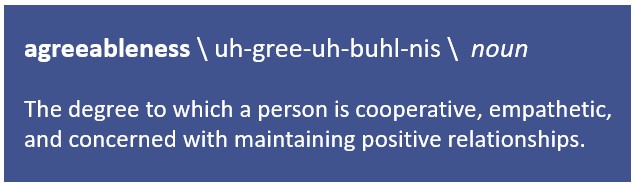
In the second organization, the primary reason for the lack of accountability is that a senior operations leader had not learned to manage their personality. This leader scored extremely high on the agreeableness scale.
The Strengths and Weaknesses of Leaders with High Agreeableness Scores
A high agreeableness score has its upsides and downsides.
| Strengths – The leader is highly trusted – They demonstrate empathy and support – They are collaborative – They can diffuse conflict | Risks – Avoids tough conversations – Conflict avoidance – Difficulty making hard calls – Over-accommodation -Can be perceived as lacking toughness -Vulnerable to being leveraged |
When a highly agreeable leader does not manage their personality, the organization experiences declining accountability as expectations become unclear or inconsistently enforced. Inferior performance is tolerated longer than it should be, and high performers get frustrated by a lack of consequences, so standards erode over time. Additionally, there is Artificial Harmony, where people avoid raising concerns because the leader avoids conflict, problems are discussed privately, not resolved openly, and a “Nice culture” replaces an “Honest culture.”
The Impact of an Agreeable Leader Personality
What people experienced was that this leader avoided difficult conversations. People below the leader “learned” two things:
- First, there will be no negative consequences for failure. If a person admits to making a mistake or if they push back when failure is discussed, the leader will fold.
- Second, holding someone to account is futile because the leader will delay or avoid deciding to support their direct report’s decision.
In this organization, people have learned to admit they did something wrong. Once the person admits to making a mistake, this senior is satisfied and allows the investigation to be prematurely closed. This premature closing of the incident allows the leader to avoid the uncomfortable conversation of why.
When it becomes acceptable for leaders to see that following policies and procedures is optional, a catastrophic outcome is inevitable.
This lack of leadership accountability did not happen overnight; it was a slow process. Unfortunately, it often takes a catastrophic event to uncover this degradation.
The Role of Leadership in Safety Systems
Both examples demonstrate the point that safety systems are not built on procedures alone. Safety systems are successful when leaders consistently and credibly enforce and model. When leaders live up to their safety responsibilities:
- Standards are reinforced
- Expectations are clear
- Trust is built
But when leaders bypass or ignore those same procedures:
- Safety becomes optional
- Mixed messages spread quickly
- The system begins to unravel
Employees are highly perceptive. They learn by watching what leaders do. When leaders fail to live up to their requirements, ignore permitting, or prioritize production over safety, employees understand that safety rules apply when it is convenient.
What Happens When Leaders Are Not Held Accountable

When leadership accountability breaks down, the consequences ripple across the organization in predictable ways:
- Safety Culture Deteriorates
The organization shifts from a culture of discipline to one of convenience. Employees begin to question whether safety is truly a priority or just a talking point. - Shortcuts Become the Norm
Unchecked behavior becomes normalized. What was once considered a deviation becomes “how we do things here.” - Credibility Is Lost
Leaders who enforce rules they do not follow lose influence. Employees disengage, and enforcement becomes inconsistent at best. - Accountability Systems Collapse
Supervisors hesitate to correct behavior. Investigations become biased or superficial. Standards exist on paper but not in practice. - Incidents Increase
Near misses, injuries, and serious events become more likely, not because people suddenly become careless, but because the system stopped functioning.
What Can Organizations Do?
Both organizations will be challenged to adjust their cultures regarding accountability. The drift away from front line leaders understanding that they are expected to adhere to standards happened slowly and became part of the culture. The first step in change for Organization 1 is for senior leadership to have a frank and honest discussion about the situation they find themselves in. Next, they will need to develop a strategy to correct the misinterpretation of what HOP means, regarding accountability.
For Organization 2, the Senior Leader will need help to make a transition in style. This will require a frank and honest conversation about the situation. The trick for this leader will be to avoid an extreme reaction and to remain consistent over the long term. They will want to fall back into their comfort zone.
Successful systems require:
- Words that are aligned with actions
- Clear expectations
- Consistency in the application of accountability
- The ability to separate learning from consequences
- Leaders who set high standard
Safety systems do not fail because procedures are missing. They fail because those procedures are not consistently followed or enforced, especially by leadership. If leaders are not held accountable, safety is no longer a system – it is a suggestion.