September 22, 2026
SIF Exposure vs Probability
If you want to prevent Serious Injuries and Fatalities (SIFs), you need to separate two ideas that are often blended together: exposure and probability.
In SIF prevention, exposure is about whether people are placed in contact with a high-consequence hazard. Probability is about how likely it is that the exposure will turn into an actual serious injury or fatality.
The distinction matters because many organizations underestimate SIF risk when they focus too much on incident outcomes, TRIR, or past injury frequency. A task can be low frequency and still carry extreme consequence. That is why effective SIF prevention starts by making SIF exposure visible, then reducing the factors that increase the chance that exposure becomes uncontrolled.
Why does the Difference Between SIF Exposure and Probability Matter?
Many safety systems are better at counting injuries than identifying high-consequence exposure. That creates a blind spot. You may have a site with a low recordable rate and still have repeated exposure to working at height, mobile equipment, energized systems, suspended loads, trenching, or line-of-fire hazards. In those cases, low injury numbers do not mean low SIF risk.
Understanding SIF exposure vs probability helps you ask better questions:
- Are people being exposed to hazards that could realistically cause a serious injury or fatality?
- What critical controls are supposed to keep that exposure from escalating?
- How likely is failure under current conditions?
- What amplifiers are increasing risk right now?
This shift moves your attention away from whether someone happened to get hurt and toward whether the work system is allowing a credible path to catastrophic harm.
What does SIF Exposure Mean?
SIF exposure means a worker is exposed to a hazard with the credible potential to cause a serious injury or fatality. The key word is credible. Not every unsafe act or minor deviation has SIF potential. The exposure must involve a realistic pathway to life-altering injury or death, usually through high energy, toxic release, loss of containment, collapse, crush, impact, electrocution, or fall potential.
Common examples of SIF exposure include:
- Working at height without effective fall protection
- Entering a confined space without verified atmospheric and rescue controls
- Working on energized electrical systems
- Operating around mobile equipment and blind spots
- Standing under suspended loads
- Excavation or trench work without proper protection
- Exposure to stored energy, pressure, or unexpected startup
- Potential fire, explosion, or chemical release scenarios
In practical terms, SIF exposure is about contact with consequence. If the hazard is uncontrolled and the outcome could realistically be fatal or life-changing, you are dealing with exposure that deserves elevated attention.
What Probability Means in a SIF Context
Probability is the likelihood that a SIF exposure will actually result in serious harm. It is not the same as exposure itself. Two people may be exposed to the same hazard, but the probability of harm may differ depending on the quality of controls, positioning, timing, environmental conditions, competence, and operational pressure.
Probability in SIF prevention should not be treated as a vague guess. It should be informed by real conditions such as:
- Whether critical controls are present
- Whether those controls are effective and verified
- Task complexity and variability
- Worker position relative to the hazard
- Duration and frequency of exposure
- Simultaneous operations and changing work conditions
- Fatigue, time pressure, or production pressure
- Supervisor oversight and stop-work capability
This is why SIF events are often described as low probability, high consequence. The consequence can be extreme even if the event does not happen often. That does not make the risk small. It means your controls must be strong enough to prevent rare but catastrophic failure.
SIF Exposure vs. Probability: The Core Difference
The simplest way to think about it is this: exposure asks whether a person is in the zone of serious harm, while probability asks how likely it is that the harm pathway will be realized.
| Concept | Main Question | Focus | Example |
| SIF Exposure | Is the person exposed to a high-consequence hazard? | Presence of credible serious harm potential | Worker is inside an unprotected trench |
| Probability | How likely is it that the exposure becomes a SIF event? | Likelihood of control failure or escalation | Soil instability, no shoring, weather changes, and weak supervision increase collapse likelihood |
This distinction is useful because teams often debate probability before they have clearly identified exposure. That sequence is backward. If a credible SIF exposure exists, the first priority is to recognize it, control it, and verify the controls. Probability helps you understand urgency and vulnerability, but it should not be used to explain away exposure.
Why Do Organizations Often Get Probability Wrong?
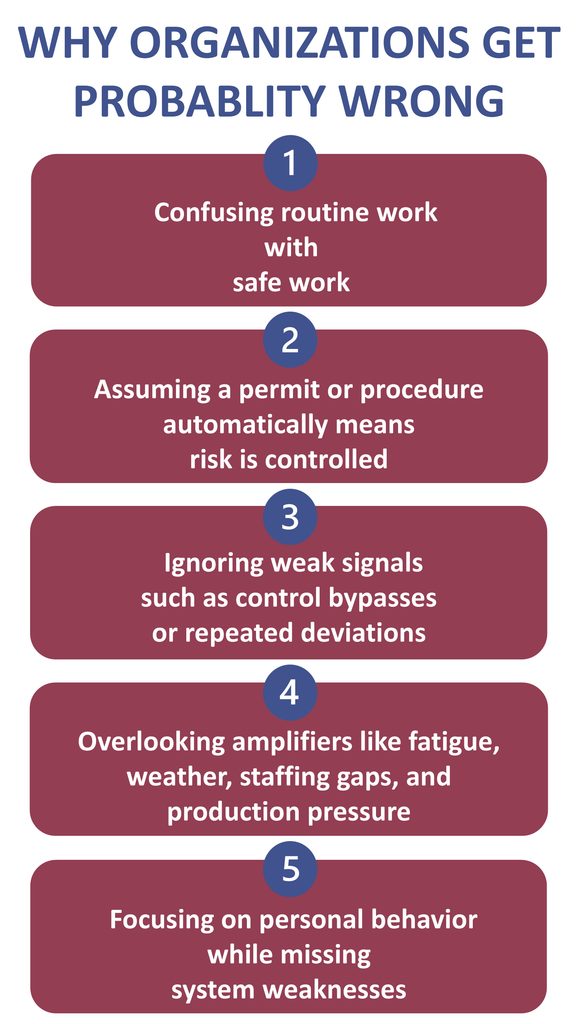
A common failure in SIF prevention is underestimating probability because nothing bad happened last time. Teams normalize exposure when hazardous work has been repeated without severe outcomes. That creates false confidence. In reality, previous survival may reflect luck more than control quality.
Organizations also misjudge probability when they rely too heavily on injury history. Recordable data is backward-looking and outcome based. It often misses high-risk exposures, near misses, and degraded safeguards that did not yet produce a serious injury. That is one reason a low TRIR is not a reliable indicator of low SIF exposure.
Other reasons probability is misjudged include:
- Confusing routine work with safe work
- Assuming a permit or procedure automatically means risk is controlled
- Ignoring weak signals such as control bypasses or repeated deviations
- Overlooking amplifiers like fatigue, weather, staffing gaps, and production pressure
- Focusing on personal behavior while missing system weaknesses
The result is a dangerous pattern: teams see exposure, but discount probability because the failure has not happened yet.
How Do Exposure and Probability Work Together in Real SIF Prevention?
Exposure and probability should be evaluated together, but not collapsed into one idea. Exposure tells you where the catastrophic potential sits. Probability tells you how vulnerable that exposure is under current operating conditions. The strongest SIF prevention systems use both.
A practical sequence looks like this:
- Identify whether the task or event involved a credible SIF exposure.
- Define the hazard energy or mechanism of serious harm.
- Identify the critical controls that must work to prevent escalation.
- Assess whether those controls were present, effective, and verified.
- Evaluate amplifiers that increase the probability of failure.
- Decide whether the work should be stopped, redesigned, or more tightly controlled.
This approach is far more useful than asking only whether an injury occurred. It also aligns with leadership-driven SIF prevention, where decision quality, work design, and critical controls matter more than lagging injury counts alone.
Examples of SIF Exposure vs. Probability In Practice
Working at Height
If a worker is on an elevated surface without adequate fall protection, the SIF exposure is obvious because a fall can produce fatal or life-altering injury. Probability increases if anchor points are unverified, surfaces are slippery, weather is changing, the worker is rushing, or rescue planning is weak.
Mobile Equipment Interaction
A pedestrian moving through an active equipment zone has SIF exposure because of crush and struck-by potential. Probability rises when sight lines are poor, traffic plans are unclear, spotters are absent, reversing alarms are unreliable, or operators are under time pressure.
Electrical Work
Exposure exists when a worker can contact energized parts or arc flash energy. Probability becomes higher when isolation is incomplete, testing is skipped, boundaries are unclear, or contractors are working with inconsistent supervision.
Confined Space Entry
The exposure comes from atmospheric hazards, engulfment, entrapment, or energy sources. Probability increases when gas testing is not continuous, rescue arrangements are weak, roles are unclear, or work conditions change after entry begins.
Suspended Loads
Anyone under or near a suspended load is exposed to a potential fatal event. Probability rises if rigging is not inspected, load paths are uncontrolled, communication is poor, weather is unstable, or there is pressure to continue the lift.
How to Assess SIF Exposure Without Overclassifying Everything
One challenge in SIF work is avoiding two extremes: missing real SIF exposure, or labelling almost every incident as SIF potential. The answer is not more debate. It is clearer criteria.
Use these filters when assessing whether an event or condition represents SIF exposure:
- Is there a credible pathway to fatal or life-altering harm?
- Is a high-energy source, collapse hazard, toxic hazard, or similar severe mechanism present?
- Would slightly different circumstances reasonably have led to a serious injury or fatality?
- Are critical controls absent, ineffective, or not followed?
If the answer is yes, the exposure likely deserves SIF attention. If the only plausible outcome is minor harm with no credible escalation path, it may not be SIF-related. This distinction matters because strong classification improves learning, trending, and allocation of leadership attention.
The Role of Critical Controls in Reducing Probability
Once exposure is identified, the next question is not whether people should simply be more careful. It is which critical controls must work every time. Critical controls are the few safeguards that prevent a high-consequence hazard from becoming a serious injury or fatality.
Examples of critical controls may include:
- Verified isolation and lockout for hazardous energy
- Engineered fall protection and anchor integrity
- Barricading and exclusion zones around line-of-fire hazards
- Shoring, shielding, or sloping for trench stability
- Atmospheric testing and rescue readiness for confined spaces
- Traffic separation plans for mobile equipment
These controls reduce probability by breaking the chain between exposure and consequence. But a control only helps if it is designed correctly, understood by the workforce, and verified in the field. Paper controls without operational discipline do not meaningfully reduce probability.
Amplifiers that Raise SIF Probability
Even when exposure is known and controls exist, probability can rise because of amplifiers. Amplifiers do not always create the hazard, but they make failure more likely or reduce the chance of recovery.
Common SIF amplifiers include:
- Time pressure and schedule recovery
- Fatigue and extended work hours
- Weather changes
- Shift handoff gaps
- Inexperienced crews or unfamiliar contractors
- Simultaneous operations
- Weak supervision
- Poor pre-job planning
- Unclear stop-work authority
- Normalization of deviance
From a leadership perspective, these factors are essential because they explain why the same job can have very different risk levels from one day to the next. This is also why effective SIF prevention requires more than static procedures. It requires ongoing attention to decision quality and work conditions.
Why Low Injury Rates Do Not Prove Low SIF Exposure
This is one of the most important ideas in SIF prevention. Injury frequency and SIF exposure are not the same thing. A company can have few recordables and still tolerate repeated high-consequence exposure. It can also have a temporary increase in minor injuries without a corresponding increase in fatal risk.
That is why organizations that are serious about SIF prevention track more than outcome metrics. They look at:
- Actual Serious Injuries and Fatalities (SIFs)
- Recordables with SIF potential
- Near misses with SIF potential
- Observed SIF exposures in the field
- Critical control verification
- Precursor trends and learning signals
This broader view improves visibility into the conditions that produce catastrophic risk, not just the injuries that happened to be recorded.
A practical decision model for leaders and EHS teams
If you are trying to improve how your organization handles SIF exposure vs probability, use a simple field-based model:
- Identify the high-consequence hazard.
- Ask whether a person is exposed to that hazard now or during the task.
- Define the critical controls that must prevent escalation.
- Verify whether those controls are truly in place and functioning.
- Check for amplifiers that increase the probability of failure.
- Decide whether the work can continue, needs redesign, or must stop.
- Capture the learning so future exposure is easier to detect and control.
This model supports better operational decisions because it focuses attention where SIF risk actually lives: in exposure, control integrity, and degraded conditions.
What Good Looks like in a Mature SIF Prevention System
Mature organizations do not wait for a fatality or life-altering injury to prove they had a problem. They build systems that identify SIF exposure early, evaluate probability realistically, and strengthen critical controls before the work proceeds.
In practice, that means:
- Clear definitions for SIF, SIF potential (SIFp), and exposure
- Consistent coding of incidents, near misses, and observations
- Leadership reviews focused on high-consequence risk, not only lagging metrics
- Strong field verification of critical controls
- Attention to amplifiers and decision-making context
- Learning loops that improve planning, supervision, and work design
This is the space where the SIF reduction mechanism becomes a management system, not just a reporting exercise.
FAQ About SIF Exposure vs. Probability
* Developed with the support of AI and reviewed by Krause Bell Group Editorial Team