September 16, 2026
Pillars of Safety Culture
A strong safety culture is not built through procedures alone. It grows when leadership, systems, communication, learning, and daily decisions all reinforce safe performance. If you are looking for the pillars of safety culture, the most useful answer is not a fixed buzzword list, but the core elements that consistently shape how people think, act, and speak about risk at work.
Across high-risk industries, the organizations that improve safety over time tend to share the same foundations: visible leadership commitment, employee engagement, clear systems, proactive risk management, and continuous learning. Together, these pillars help reduce exposure to risk, improve reporting quality, strengthen trust, and support more reliable decision-making before incidents occur.
What are the Pillars of Safety Culture?
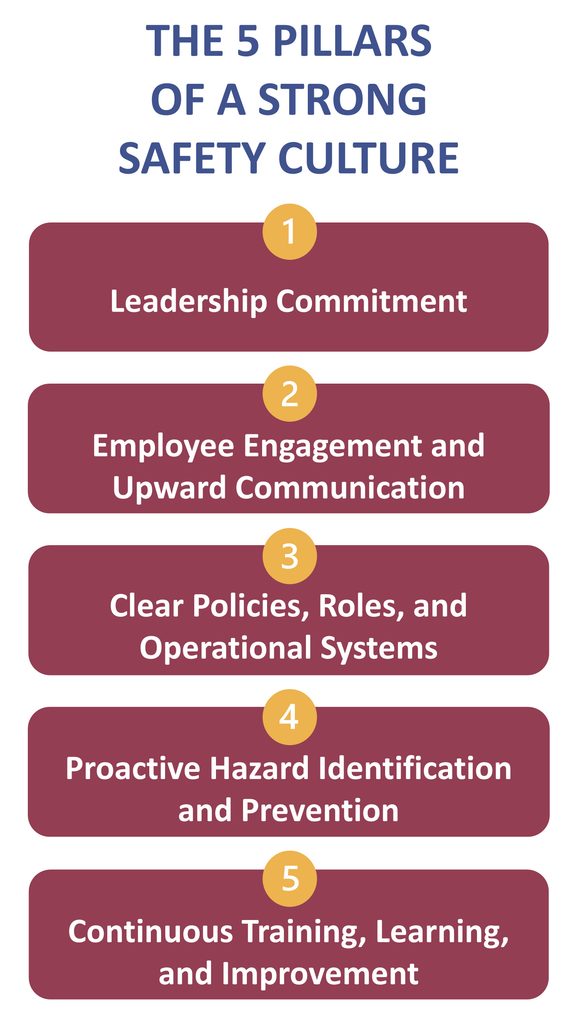
The pillars of safety culture are the essential organizational elements that make safe behavior expected, supported, and sustainable. In practice, a strong safety culture usually includes these five pillars:
- Leadership commitment
- Employee engagement and upward communication
- Clear policies, roles, and operational systems
- Proactive hazard identification and prevention
- Continuous training, learning, and improvement
These pillars matter because culture is revealed in daily behavior, not in slogans. If leaders send mixed signals, if people are afraid to report concerns, or if training is disconnected from real work, the culture weakens even when formal compliance exists on paper.
Why Safety Culture Pillars Matter in Real Operations
Safety culture affects far more than injury rates. It influences whether people raise concerns early, whether supervisors respond consistently, whether procedures are used under pressure, and whether leaders can see weak signals before a serious event develops. In high-risk environments, those differences can determine whether an organization prevents exposure or reacts after harm has already occurred.
This is also why mature organizations do not rely only on lagging indicators such as recordable injuries, citations, or losses. Those measures matter, but they tell you what already happened. A stronger culture is built when you also track leading indicators such as quality of safety conversations, participation in learning, reporting confidence, leadership follow-through, and the ability to make safe decisions in changing conditions.
The 5 Key Pillars of a Strong Safety Culture
1. Leadership Commitment
Leadership commitment is the first pillar because culture takes its cues from what leaders prioritize, tolerate, measure, and reward. Employees quickly notice whether safety is truly a business value or whether it only matters when convenient. If production pressure regularly overrides safe choices, the message is clear regardless of what policy says.
Visible commitment means more than approving a program. Leaders need to model the behaviors they expect, ask strong questions about risk, respond constructively to concerns, and make sure resources match expectations. It also means creating procedural fairness so employees believe that decisions are consistent and that speaking up will not create negative consequences.
In practice, strong leadership commitment often shows up through:
- Regular field presence and meaningful safety conversations
- Clear accountability for managing exposure, not just outcomes
- Follow-through on reported hazards and workforce concerns
- Balanced decision-making when production and safety compete
- Ongoing leadership development tied to safety performance
For many organizations, this is also where safety culture and the role of safety leadership overlap most directly. If leadership behavior does not change, the rest of the system usually plateaus.
2. Employee Engagement and Upward Communication
A safety culture becomes credible when employees are active participants rather than passive recipients of rules. This pillar includes involvement, ownership, trust, and the ability to communicate concerns upward without fear. When people believe that reporting a hazard, near miss, or weak signal will be taken seriously, the organization gains access to information it would otherwise miss.
Low-trust environments create underreporting and silence. People may avoid speaking up because they expect blame, delay, or no visible action. That weakens learning and increases the chance that small problems remain hidden until they contribute to a more serious event.
Strong engagement is supported when you:
- Encourage reporting of hazards, concerns, and near misses
- Respond quickly and transparently to employee input
- Involve frontline teams in problem-solving and risk review
- Build peer accountability without creating fear
- Strengthen leader-member relationships and trust
This pillar aligns closely with research-based culture measurement areas such as upward communication, perceived organizational support, and safety climate. When employees feel heard and respected, employee engagement in safety culture is easier to sustain under normal work and under pressure.
3. Clear Policies, Roles, and Operational Systems
Even highly motivated teams need structure. A strong safety culture depends on clear expectations, reliable procedures, role clarity, and systems that support consistent execution. Without this pillar, organizations often drift into informal workarounds, inconsistent supervision, and preventable variation across teams or sites.
Policies and procedures should not exist only for compliance audits. They should help people do the job safely in real operating conditions. That means instructions must be practical, accessible, and aligned with how work is actually performed. It also means roles and responsibilities need to be explicit, especially when risk ownership crosses departments.
Key components include:
- Documented safety expectations and reporting processes
- Clear escalation paths for hazards and emerging risks
- Defined roles for leaders, supervisors, and frontline employees
- Emergency response and incident management protocols
- Systems that make safe decisions easier to execute
This pillar becomes much stronger when policies are reviewed against actual field conditions instead of remaining static documents. A usable system supports culture. A confusing one quietly erodes it.
4. Proactive Hazard Identification and Prevention
One of the most important pillars of safety culture is the ability to identify and manage risk before failure occurs. Organizations with strong cultures do not wait for injury data, regulatory findings, or serious incidents to tell them where exposure exists. They actively search for weak signals, operational drift, and conditions that could lead to harm.
This is where the shift from lagging to leading indicators becomes especially important. Lagging metrics show the result after the fact. Proactive hazard prevention focuses attention on the conditions, behaviors, and decisions that shape future outcomes. That might include pre-job risk review, quality of controls, field observations, operational learning, and serious incident exposure analysis.
Common practices under this pillar include:
- Routine hazard assessments and job risk reviews
- Near-miss reporting with visible follow-up
- Regular audits focused on exposure, not just paperwork
- Review of Serious Incident and Fatality potential (SIFp)
- Engineering, administrative, and behavioral controls applied appropriately
In complex environments, prevention also depends on decision quality. Teams often make choices under time pressure, uncertainty, and competing priorities. A stronger culture helps people recognize risk earlier and choose safer actions before small deviations escalate.
5. Continuous Training, Learning, and Improvement
Training is a core pillar of safety culture when it helps people build judgment, capability, and confidence in real work situations. It is less effective when it becomes a check-the-box exercise disconnected from daily risk. The goal is not only to deliver information, but to improve how people recognize hazards, make decisions, and respond to changing conditions.
Effective organizations treat learning as continuous. They adapt training to role, exposure level, and operational reality. They also use feedback, incident learning, and culture data to identify where understanding is weak or where habits need reinforcement. This creates a cycle in which learning supports better performance, and better performance reveals where learning should go next.
Useful approaches include:
- Role-based training tied to actual hazards and decisions
- Leadership development for supervisors and senior leaders
- Short refreshers and coaching instead of one-time events only
- Lessons learned from incidents, near misses, and field feedback
- Periodic reassessment of culture, communication, and safety climate
When training is paired with feedback and measurement, it becomes a driver of cultural improvement rather than an isolated activity.
How these Pillars Work Together
The five pillars of safety culture are strongest when they reinforce one another. Leadership commitment builds trust. Trust improves upward communication. Better communication reveals hazards earlier. Strong systems help teams respond consistently. Continuous learning turns that experience into better decisions over time.
If one pillar is weak, the whole culture becomes less reliable. For example, strong procedures cannot compensate for leaders who ignore concerns. Frequent training cannot solve a problem if employees do not feel psychologically safe to speak up. Likewise, engagement tends to decline when reported issues disappear into a slow or unclear system.
This is why many organizations benefit from a connected approach that links culture, leadership, systems, and data. When you evaluate these elements together, you get a far more accurate picture of how safety actually functions.
What are the Components of Safety Culture?
This is a common question. Select a framework that helps you assess whether your organization has:
- Committed and credible leadership
- Engaged employees who can speak up
- Clear and usable safety systems
- Proactive risk identification and control
- Ongoing learning and improvement
The Krause Bell Group Culture Survey is a framework that addresses those areas well, using five scales that have been scientifically validated and extensively tested to reveal how workplace dynamics shape safety outcomes.
Signs Your Safety Culture Pillars Need Attention
- Hazards are reported late or only after escalation
- Employees are reluctant to challenge unsafe decisions
- Supervisors send mixed messages about production versus safety
- Procedures exist but are not consistently followed in the field
- Training completion is high, but behavioral change is limited
- Metrics focus on injury counts while exposure data is weak
- Recurring issues appear across sites, shifts, or business units
These signals do not always mean the culture is poor overall, but they do suggest that one or more pillars may be underdeveloped or misaligned.
How to Strengthen the Pillars of Safety Culture
The most effective starting point is diagnosis. Before launching another campaign or training cycle, you need to understand how safety functions across leadership, communication, systems, and decision-making. That often requires more than incident statistics alone. Culture surveys, leadership assessments, and structured reviews can reveal the patterns that lagging indicators miss.
From there, organizations can prioritize improvements such as leadership coaching, stronger reporting processes, better follow-through on concerns, clearer operational controls, or more targeted learning. The key is to focus on practical ways to improve safety culture rather than broad messaging without accountability.
For organizations operating in high-risk environments, this work is often most effective when safety culture is viewed as a connected system. Krause Bell Group supports this through research-based consulting, assessment tools, and leadership development approaches designed to strengthen the links between culture, leadership, systems, and data. Frameworks such as the Safety Loop, along with tools like the Culture Survey and Safety Leadership 360, help leaders understand where cultural strengths exist and where improvement is needed to reduce risk exposure and prevent serious incidents.
FAQ About Pillars of Safety Culture
* Developed with the support of AI and reviewed by Krause Bell Group Editorial Team