May 22, 2026
Why Compliance Won’t Prevent SIFs
If your dashboards are green yet serious near misses keep happening, you are seeing the limits of compliance. To learn why procedures and box-checking don’t automatically produce safety, see Why Safety Procedures Don’t Always Lead to Safe Behaviors. SIF prevention is not about proving you have controls – it is about proving those controls work every time exposure occurs. This article shows you how to shift from paperwork assurance to real risk reduction.
Define SIFs and SIF Precursors with the Right Level of Precision
Serious Injuries and Fatalities (SIFs) are life-altering or life-threatening injuries or fatalities, often tied to high-energy, low-frequency events. SIF precursors are high-risk situations in which controls are absent, ineffective, or not followed – any of which can allow a severe outcome. This distinction matters. A compliant checklist can show a control is “present,” while a precursor lens asks whether the control is capable, available, and used under real conditions. The Campbell Institute and other leaders in the field emphasize this triad – absence, ineffectiveness, non-compliance – because each failure path must be closed to reduce SIF exposure. For a practical guide to finding these conditions, see How to Identify SIF Precursors on your Job Sites.
Why Compliance Alone Cannot Prevent SIFs
Compliance equals evidence that minimum requirements exist. SIF prevention demands evidence that critical controls consistently perform under variation – production pressure, time-of-day, contractor turnover, weather, and other realities of work. Forms, permits, and training records are necessary, but they protect you in the boardroom more than they protect the person at height or inside a confined space. When organizations elevate artifacts over performance, workers learn that “the signature is what matters,” and the system drifts toward box-checking instead of problem-solving. As shown in the video When Recordable Injuries Decline While SIFs Remain Level, compliance metrics can mask SIF risk.
Three common gaps explain persistent SIF exposure in compliant organizations: controls that look good on paper but cannot withstand real conditions, verification that inspects existence instead of function, and metrics that reward low report counts rather than learning. To change outcomes, shift governance from reassurance to reliability – test whether critical controls prevent harm when it counts. Focusing on SIFs does not mean ignoring smaller injuries.
Design For Controls That Work – Not Just Controls That Exist
Start with credible worst-case harm, then work backward to the few controls that make the difference. Define exactly how each control should perform and how you will know it is working before, during, and after exposure.
- Identify high-consequence hazards: energy sources like gravity, pressure, electricity, moving machinery, line-of-fire.
- Define performance standards: what “good” looks like in observable terms – capability, timing, location, and user interaction.
- Build verification into the work: simple checks that confirm the control is in place and functioning at the point of exposure.
- Plan for failure: escalation rules when a control is unavailable or fails a check – stop, substitute, or add independent protection.
- Prefer higher-order controls: remove, substitute, or engineer-out energy before relying on admin rules or PPE.
For a system approach to identifying and reducing exposure rather than relying on rules, focus your program on critical controls and verification.
| Compliance Evidence | SIF Prevention Evidence |
| Procedure exists and employees trained | Procedure tested in field conditions and usable as written |
| Permit completed and signed | Critical control verified functional at point of exposure |
| Audit shows 100 percent form completion | Independent checks catch and correct control failures |
| Lag indicators are “zero” this month | Exposure, precursor trends, and learning reviews improving |
| Vendors provide compliance certificates | Contractors meet the same control performance tests |
Leadership Behaviors That Cut SIF Exposure
Krause Bell Group’s research on safety leadership shows that leaders shape whether people optimize for appearances or for real risk reduction. This starts at the top. Use these behaviors to move the system toward reliability. For how leadership sets the tone, see Prevention of Serious Injuries and Fatalities Must Start with Leadership.
- Make harm the anchor – ask “how could someone get seriously hurt here?” before asking about compliance.
- Practice Safe Decision Making® Principles – slow down high-consequence decisions, surface assumptions, and confirm critical controls.
- Invite problem-solving – reward reporting, remove blame from precursor learning, and fix conditions, not people.
- Verify like it matters – personally observe controls at the point of exposure and test function, not paperwork.
- Align incentives – measure the presence and performance of critical controls, not just injury rates or audit scores.
Measure What Matters for SIF Prevention
What you measure drives what people optimize. Shift from counting paperwork to validating reliability. For metrics that reveal real risk, see Leading Indicators for SIF Prevention.
- Critical control performance – percent of exposures where controls passed a functional check.
- Exposure and precursor learning – volume, cycle time, and quality of learnings closed.
- Independent verification – frequency and findings from gap-finding observations.
- Drift indicators – staffing, schedule pressure, changeovers that degrade control reliability.
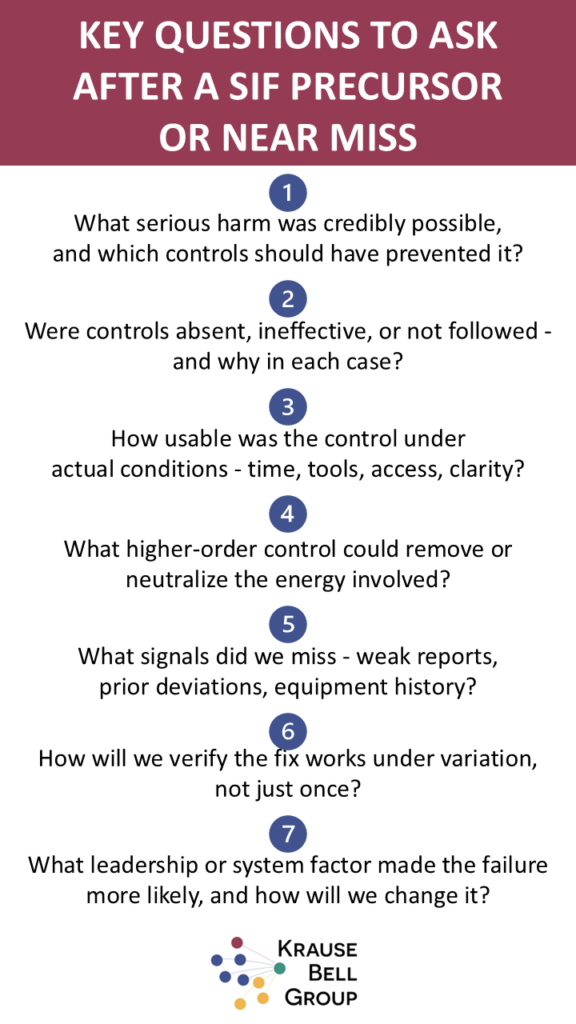
Key Questions to Ask After a SIF Precursor or Near Miss
- What serious harm was credibly possible, and which controls should have prevented it?
- Were controls absent, ineffective, or not followed – and why in each case?
- How usable was the control under actual conditions – time, tools, access, clarity?
- What higher-order control could remove or neutralize the energy involved?
- What signals did we miss – weak reports, prior deviations, equipment history?
- How will we verify the fix works under variation, not just once?
- What leadership or system factor made the failure more likely, and how will we change it?
A 30-Day Plan to Pivot From Compliance to SIF Prevention
- Pick one high-consequence task with recent near misses.
- Map credible worst-case harm and list the few critical controls.
- Write clear performance standards for each control – what to check and how.
- Pilot point-of-exposure verification with one crew for two weeks.
- Review failures without blame, fix constraints, and scale what works.
For a practical, step-by-step guide to managing critical risks where compliance falls short, see Critical Risk Management and SIF Prevention.
FAQs
Next Steps for Leaders
If you want to accelerate SIF prevention, invest in leadership capability and decision quality. Krause Bell Group’s Masterclasses – including the Executive Masterclass on Serious Incident and Fatality Prevention and Safe Decision Making® Principles – help senior leaders, safety professionals, and frontline managers build the habits and governance that produce reliable control performance. Explore upcoming sessions in North America and Europe to equip your team with proven practices.
Leaders searching for why compliance won’t prevent SIFs are asking the right question. The answer is to govern for reliability, not reassurance – and to prove it where it matters most, at the point of exposure.
* Developed with the support of AI and reviewed by Krause Bell Group Editorial Team