April 14, 2026
Why do people do what they do? Understanding behavior by using ABC analysis.
A supervisor walks around his production area and sees one of his team members not following a certain safety procedure. “Not again,” he thinks. “I’ve told him this already. Multiple times!” At that point, most supervisors reach the same conclusion: he just doesn’t care.
This is a normal reaction. We all have it when we’ve asked someone to do something differently, but they don’t change their behavior. What we should actually do at that moment is question ourselves, because if someone continues to behave in a certain way—even after repeated feedback—they always have a reason.
People don’t ignore rules—they do it for a reason. If a behavior continues, something in the system is rewarding it, whether we realize it or not. As long as we don’t understand what that reason is, we can repeat our request even a thousand times, but it probably won’t change a thing.
This is of course easier said than done. You can’t go inside another person’s head to know why they do what they do.
Leveraging ABC Analysis for Positive Change
This is where ABC analysis comes into play. It helps you understand exactly what drives people to behave the way they do.
ABC stands for ‘Antecedent – Behavior – Consequence’ and it simply explains a logic. Every behavior is triggered by something – the antecedent – and has a consequence.
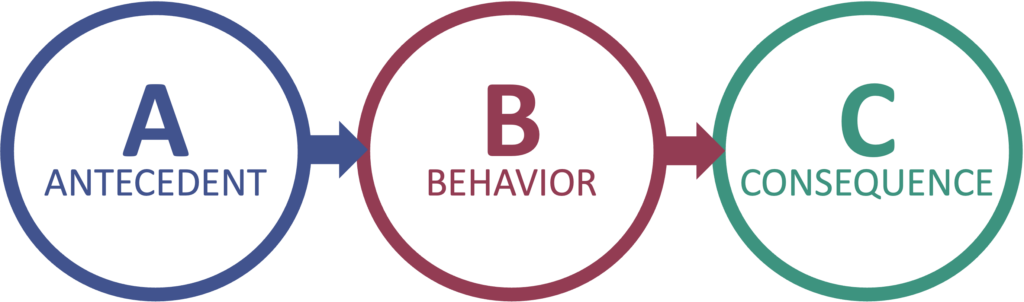
A very simple example is that if your phone rings (the antecedent), you pick up the phone (the behavior), and you have a conversation with someone (the consequence). Many people think the reason they pick up the phone is because the phone rings. Now I agree that it would be a bit stupid to pick up the phone if it doesn’t ring, but the real reason for picking up the phone is that you anticipate having a conversation. It’s the anticipated consequence really driving your behavior.
Let’s explore that a bit further. The reality is that if your phone rings, you first look at who’s calling. The name that pops up on your screen determines if you pick up the phone or not, because it tells you something about the type of conversation you will have, i.e. what the consequence will be like. If it’s a friend who’s calling to discuss where and when you’ll meet for dinner that evening, you will likely pick up. If it’s your boss who wants to know the status of that task you have not yet completed, you may choose to ignore it.
This is the first lesson in ABC analysis: Consequences drive behavior. Antecedents only influence them as long as they are an accurate predictor of the consequence. This also means that behavior is rarely just an individual choice. The consequences people experience are shaped by their environment—by priorities, systems, and leadership decisions.
All Consequences are Not Created Equal
But there’s more. Not all consequences are equal. There are three elements that define its impact:
- Is it Certain(C) or Uncertain (U)?
- Is it Positive (P) or Negative (N)?
- Is it Immediate (I) or Later (L)?
If the consequence is immediate, it influences you more than if it is later, say in a couple of weeks or months. A certain consequence outranks an uncertain one.
The strongest consequences are PIC-NIC. So, either Positive, Immediate, and Certain or Negative, Immediate, and Certain.
In practice, this means that the behaviors you see are often logical responses to the consequences people experience in their day-to-day work. If we want to change behavior, we don’t start by telling people what to do—we start by understanding what about the current behavior make sense to them.
Applying the ABC Model to Safety
In safety, we think the mere fact that a behavior may get you injured is enough to keep you from doing it. The reality is that an injury is negative, immediate, and uncertain (NIU). If you hit a hammer on your finger, it’s going to be painful (negative/N), and you feel it immediately, but you don’t hit your finger with the hammer every single time, do you? No, so the consequence is uncertain (U). It’s the uncertain part of the consequence that doesn’t have a significant influence on behavior.
Hearing loss and back pain are even more difficult to control as they are not only uncertain, but also later (UL). You typically don’t suffer hearing loss or tinnitus the first time you’re exposed to a loud sound, but it happens after multiple exposures (later/L). Also, it doesn’t happen to everyone (uncertain/U).
Many professional movers get back injuries after multiple years of working, but not all, and not on the first day of their job. Therefore, the consequence is later and uncertain (LU). Lifting two or three boxes at the same time saves time. That is positive, immediate, and certain (PIC), which drives the behavior more.
The same logic applies at a broader level. In many organisations, meeting production targets is a positive, (almost) immediate, and certain consequence (PIC), while following every safety procedure can feel slower or more difficult. In that context, it is not surprising that people take shortcuts—not because they don’t care about safety, but because the consequences they experience every day point them in a different direction.
You can make this even more powerful. Think of the desired behavior, the one that you are trying to instill in the other person. What are PIC consequences that you can provide so that the desired behavior is also desirable for the person?
Here’s a simple example from a company in the Middle East. The company had trouble getting their employees to wear safety glasses because they felt that the safety glasses were uncomfortable. This is a NIC consequence of the desired behavior.
So, the company decided to take a different approach. They asked for feedback. They used that feedback to go to the supplier and get a selection of different types of safety glasses. They allowed the employees to choose the one that was most comfortable, increasing the likelihood they would keep wearing them.
But here’s the real kicker: because they were wearing the glasses outside, they were also sunglasses. There was one style that made them ‘look cool,’ and looking cool was important because it was a PIC consequence of the desired behavior.
The end result? People would recognize employees from that company in town as they would still be wearing those glasses, because they looked cool!
Conclusion: It’s Not About Rules, It’s About Consequences
To conclude: people don’t do things because of rules—they do things because of consequences. If a behavior continues, it is because, in some way, that behavior still works for the person doing it.
Understanding this is critical if you want to influence behavior in a meaningful way. You must shift the focus from correcting people to understanding—and shaping—the conditions in which they operate.
Learn more about how to conduct an ABC Analysis in ABC Analysis in 5 Steps