October 27, 2026
Why Management Should Care About the Quality of Incident Investigations
A quality incident investigation should produce two outcomes management should care deeply about:
- Greater employee confidence in the organization’s commitment to safety.
- Improved information for making decisions that reduce exposure.
This is why investigation quality should not be judged primarily by how quickly an investigation is closed. Timeliness matters, but closure is an administrative milestone, and while investigation deadlines came from leaders wanting to demonstrate their value for safety, it is a crude measure and results in unintentional consequences. The more important question is whether the investigation produces information leadership can trust and use, and a set of actions that will control exposure on a sustained basis.
Management should care about the quality of incident investigations for the same reason it cares about the quality of financial, operational, or customer data: leaders cannot make good decisions with bad information. However, incident investigations have an additional consequence. The way an organization investigates an event also tells employees whether leaders are interested in learning or blaming, whether they are willing to examine their own decisions, and whether speaking up leads to improvement.
Outcome 1: Employee Confidence in the Organization’s Commitment to Safety
Quality Investigations Shape Employee Perceptions of Leadership…
An investigation of an incident can be a pivotal experience for an employee. Someone may have been injured, witnessed a serious event, reported a near miss, paused work, or made a decision that contributed to an unwanted outcome. Employees pay close attention to what happens next.
They notice what questions are asked, whether investigators appear curious or judgmental, whose perspective is valued, and whether the investigation examines the entire system or stops with the actions of the person closest to the event. Coworkers notice as well. From that experience, people form conclusions about whether the organization genuinely wants to learn and whether reporting an event will result in improvement or personal exposure.
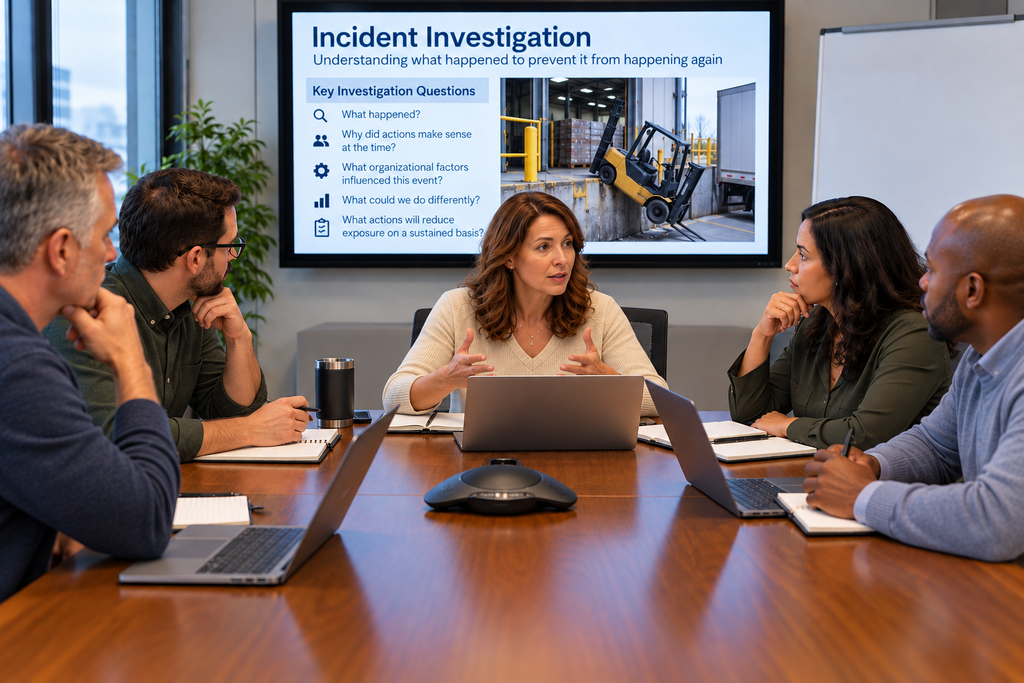
A high-quality investigation communicates that the organization wants to understand what happened, why actions made sense at the time, what factors influenced those actions, and what the organization could do differently. This approach supports openness and learning, while a superficial or blame-oriented investigation sends the opposite message.
…And Protects Leadership Credibility
Effective safety leaders communicate the message that safety is a core value, that speaking up or pausing work is encouraged, and that the organization wants to learn from incidents. Investigations are one of the key moments when employees compare those statements with leadership behavior.
Credibility erodes when investigations consistently identify employee behavior as the primary causal factor while organizational factors receive little attention. If the recurring response is retraining, safety standdowns, or reminding employees to follow procedures, employees will question leadership safety commitment. Employees are looking to see if leadership is willing to examine the impact of risk amplifiers like equipment design, staffing, production pressure, conflicting priorities, resource decisions, or weaknesses in established controls. Employees are also looking to see if leadership is willing to admit that there have been failures in the implementation of exposure controls.
Investigations should not avoid individual accountability, but the same curiosity should be applied throughout the organization. Effective investigation requires interviewing skills, systems thinking, bias awareness, and sound analysis. The process should be capable of examining frontline actions and management decisions with comparable rigor.
Outcome 2: Improved Information for Making Decisions to Reduce Exposure
Quality Data Improves Management Decisions
The most important management value of an investigation may be the information it provides about how organizational decisions shape exposure.
Decisions that influence safety often do not look like safety decisions. Staffing levels, schedules, equipment purchases, maintenance priorities, budgets, training resources, contractor selection, and work design can all change the context and conditions under which people work. Krause Bell Group Safe Decision Making® research found that two-thirds of influential decisions were made at the management/site leadership level and above. The findings also indicate that decision-makers often did not recognize that the decision they were making was safety-critical.
A good investigation should make those connections visible. It does not stop at what an employee did immediately before the incident. It explores how earlier decisions, operating conditions, and organizational expectations shaped exposure. It is not about moving blame from employees to management. It is about giving leaders visibility into the system they are positioned to influence.
At a minimum, a good investigation should provide leadership with a clear understanding of the immediate causal exposure – the Serious Injury and Fatality Potential (SIFp), what controls were intended to control the exposure, and whether those controls were adequate, implemented, and used as intended.
Management Learns Where the Organization Is Vulnerable
One investigation explains an event. A collection of high-quality investigations provides the data necessary to uncover underlying systemic issues that are leading to a lack of exposure control.
When investigation information is consistently defined and accurately classified, leadership can learn about the patterns that exist and that are difficult to see one case at a time. Good data should tell leaders where significant exposures are concentrated, which tasks have SIF potential, which controls repeatedly fail or are inconsistently implemented, and where there are recurring gaps between the organization’s control plan and the way work is performed.
It should also reveal recurring organizational conditions or amplifiers, patterns in management and operational decisions, common causal themes across locations or business units, and whether corrective actions are reducing exposure.
This is where investigation quality and data quality become inseparable. If investigators classify exposures differently, apply SIFp inconsistently, enter superficial causal factors or interpret data fields differently, the organization will be stuck with a large amount of data that provides unreliable information.
A sophisticated dashboard cannot correct weak source data. It can only display it more attractively.
Management Knows Where to Act and Invest
Management needs investigation information to make choices.
Resources are finite. Leaders must decide where to invest capital, where engineering changes are needed, which controls require greater verification, where procedures or work design need to change, where additional leadership attention is warranted, and which lessons should be transferred across the enterprise.
Accurate investigation data helps management distinguish isolated events from recurring systemic weaknesses. It can identify tasks that produce few incidents but have high SIF potential. It can reveal controls that exist on paper but are not consistently implemented. Finally, the data should show where multiple events share common organizational or decision-making influences.
That is far more useful than simply knowing the number of incidents that occurred or the number of overdue investigations.
EHS data systems should be designed around management questions:
- Why are we collecting this information?
- Do we trust it?
- What patterns can we identify?
- How is the information changing decisions?
- Do I trust this data to lead the organization to measurable improvement?
Collecting more fields is not the objective. Producing information that leadership can trust and act on is.
The Leadership Standard: Learning and Better Decisions
A successful investigation should leave leadership knowing something it did not know before or confirming things they suspected were leading to a lack of exposure control. It should clarify the exposure and its potential, test whether controls are working, illuminate the decisions and conditions that shaped the event, identify implications beyond the immediate location, and produce data that strengthens future analysis.
It should also leave employees with a clear impression: the organization took the event seriously, listened to the people who understand the work, examined the system fairly and acted on what it learned.
The combination of employee confidence and better management information is why leaders should care deeply about investigation quality and accurate data.
A good investigation does more than explain yesterday’s incident. It shapes how employees perceive leadership today and improves the decisions leaders make tomorrow.
If you have reservations about the quality of your investigations, we recommend an independent review of the incident investigation system.
For more information about Incident Investigations, read Rethinking Incident Investigation: We Can Do Betteror watch our webinar on the same topic.