September 17, 2026
Krause Bell Group’s Safe Decision Making® Research: What Leaders Need to Know
Understanding how decisions shape safety outcomes has become a central focus for organizations aiming to prevent serious injuries and fatalities (SIFs). Krause Bell Group’s multi‑year research—drawn from over 600 decisions linked to 60 SIF events, and expanded to a database of more than 4,000 decisions—shows that leadership choices, not just front‑line actions, drive safety performance. The findings are presented in two articles that explain whose decisions matter and where they break down.
Whose Decisions Have the Greatest Impact?
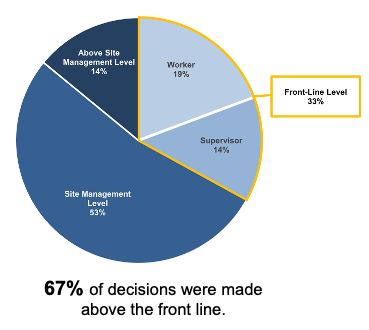
Contrary to the assumption that everyone’s choices weigh equally, our research revealed a clear hierarchy. Of the decisions influencing SIF events, two‑thirds were made by individuals in management positions, with site‑level managers accounting for the clear majority. Front‑line workers contributed fewer than 20 % of the decisions that led to serious or fatal injuries. This pattern holds across industries: 33 % of decisions in the dataset occurred at the front line, while 67 % were made at the site leadership level or above.
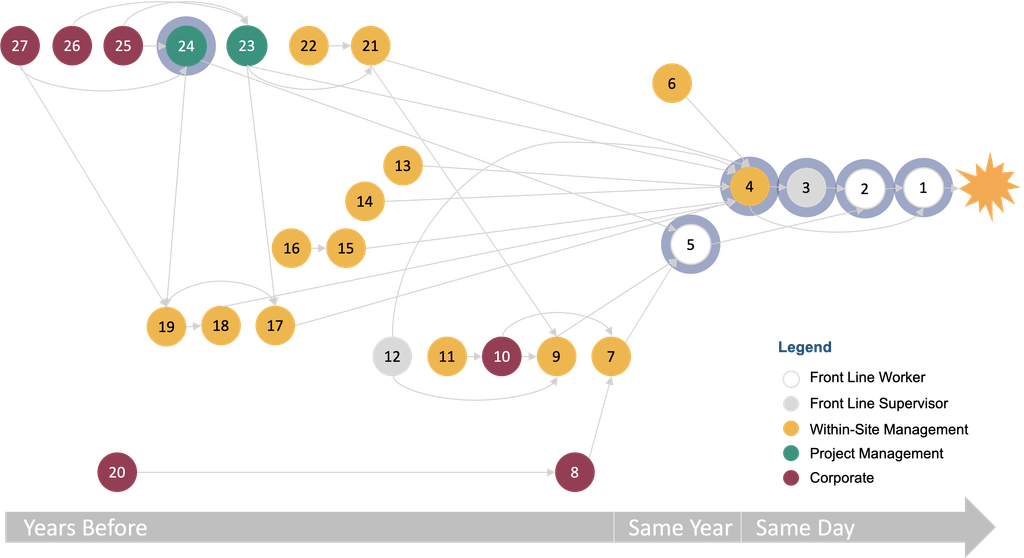
Decisions are interconnected—each choice shapes the context for the next—therefore, the real leverage point for leaders is not to micromanage front‑line behavior, but to recognize how their own decisions affect the organization. Improving safety, therefore, starts with strengthening the decision‑making capabilities of those who set equipment standards, allocate resources, hire talent, and shape work processes.
Situations Where Leadership Decisions Matter Most
The research identified specific situations in which site‑level leaders’ choices have outsized safety consequences. These include:
- Designing, maintaining, purchasing, and installing equipment
- Troubleshooting operational issues
- Designing, changing, or purchasing facilities
- Designing or changing work processes
- Conducting formal risk assessments
- Planning work
- Purchasing goods and services
- Hiring personnel
- Designing hazard mitigation measures
In these contexts, common errors revolve around developing criteria and specifications, identifying needed information, communication breakdowns, and assigning people to tasks. For example, a 2010 metal‑dust explosion that killed three workers traced back to years of management decisions—such as skipping backup equipment, enforcing 24/7 schedules, deferring maintenance, and ignoring lid‑closure rules—rather than the worker’s final choice to install a used blade.
The Role of Cognitive Bias
Even experienced leaders are vulnerable to systematic thinking errors. The original 2015 study found evidence of cognitive bias in 85 % of the decisions examined. Bias arises from brain mechanisms that favor speed over accuracy, especially under stress, making it a universal human trait.
At the management level, the top three biases were:
- Availability bias – selecting the first available person for a task without reviewing alternatives
- Overconfidence in others – assuming a regional safety manager overseeing many sites can personally monitor a high‑risk job
- Categorization bias – treating all similar projects (e.g., crane installations) as identical and skipping necessary risk checks
Front‑line decisions showed different patterns: status quo bias, normalization of deviance (where rule‑breaking becomes routine), and overconfidence in self (e.g., clearing a jam without de‑energizing equipment). Recognizing these tendencies allows leaders to anticipate bias and put safeguards in place.
Where Do Decisions Break Down?
Understanding the decision‑making process reveals where improvements are most needed. The research showed that failures occur at every step, but the most common breakdown is awareness: leaders often do not realize they are making a safety‑critical decision. Increasing knowledge of SIF precursors (early warning signs) can heighten this awareness, particularly for front‑line teams.
Implications for Safety Improvement
These insights shift the focus of safety programs from isolated behavior‑based tactics to a systems view of decision making. Since leaders’ choices affect exposure to risk and organizational culture, decisions about investment, structure, operations, and hiring are inherently safety decisions. Improving them creates a Safe Decision Making® Network that connects choices across levels and steadily moves the organization toward zero‑injury outcomes.
Conclusion: Practical Steps for Leaders
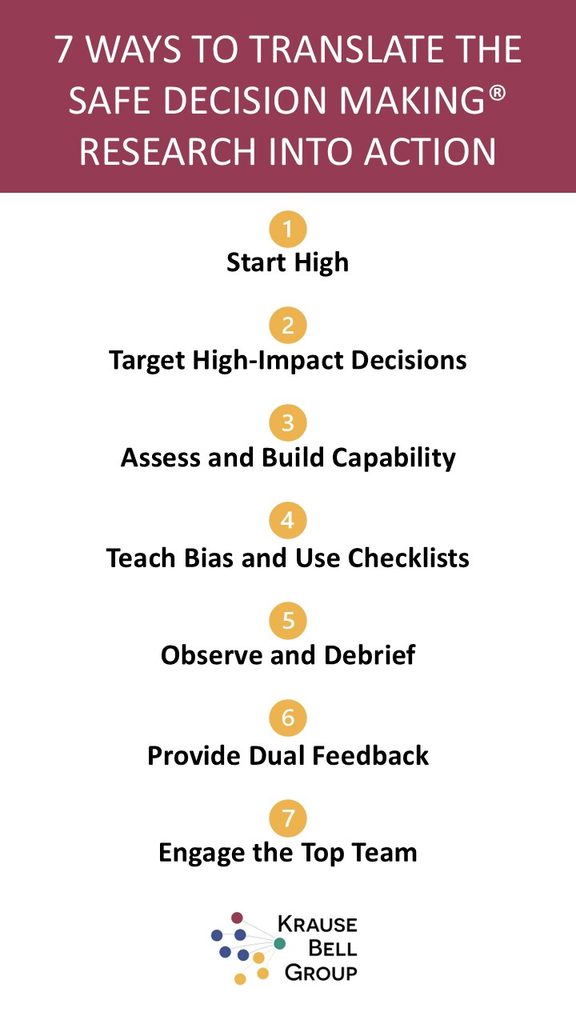
Seven ways leaders can translate the research into action:
- Start high – Begin with senior leaders and work downward, ensuring those with the broadest influence are equipped first.
- Target high‑impact decisions – Select a manageable set of decisions and situations (e.g., equipment purchases, hiring, risk assessments) that have the strongest link to SIF potential.
- Assess and build capability – Evaluate leaders’ decision‑making skills for safety and provide targeted training where gaps exist.
- Teach bias and use checklists – Educate leaders about the most common biases and create simple checklists to counter them during key decisions.
- Observe and debrief – Watch decisions as they happen, note both process and context, and hold brief discussions afterward to confirm bias was avoided.
- Provide dual feedback – Give leaders feedback on their decision process while sharing insights about the organizational context with the broader team.
- Engage the top team – Involve senior leadership in improving the conditions that shape decision making, such as information flow, time pressures, and cultural norms.
By treating safe decision making as a critical lever—rather than an afterthought—organizations can align everyday choices with their safety goals and build lasting protection for people and the business alike.
Learn more about effective decision making and Krause Bell Group’s Safe Decision Making® research in:
- Organizational Decision Making for Safety: Part 1. New Research and Implications for SIF Prevention
- Organizational Decision Making for Safety: Part 2. Organizational Improvement Strategies