How Business Decisions Can Drive Unsafe Work
Learn about the dangerous, hidden risks embedded in decision-making that force tradeoffs between safety and productivity.
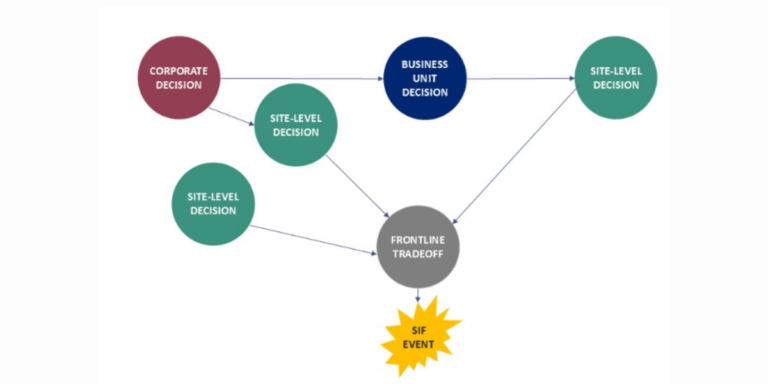
Recent studies have made something new and exciting clear: The central theme, the through-line most useful to SIF prevention, is all about decision making for safety. Yes, reducing exposure to risk and improving the culture are crucially important. But how do leaders at different organizational levels influence those things most effectively?
When we think about the sheer numbers of decisions made by leaders the task of improving them all seems quite daunting. The study identified a subset of decisions which had the greatest impact on 60 serious and fatal events. This article outlines an improvement strategy for organizations based on the findings.
The notion that leadership matters to organizational safety is intuitive for most people. Despite this understanding, safe decision making is an aspect of leadership that has not received enough attention.
Here’s a 5-step method for an ABC analysis, with an example. Step 1 Pinpoint a single action that you want to change. Be extremely specific. Think of a specific person, at a specific point in time, in a specific situation. Step 2 Identify as many antecedents that were present in that specific situation. Antecedents are…
Executives don’t select people outside EHS to lead the EHS function for no reason. They do it because they need a sufficient level of skill, knowledge, and attributes to play at the necessary level. Organizations that attain real safety excellence are aware of this issue and taking active steps to address it.
Most of our clients make a great effort to start meetings in a meaningful way with respect to safety. Many enjoy collecting relevant safety topics for easy reference at the beginning of meetings, and we’ve seen countless humorous videos that illustrate critical risks and risk reduction activities. We’ve admired highly engaged employees who talk about the…
Developing a Safety Improvement Strategy: Part 1 What Is a Safety Improvement Strategy and Why Do you Need One? It always surprises me when I see leading organizations who value safety lacking a comprehensive strategy to attain their objectives. The situation is usually something like this: “We are doing a lot to improve safety performance….
In our work at Krause Bell Group, we’ve found that the most important ingredient in any safety program is strong leadership. But all too often, senior executives and safety leaders don’t “get” safety at the level they need to in order to be effective. So what is it that senior leaders need to ‘Get’ about…
What role does safety play in organizational decision making and how does cognitive bias affect it?
You are the maintenance manager at a recycling plant. You have 30 work orders outstanding and you’re already over your budget for the month, but a request comes in to repair an important piece of equipment. Your worker assigned to evaluate the problem says it will be $1000 to repair the machine. He can keep…
This is the third in a series of three videos in which Tom Krause explores the role of cognitive bias in decision-making (Watch Part 1 here and Part 2 here). In this final video, Tom provides an example of how our understanding of cognitive bias relates to safety. Part Three: Learn more about our approach…
EVENTS
© 2025 Krause Bell Group | Privacy Policy | Terms of Use

"*" indicates required fields