October 12, 2026
How to Prioritize Critical Tasks for SIF Risk
If you want to reduce serious injuries and fatalities, you cannot treat every task as equally important. The right focus is not the number of minor injuries a job may produce, but the combination of exposure, consequence potential, and the reliability of the controls that stand between people and catastrophic outcomes. That is the core of how to prioritize critical tasks for SIF risk.
In practice, this means identifying the work where a single error, failed safeguard, or changing condition could lead to a life-altering event. It also means looking beyond lagging metrics and asking better questions: where is high energy present, which tasks create repeated exposure, what SIF precursors are visible, and which critical controls must work every time? When you prioritize that way, your safety effort becomes more selective, more practical, and far more effective.
Start with a Clear Definition of SIF Risk
SIF risk refers to the potential for a task, condition, or event to result in a serious injury or fatality. That includes fatal events, permanent disabling injuries, and other high-consequence outcomes that can change lives in an instant. A task does not need to have caused a severe event in the past to qualify as high SIF risk. It only needs the credible potential to do so under realistic conditions.
This distinction matters because many organizations still spread attention across all safety issues in the same way. A cut finger and a dropped load do not belong in the same priority category. One may be recordable, while the other may have fatal potential. If you want a useful SIF assessment, you have to rank tasks by consequence exposure, not just by injury frequency.
Why Traditional Safety Metrics are Not Enough
Recordable rates can help you track overall injury performance, but they are weak tools for prioritizing critical tasks for SIF risk. They tend to count events by occurrence rather than by potential severity. As a result, teams may spend time reducing lower-consequence incidents while missing the work that carries the highest fatality exposure.
A better approach is exposure-based prioritization. Instead of asking only what has happened, ask where serious harm could happen next. That shifts attention toward tasks involving:
- Work at height
- Mobile equipment and line-of-fire exposure
- Stored or uncontrolled energy
- Confined space entry
- Lifting and suspended loads
- Excavation and trenching
- Process safety hazards
- High-risk maintenance, shutdown, or non-routine work
This is where your most important task prioritization decisions should be made.
How to Identify Critical Tasks with the Highest SIF Exposure
The first step in how to prioritize critical tasks for SIF risk is to identify which tasks can realistically lead to catastrophic outcomes. Focus on the work itself, the energy involved, the surrounding conditions, and how work is actually performed in the field.
Look for High-Energy and High-Consequence Work
Tasks deserve priority when they involve energy sources or work conditions that can quickly overwhelm a person’s ability to recover. This includes gravity, pressure, electricity, moving equipment, hazardous chemicals, rotating machinery, unstable loads, and oxygen-deficient or toxic atmospheres.
If a task places someone in the path of that energy, it should move up your priority list.
Separate Routine Paperwork from Real Operational Exposure
Not every documented task is equally critical. Some jobs look controlled on paper but become unstable in the field because of production pressure, changing weather, contractor coordination, equipment condition, or weak supervision. Prioritize based on actual exposure, not on whether a procedure exists.
Pay Attention to Non-Routine and Upset Conditions
Many SIF events occur during maintenance, startup, shutdown, troubleshooting, cleaning, emergency response, and recovery work. These tasks often involve variation, time pressure, and workarounds. If your task list focuses only on routine production activities, you may miss some of your most important SIF exposures.
The Practical Method for Prioritizing Critical Tasks for SIF Risk
A workable method should be simple enough for leaders and frontline teams to use, but strong enough to drive better decisions. The most effective process usually follows five steps.
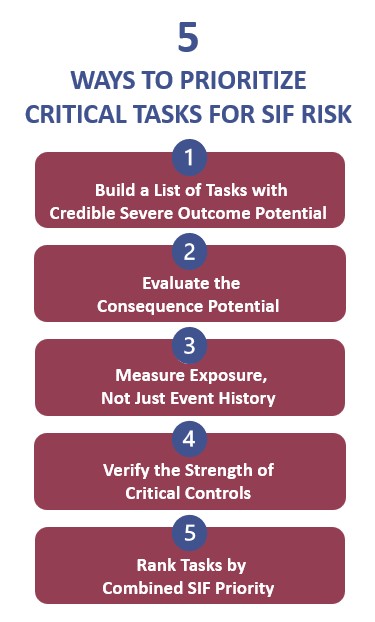
1. Build a List of Tasks with Credible Severe Outcome Potential
Start by mapping jobs, activities, and task steps where serious harm could occur. Use incident history, near misses, field observations, job hazard analyses, permit data, maintenance records, and workforce input. Ask supervisors and workers a direct question: what tasks here could kill or permanently injure someone if conditions shift or controls fail?
2. Evaluate the Consequence Potential
For each task, assess the worst credible outcome. Avoid unrealistic extremes, but do not downplay consequences either. If a worker could be crushed, electrocuted, fall from height, become engulfed, or be exposed to toxic release, the task belongs in a high-priority pool.
3. Measure Exposure, Not Just Event History
A task performed once a year may still be critical, but tasks repeated daily across multiple crews deserve special attention because repeated exposure multiplies risk. Consider frequency, duration, number of people exposed, environmental variability, and whether contractors are involved.
4. Verify the Strength of Critical Controls
This is where many SIF prevention efforts improve sharply. Do not ask only whether controls exist. Ask whether the critical safeguards are present, understood, used correctly, and capable of preventing or mitigating the event. A permit, procedure, or checklist alone is not enough if the field conditions make failure likely.
5. Rank Tasks by Combined SIF Priority
Once you understand consequence, exposure, and control reliability, rank tasks based on where intervention will reduce the greatest severe risk. High consequence plus frequent exposure plus weak or inconsistent safeguards should sit at the top of the list.
A Simple SIF Task Prioritization Matrix
If you need a practical way to run a SIF assessment, a matrix can help teams compare tasks consistently.
| Factor | What to Assess | High-Priority Signal |
| Consequence Potential | Worst credible outcome if control fails | Fatality, life-altering injury, permanent disability |
| Exposure Frequency | How often people perform or encounter the task | Daily, multi-shift, multi-site, repeated contractor exposure |
| Number of Exposed People | How many workers could be harmed | Multiple people in the hazard zone |
| Task Variability | How much conditions change during execution | Non-routine, weather-sensitive, upset conditions |
| Critical Control Reliability | Whether safeguards are effective and verified | Controls are weak, bypassed, inconsistent, or unverified |
| Precursor Presence | Whether warning signs already exist | Frequent deviations, near misses, line-of-fire exposure, poor isolation |
Tasks scoring high across several of these factors should become your immediate SIF focus.
Use SIF Precursors to Sharpen Prioritization
SIF precursors matter. They are the visible clues that a task or condition has elevated fatality potential. If you want to know how to prioritize critical tasks for SIF risk more accurately, look for these signals before an event happens.
Common SIF Precursors
- Line-of-fire exposure
- Uncontrolled or poorly isolated energy
- Work at height without fully reliable fall protection
- Bypassed interlocks or guards
- Confined space entry with weak atmospheric verification
- Suspended loads over people
- Vehicle-pedestrian interface issues
- Inadequate rescue readiness
- Simultaneous operations that create conflicting hazards
- Time pressure causing shortcuts in critical steps
Precursors do not guarantee a severe event, but they do show where attention should shift immediately. They are especially useful when injury rates appear low, because they reveal severe exposure that lagging data can hide.
Identify and Verify Critical Safeguards
Once a task is flagged as high priority, the next question is simple: what must work to prevent a serious injury or fatality? These are your critical safeguards. They are not every control on the page. They are the few barriers that matter most when consequences are severe.
Examples of Critical Safeguards
- Energy isolation and lockout verification
- Fall protection systems and anchor integrity
- Gas testing and ventilation for confined spaces
- Equipment exclusion zones and spotter controls
- Lifting plans and load path controls
- Ground stability controls for excavation
- Permit-to-work quality and authorization discipline
- Rescue plans that are realistic and ready to execute
What Verification Should Look Like
Verification should happen in the field, not only in paperwork review. Leaders and supervisors should confirm that the safeguard is physically present, functional, understood by the crew, and suitable for the exact conditions of the job. If a control depends on perfect human behavior under pressure, it may be weaker than it appears.
This is where many organizations improve through a structured process such as SIF Exposure Analysis, because it helps connect high-risk tasks with the barriers that most directly reduce severe exposure.
Questions to Ask During a SIF Assessment
If your team needs a repeatable evaluation process, these questions can anchor better decisions:
- What is the worst credible outcome of this task?
- What energy sources are involved?
- How often are people exposed to this task?
- Under what conditions does the task become less stable?
- What SIF precursors are already visible?
- Which critical controls must work every time?
- How are those controls verified before and during work?
- What would make a control fail in real operations?
- Who can stop the job if barriers are not reliable?
- What should be fixed first to reduce the greatest severe exposure?
These questions align well with the broader logic behind the 5 factors for a risk assessment, but they are tuned specifically to serious injury and fatality prevention.
How Leaders Should Prioritize Action After Ranking Tasks
Prioritization only matters if it changes where time, attention, and resources go. After ranking critical tasks, leaders should focus on the highest exposure areas first and resist the urge to spread effort evenly across the organization.
Direct Action to the Top-Risk Work
Spend leadership time in the field where high-consequence tasks occur. Review how work is planned, how decisions are made under pressure, and whether crews trust the stop-work process. SIF prevention improves when leaders visibly support production decisions that favor control integrity over speed.
Fix Weak Systems, Not Just Worker Behavior
If a task remains high priority because safeguards are inconsistent, the answer is rarely more reminders alone. Address scheduling pressure, permit quality, equipment design, supervision, contractor alignment, and decision pathways. Serious events are often linked to system weaknesses, not isolated mistakes.
Use Applied Learning to Improve Decision Quality
Critical task prioritization becomes stronger when people know how to recognize severe exposure and make better choices before work starts. This is one reason organizations apply Krause Bell Group’s Safe Decision Making® Research, implement leadership development programs, and focus on applied learning: they help turn a risk list into better operational decisions.
What does a Strong SIF Prevention Program Include?
Many teams ask, what is the SIF prevention program that supports this work? A strong program usually includes a focused set of elements tied directly to severe risk reduction:
- A clear definition of SIFs, potential SIFs, and precursors
- A repeatable method for identifying critical tasks
- A way to rank exposure by consequence and control strength
- Field verification of critical safeguards
- Leadership routines centered on high-risk work
- Investigation of actual SIFs and potential SIFs for learning
- Leading indicators tied to exposure reduction
- Coaching and skill building for decision quality
Focusing on these elements is far more effective than relying on broad safety activity alone.
Leading Indicators that Support Task Prioritization
If you want your prioritization process to be successful, measure what shows whether severe exposure is being reduced. Useful indicators include:
- Percentage of high-risk tasks with identified critical controls
- Percentage of critical controls verified in the field
- Number of potential SIFs identified and reviewed
- Permit quality for high-hazard work
- Rescue readiness for confined space, work at height, and similar tasks
- Frequency of leadership presence in high-consequence work areas
- Closeout rate for corrective actions tied to critical safeguards
These indicators are more useful for SIF prevention than relying only on recordable injury trends.
Common Mistakes When Prioritizing Critical Tasks for SIF Risk
- Treating all tasks as equal because they are all on a hazard register
- Using past injury frequency as the main ranking method
- Confusing paperwork completion with control effectiveness
- Ignoring contractor and non-routine work exposure
- Failing to define which safeguards are truly critical
- Not revisiting task rankings when conditions, equipment, or staffing change
- Focusing corrective action on behavior while leaving system pressure untouched
A good prioritization process is selective, dynamic, and field-based.
FAQ about Prioritizing Critical Tasks for SIF Risk
Turning prioritization into better SIF outcomes
The organizations that improve fastest do not simply identify high-risk tasks. They build a disciplined process around exposure analysis, decision quality, and safeguard verification. If your goal is to strengthen SIF reduction and prevention, start by ranking work according to what exposes people most often, what controls must never fail, and what can result in a life-altering consequence.
This is the most practical answer to how to prioritize critical tasks for SIF risk. It gives leaders and teams a clear path to focus effort where it matters most and to reduce the severe exposures that too often stay hidden inside normal operations.
* Developed with the support of AI and reviewed by Krause Bell Group Editorial Team