September 28, 2026
3 C’s of Safety Culture
The 3 C’s of safety culture are compliance, competence, and commitment. Together, these three components help you understand why some organizations only meet minimum safety requirements while others build a culture that consistently reduces risk, improves decision-making, and strengthens performance. If you want a simple answer to what the three C’s stand for, that is it. If you want to apply the model in a real workplace, each C needs to be visible in leadership behavior, workforce capability, communication, and day-to-day operations.
For safety-critical organizations, the value of this framework is not in the label itself. It is in how clearly it exposes weak points. You may have rules but poor follow-through. You may have trained people but inconsistent judgment under pressure. You may have leaders who talk about safety but send mixed signals through production pressure. The 3 C’s of safety culture give you a practical way to assess whether your systems, people, and leadership are aligned.
What are the 3 C’s of Safety Culture?
The three C’s of safety culture are:
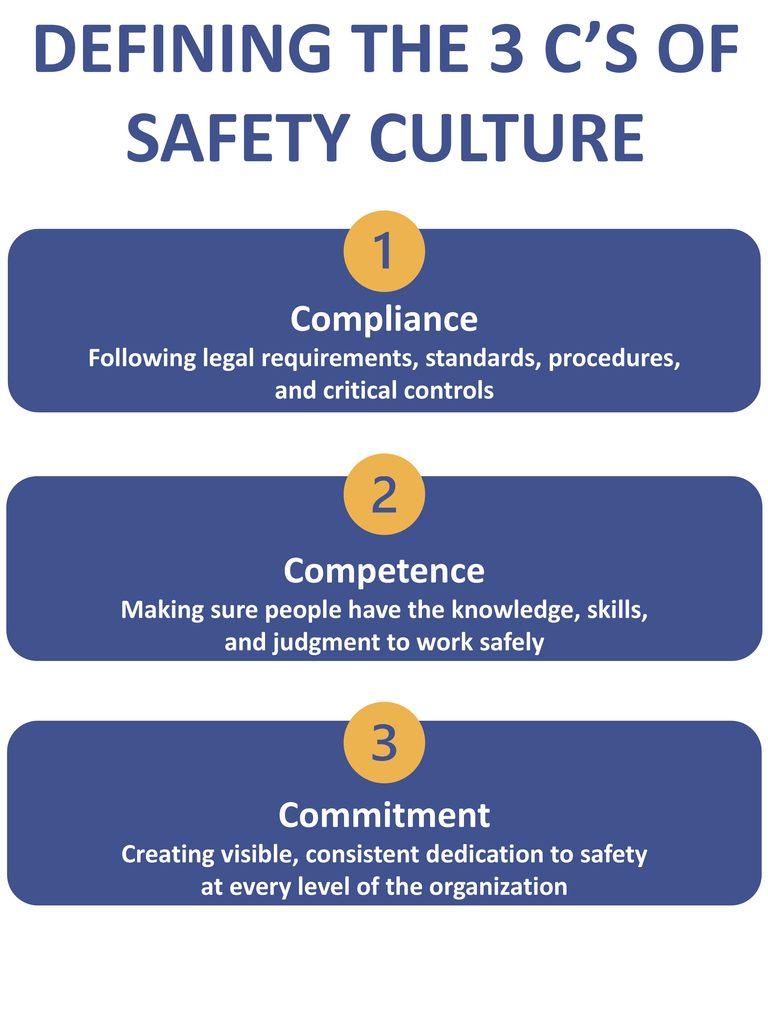
- Compliance – following legal requirements, standards, procedures, and critical controls
- Competence – making sure people have the knowledge, skills, and judgment to work safely
- Commitment – creating visible, consistent dedication to safety at every level of the organization
These three components of a safety culture work together. Compliance sets the baseline. Competence enables safe action. Commitment sustains the behaviors, conversations, and decisions that make safety real in the field. When one of the three is weak, the culture becomes unstable. For example, high commitment without competence can lead to good intentions but poor execution. Strong compliance without commitment often creates checkbox behavior. Competence without compliance may produce inconsistent practices that depend too much on individuals.
Why the 3 C’s Matter in the Workplace
Many people asking “what are the 3 C’s in the workplace?” are really asking a bigger question: what makes safety reliable, not just documented? The answer is that safe performance depends on more than rules. It depends on whether your organization can turn expectations into consistent behavior, especially in high-risk environments where error tolerance is low.
The 3 C’s matter because they connect the structural side of safety with the human side. Compliance addresses requirements and control measures. Competence addresses whether people can identify hazards, make sound decisions, and respond effectively. Commitment addresses whether leaders and teams reinforce safety through priorities, communication, and accountability. This is why the framework is useful across manufacturing, mining, oil and gas, transportation, pharmaceuticals, government, and other operational settings.
Used well, the model helps you identify practical gaps such as:
- Procedures that exist but are not followed consistently
- Training that is delivered but not retained or applied
- Leaders who support safety verbally but not behaviorally
- Weak upward communication around hazards and near misses
- Confusion between compliance activity and real culture change
Compliance as the Foundation of Safety Culture
Compliance is the first of the 3 C’s because every organization needs a baseline of control. This includes regulatory obligations, internal standards, permits, procedures, inspections, documentation, and critical risk controls. At a minimum, compliance helps you define what safe work should look like and what must be done to reduce exposure.
But compliance only creates value when it is operational, not just administrative. A policy stored in a system does not protect anyone. A procedure that is outdated, impractical, or routinely bypassed does not reduce risk. Strong compliance means your requirements are understood, accessible, realistic, and enforced in a way that supports safe execution rather than paper completion.
In practice, effective compliance usually includes:
- Clear ownership of legal and operational requirements
- Hazard identification and risk assessment tied to actual work
- Defined critical controls for serious injury and fatality prevention
- Routine verification that controls are present and effective
- Investigation and correction when standards are not met
A common mistake is treating compliance as the whole of safety culture. It is not. Compliance is necessary, but it rarely changes behavior by itself. If your people follow rules only when observed, or if teams work around procedures to meet production targets, then compliance exists on paper while culture tells a different story.
Competence Turns Safety Expectations into Safe Performance
Competence is the second C, and it answers a critical question: can your people actually do the work safely under real operating conditions? This goes beyond certifications and onboarding records. Competence includes technical ability, situational awareness, hazard recognition, communication, decision-making, and the ability to adapt when conditions change.
In many incidents, the issue is not a complete lack of training. It is a gap between formal instruction and field application. Someone may know the procedure but miss a weak signal, misread an exposure, or make an unsafe tradeoff under pressure. That is why competence should be treated as a live capability, not a one-time event.
Strong safety competence often includes a mix of:
- Role-specific technical training
- Refresher training for critical tasks
- Coaching by supervisors and experienced peers
- Scenario-based learning for non-routine work
- Practice in stop-work decisions and hazard escalation
- Verification of understanding in the field
Competence also has a leadership dimension. Leaders need the capability to set expectations, notice drift, ask better questions, and reinforce sound decisions. In safety-critical work, the ability to make safe decisions under pressure is often what separates a compliant organization from a resilient one.
Commitment is what Makes Safety Culture Credible
Commitment is the third C and often the most visible indicator of whether safety is truly valued. It is shown through priorities, tradeoffs, follow-up, resource allocation, and the quality of day-to-day leadership. When commitment is strong, people believe safety matters even when the schedule is tight, operations are complex, or performance pressure increases.
Commitment is not a slogan, annual campaign, or leadership statement. It becomes real when managers respond to concerns, when supervisors reinforce standards consistently, and when teams can raise issues without fear of blame or dismissal. This is where safety culture connects closely with trust, procedural fairness, and upward communication.
Signs of real commitment include:
- Leaders asking about exposure, not just outcomes
- Timely action on reported hazards and near misses
- Consistent follow-through after investigations
- Visible support for speaking up and stopping work
- Balanced decision-making that does not reward risk-taking
Without commitment, organizations often default to mixed messages. Teams hear that safety comes first, but they see faster work rewarded, reporting ignored, or shortcuts tolerated. That disconnect damages trust quickly. Once that happens, people become less likely to raise concerns, share mistakes, or engage fully with improvement efforts.
How the 3 C’s Work Together
The 3 C’s are most useful when you treat them as an integrated system rather than separate topics. Compliance defines the standard. Competence enables people to meet that standard.
Commitment makes the standard meaningful and sustainable. If one C is missing, the other two lose strength.
| Main Purpose | If It Is Weak | |
| Compliance | Set clear requirements and controls | Standards become inconsistent, unclear, or unenforced |
| Competence | Build the ability to work safely and make good decisions | People rely on guesswork, habit, or incomplete knowledge |
| Commitment | Reinforce safety through leadership and culture | Safety becomes reactive, symbolic, or secondary to pressure |
This is also why organizations should avoid reducing safety culture to compliance scores alone. A site can pass audits and still have weak communication, low trust, poor supervision, or decision-making drift. Looking at all three C’s gives you a more accurate picture of what good safety culture looks like.
Safety Culture, Safety Climate, and Communication
When people search for the 3 C’s of safety culture, they sometimes encounter a different version of the idea: safety culture, safety climate, and communication. That usage appears in healthcare and academic discussions, where the focus is often on how people perceive safety, how open communication supports learning, and how those factors shape outcomes.
It helps to separate the two concepts. Compliance, competence, and commitment are a practical workplace framework for building safety culture. Safety culture, safety climate, and communication describe related dimensions of how safety is experienced and reinforced. They are not identical models, but they overlap in useful ways.
- Safety culture refers to the deeper values, norms, and shared expectations around safety
- Safety climate reflects how people currently perceive the organization’s safety priorities and practices
- Safety communication shapes whether concerns, lessons, and risk signals move effectively through the system
This overlap matters because commitment is often visible through climate and communication. If leaders say the right things but workers do not feel safe speaking up, the culture is weaker than it appears. If compliance requirements exist but field teams receive inconsistent direction, both climate and competence are affected. For that reason, any practical use of the 3 C’s should include attention to communication quality, leadership signals, and the employee experience of safety.
How to Assess the Three Components of a Safety Culture
If you want to improve the 3 C’s of safety culture, start by measuring what people experience, not only what the system says should happen. Policies, training records, and audit results matter, but they do not tell the full story. You need to understand how standards are applied, how decisions are made, and whether employees trust the process enough to speak up.
A useful assessment usually combines multiple inputs:
- Document and procedure review for compliance maturity
- Field observations to see how work is really performed
- Interviews or focus groups with leaders and frontline workers
- Culture or climate surveys to measure perceptions and patterns
- Analysis of incidents, near misses, and exposure trends
- Review of leadership behaviors and accountability signals
For example, a survey may show that workers understand procedures but hesitate to report issues upward. That points less to competence and more to commitment, trust, or procedural fairness. A high rate of repeat deviations may suggest weak compliance design, weak supervision, or training that is not translating into practice. Looking across the three C’s helps you diagnose root issues more accurately.
Organizations that want a deeper view often benefit from structured safety culture assessment guide methods that examine leadership, communication, climate, and support systems together rather than in isolation.
Practical Ways to Strengthen each C
Improve Compliance
- Simplify procedures for high-risk tasks so they are usable in the field
- Focus on critical controls, not just total rule volume
- Verify whether procedures match actual conditions and constraints
- Close corrective actions quickly and visibly
- Make accountability consistent across roles and levels
Build Competence
- Use scenario-based learning for rare, complex, or high-consequence work
- Test understanding in real settings, not only classrooms
- Coach supervisors to recognize weak signals and decision traps
- Refresh critical knowledge before non-routine jobs
- Develop decision-making capability, not only task knowledge
Increase Commitment
- Make leadership engagement visible and consistent
- Respond to reported concerns with action and feedback
- Reward transparency, learning, and sound operational decisions
- Strengthen upward communication across levels
- Address mixed messages between production, cost, and safety priorities
The Role of Leadership in the 3 C’s of Safety Culture
Leadership is the force that connects all three C’s. Leaders shape compliance by setting standards and reinforcing controls. They shape competence by deciding what training, coaching, and development actually happen. They shape commitment by what they notice, tolerate, prioritize, and reward.
This is especially important in high-risk industries where serious incidents are rarely caused by one isolated factor. They emerge from exposure, assumptions, weak communication, poor decisions, and inconsistent reinforcement over time. Leaders influence whether those risks stay hidden or are surfaced early enough to manage.
Strong leaders do more than communicate expectations. They create conditions where people can raise concerns, clarify uncertainty, and make safer decisions in the moment. They also pay attention to whether formal systems are producing the intended field behavior. If not, they adjust the system rather than blaming only the worker.
For organizations focused on serious injury and fatality prevention, this leadership role becomes even more critical. Culture change tends to be stronger when leaders use data, assessment, and direct engagement to understand where the gaps really are. This reflects how leadership creates culture in practice.
Common Mistakes when Applying the 3 C’s
- Treating compliance as proof of a strong culture
- Equating training completion with true competence
- Assuming leadership commitment exists because messaging sounds positive
- Ignoring worker perception of fairness, support, and communication
- Using the framework as a poster instead of an operating model
- Failing to connect safety indicators with field exposure and decision quality
The most effective use of the 3 C’s is practical and diagnostic. It should help you identify where breakdowns occur, why they occur, and what needs to change in systems, leadership, and workforce behavior.
How this Connects to Krause Bell Group’s Approach
While Krause Bell Group does not use the 3 C’s of safety culture as an official branded framework, the topic strongly connects with what safety culture is and how we approach safety improvement. Our work emphasizes safety culture, leadership, decision-making, and data-driven assessment, especially in relation to serious incidents and fatalities.
The 3 C model useful as a starting point, but not as the endpoint. In practice, organizations usually need a more complete picture of what is driving safety outcomes. That includes how leaders influence behavior, how communication flows upward, how people experience fairness and organizational support, and how systems affect decision-making in the field. A stronger assessment process can help you move from a general framework to targeted action.
FAQ about the 3 C’s of Safety Culture
* Developed with the support of AI and reviewed by Krause Bell Group Editorial Team