May 29, 2026
Executive Guide to SIF Prevention
Serious Injury and Fatality Prevention is not a reporting exercise. It is a leadership discipline. If you are responsible for operational performance, workforce protection, or enterprise risk, you need a practical way to identify where catastrophic harm can occur, decide which controls truly matter, and make sure those controls hold under real-world pressure. This executive guide to SIF prevention gives you that framework.
Published safety analyses show that fatality counts have not dropped as quickly as minor injury rates in some sectors. That gap exists because traditional safety metrics often track frequency better than they track severity potential. To prevent serious injuries and fatalities, you need to focus your attention on high-energy hazards, weak controls, decision quality, field conditions, and the organizational patterns that allow critical risk to persist.
This guide is built for senior leaders, operations leaders, and EHS professionals who need to move from general safety management to focused SIF prevention. You will find clear definitions, executive priorities, practical implementation steps, useful metrics, and a governance model you can apply across complex operations.
Why SIF Prevention Requires a Different Executive Lens
A low injury rate can create false confidence. It may tell you that minor injuries are under control, but it does not prove that exposure to fatal falls, line-of-fire events, uncontrolled energy, mobile equipment, confined spaces, or process failures is being managed effectively. That is why serious injury and fatality prevention cannot be treated as a simple extension of traditional injury reduction programs.
From an executive perspective, SIF prevention starts with one shift in thinking: not all incidents carry the same potential. A hand laceration from poor housekeeping and a dropped load that narrowly misses a worker should never be treated as equivalent signals. The first may increase recordables. The second may reveal a pathway to fatal harm.
That distinction changes how you allocate attention, funding, leadership time, and operational accountability. Instead of asking only, “How many incidents did we have?” you also need to ask:
- Where does catastrophic potential exist in your work?
- Which controls are essential to keep that potential from becoming harm?
- How do you know those controls are present, understood, and functioning?
- What decisions are allowing exposure to continue?
For executives, the value of SIF prevention is not limited to compliance. It improves operational resilience, clarifies risk ownership, strengthens leadership credibility, and protects people from the events that matter most.
What Counts as Serious Injury and Fatality Event
A serious injury and fatality event includes actual outcomes such as work-related fatalities or injuries causing permanent disability. In many organizations, the exact definition varies by industry and hazard profile, but the common thread is severe or irreversible consequence. OSHA severe injury reporting criteria include outcomes such as amputations, inpatient hospitalizations, and loss of an eye.
Executives also need to understand SIF potential. A SIF-potential event is an incident, near miss, or exposure where the most credible outcome could reasonably have been a fatality or serious life-changing injury under slightly different circumstances. This is critical because many of the best opportunities for prevention appear before catastrophic harm occurs.
In practice, a useful executive definition should do three things:
- Separate low-severity events from high-consequence exposure
- Create consistency in classification across sites and business units
- Support decisions about investigation priority, corrective actions, and governance review
If your company uses different terms such as PSIF, HiPo, or fatality and serious injury risk, the exact label matters less than the quality of the decision process behind it.
Why TRIR and Recordable Rates Are Not Enough
Traditional lagging indicators like TRIR can still be useful, but they are not reliable stand-alone indicators of serious risk. They aggregate incidents with very different consequence potential and often push leadership attention toward what is easiest to count rather than what is most important to control.
When executives rely too heavily on recordable rate, several problems emerge:
- Low TRIR is mistaken for strong control of critical risk
- Temporary spikes drive reactive attention without context
- Projects or contractors are judged on summary numbers rather than risk exposure quality
- Management teams chase frequency reduction while missing weak barriers around high-energy work
This matters because serious injury and fatality events are relatively infrequent, but they are rarely random. They often emerge from patterns that are visible earlier through precursor conditions, control failures, operational drift, and weak supervision around high-risk work.
As an executive, you should still review lagging indicators, but not in isolation. A stronger governance question is: “What does our injury rate fail to tell us about exposure to catastrophic harm?” Once you ask that, you naturally move toward a more useful set of indicators, including high-potential events, verification of critical controls, quality of planning for non-routine work, and speed of response to precursor conditions.
The Risk Signals Executives Should Monitor Instead
If you want a serious injury and fatality prevention program to work, you need visibility into exposure, not just outcomes. The strongest organizations monitor a combination of leading Indicators for SIF Prevention and lagging indicators that reveal whether high-risk work is understood, controlled, and challenged when conditions change.
Core Signals of Elevated SIF Risk
- Exposure to high-energy hazards such as gravity, pressure, electricity, chemical release, moving equipment, stored energy, and ignition sources
- Missing, failed, bypassed, or poorly understood critical controls
- Near misses and low-consequence incidents with clear SIF potential
- Non-routine work, startup, shutdown, maintenance, and contractor interfaces
- Signs of normalization of deviance, production pressure, or unclear stop-work authority
- Repeated planning failures, permit weaknesses, or poor field verification
What Makes a Metric Useful For SIF Prevention
A metric should link directly to a material source of catastrophic risk. It should be clearly defined, practical to collect, consistent across the business, and tied to decisions. If a measure looks good on a dashboard but does not help leaders intervene earlier or better, it is not a strong SIF prevention metric.
Common Barriers that Weaken Serious Injury and Fatality Prevention
Most organizations do not struggle because they lack policies. They struggle because their systems, incentives, and daily work processes do not consistently protect against high-consequence exposure. These are the barriers executives need to surface and address.
Lagging Indicators Dominate Management Attention
When leadership meetings focus primarily on recordables, lost-time cases, and monthly trends, the discussion often stays backward-looking. SIF prevention requires a forward-looking management rhythm built around exposure, safeguards, and verification of critical controls. If your dashboard does not show where catastrophic risk is building, it will not support the right decisions.
Ownership of Critical Risk is Unclear
Shared responsibility sounds positive until no one is clearly accountable. Executives should test whether business leaders can answer basic questions: who validates controls before high-risk work begins, who can stop work, who signs off on changes in conditions, and who reviews recurring precursor patterns? Ambiguity here is a major SIF weakness.
Safety Becomes Reactive
Many organizations still strengthen controls only after an injury, a near miss, or an audit finding. But serious injury and fatality prevention depends on readiness before work starts. That means identifying credible fatality pathways, confirming controls in the field, and treating changes in work scope as decision points, not paperwork updates.
Familiarity Hides Risk
Routine work is often where vigilance drops. Teams become comfortable, shortcuts become normalized, and warning signs lose their impact. Familiarity creates the illusion that a task is safe because it has been done many times before. Executive leaders need operating systems that re-check assumptions around routine tasks with high-consequence potential.
Human Error is Treated as the Main Cause
Blaming individuals may close an investigation, but it rarely reduces serious risk. People make mistakes, especially under pressure, fatigue, poor supervision, unclear procedures, or conflicting production demands. SIF prevention improves when leaders ask what conditions made the error more likely and why the system did not fail safely.
Normalization of Deviance Goes Unchallenged
When deviations from standard practice continue without immediate consequence, they start to feel acceptable. Over time, this creates dangerous drift. A permit step gets skipped, a barrier stays out of service, isolation is assumed rather than verified, or mobile equipment routes are improvised. Executive leaders must ensure these weak signals are treated as serious indicators, not tolerated habits.
How to Define SIF Criteria and Create Consistency
One of the fastest ways to weaken a SIF prevention effort is to leave classification to subjective judgment. If one site labels an event high potential and another dismisses the same scenario as minor, your enterprise data becomes unreliable and governance loses focus.
A strong executive standard includes:
- A clear definition of actual SIF outcomes
- A practical definition of SIF potential
- A list of high-energy hazards relevant to your operations
- Simple classification rules for incidents, near misses, and observations
- A review process for borderline cases
A useful decision test often includes three questions:
- Was there exposure to a high-energy or high-consequence hazard?
- Was a critical control absent, ineffective, bypassed, or not verified?
- Could the most credible outcome reasonably have been fatal or life-altering if conditions were slightly different?
If the answer is yes across those dimensions, the event deserves SIF-level attention even if the actual outcome was minor.
How to Identify SIF Precursors Before Harm Occurs
SIF precursors are the conditions, behaviors, process weaknesses, and control failures that increase the likelihood of a serious event if work continues. For executives, precursors are especially valuable because they give you a chance to intervene before the organization pays the full human and operational cost of catastrophic failure.
Precursors can be physical, operational, or organizational. Examples include:
- Work at height without verified fall protection
- Line-of-fire exposure around suspended loads or moving equipment
- Defeated machine guarding or incomplete isolation
- Confined space work with weak atmospheric controls
- Permit-to-work gaps for hot work, electrical work, or excavation
- Contractors starting work without clear hazard orientation
- Fatigue, rushed shifts, or weak handover between crews
- High-risk tasks performed under production pressure
The key executive question is not whether these issues exist somewhere. In most operations, they do. The question is whether your system captures them consistently, escalates them appropriately, and uses them to improve planning, supervision, and control design.
A Practical Executive Model for SIF Prevention
At an enterprise level, serious injury and fatality prevention works best when it is structured as a management system rather than a campaign. A simple and effective model follows four connected phases: plan, do, check, and act. This mirrors proven improvement methods while keeping the focus on catastrophic risk.
Plan – Define Critical Risk and Governance
Start by identifying where fatal and life-altering harm can occur in your operations. Establish your SIF definitions, map the high-energy hazards, assign accountability, and define what controls are considered critical. This is also where you set expectations for classification, reporting, and executive review.
Do – Apply Controls in Live Operations
Translate strategy into frontline practice. Integrate SIF thinking into planning, permits, pre-task reviews, contractor management, maintenance, non-routine work, and incident reporting. Make sure high-risk work does not proceed on assumptions. Controls should be specific, verified, and understood by the people doing the job.
Check – Verify that Controls Actually Work
Paper controls are not enough. Leaders need evidence that critical safeguards are present and effective under field conditions. This includes observations, critical control verifications, trend analysis, investigation quality checks, and regular review of potential SIF events.
Act – Strengthen the System Based on What You Learn
Use findings from investigations, precursor trends, audits, and field feedback to improve standards, training, planning tools, and leadership routines. Serious injury and fatality prevention becomes sustainable when your organization learns faster than risk conditions can repeat.
How Executives Should Implement a SIF Prevention Program
Implementation is where many organizations lose momentum. They adopt terminology, hold workshops, and update forms, but they do not change the operating system around critical risk. A workable executive guide to SIF prevention needs a deployment path that fits real business conditions.
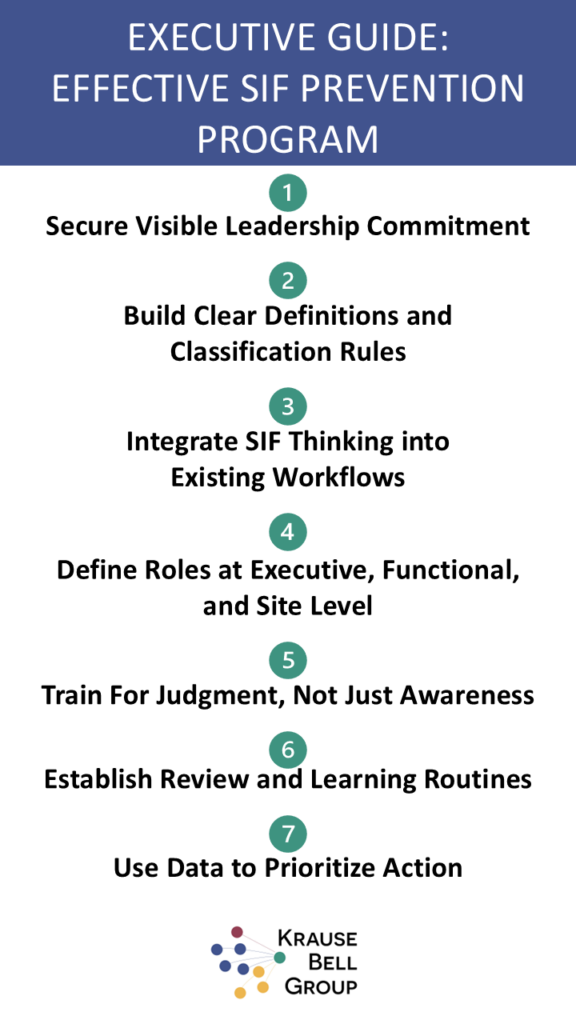
1. Secure Visible Leadership Commitment
Senior leaders need a shared understanding that low injury frequency does not guarantee protection from fatal risk. Commitment should show up in business reviews, field presence, funding decisions, and the willingness to challenge production when controls are weak.
2. Build Clear Definitions and Classification Rules
Standardize what counts as SIF, SIF potential, and precursor exposure. Give sites a simple decision framework and a central review path for difficult cases. Consistency matters more than perfect terminology.
3. Integrate SIF Thinking into Existing Workflows
Do not create a separate process that people forget to use. Embed SIF triggers into incident reporting, near miss review, permit systems, audits, pre-job planning, management of change, and contractor onboarding.
4. Define Roles at Executive, Functional, and Site Level
- Executives set expectations, allocate resources, and review systemic trends
- Operations leaders own risk decisions in the field
- EHS teams enable standards, coaching, and analytics
- Supervisors verify controls before and during work
- Frontline teams identify changes, challenge weak conditions, and stop work when needed
5. Train For Judgment, Not Just Awareness
Training should help people recognize high-consequence exposure, assess control quality, and escalate concerns. Good SIF training uses realistic scenarios, operational language, and examples from your own work instead of generic safety theory.
6. Establish Review and Learning Routines
Potential SIF events should receive deeper review than standard incidents because they reveal pathways to catastrophic harm. Look for common decision failures, recurring weak controls, and organizational conditions that increase vulnerability.
7. Use Data to Prioritize Action
Track where precursor conditions cluster, which critical controls fail most often, which business units experience repeat exposure, and how quickly corrective actions close. Data should help you decide where to intervene, not simply create more reports.
Leading and Lagging Indicators for SIF Prevention
Executives need both leading and lagging indicators, but they serve different purposes. Lagging indicators tell you what happened. Leading indicators help you influence what happens next.
Lagging Indicators that Still Matter
- Actual serious injury and fatality cases
- SIF rate or serious event frequency
- Number of classified high-potential incidents
- Severity mix inside broader incident data
These measures are important, but they can be unstable over short periods because severe events are relatively rare. That makes them poor stand-alone steering tools.
Leading Indicators that Give Executives Better Control
- Verification rate of critical controls for high-risk work
- Quality of pre-task planning for non-routine activities
- Timeliness of correction for identified SIF precursors
- Number and quality of high-potential near miss reports
- Field leadership engagement on critical risk
- Permit-to-work quality for hazardous jobs
- Contractor readiness for site-specific high-consequence hazards
- Effectiveness checks after corrective actions are closed
A Practical KPI Table for Leadership Teams
| Metric | What it tells you | Why it matters for SIF prevention |
| Critical control verification rate | Whether essential safeguards are checked in the field | Reveals if protection exists beyond paperwork |
| Potential SIF event count | Volume of high-consequence warning signals | Shows exposure visibility and learning opportunities |
| Precursor correction time | How fast serious risk issues are addressed | Measures response discipline before harm occurs |
| Non-routine work review quality | Strength of planning for unusual tasks | Targets conditions where catastrophic events often emerge |
| Leadership field verification | Executive and operational engagement with real work | Improves accountability and signal detection |
| Repeat precursor trend | Whether the same serious-risk pattern keeps returning | Highlights systemic weakness, not isolated error |
What Strong Executive Governance Looks Like
Serious injury and fatality prevention improves when executive oversight is specific. General messages about caring for safety are not enough. Leaders should create a governance process that keeps critical risk visible and forces quality discussion about exposure and controls.
Your governance model should include:
- Regular review of actual and potential SIF events
- Trend analysis of recurring precursor conditions
- Clear escalation rules for failed or missing critical controls
- Cross-functional review involving operations, EHS, engineering, and contractor oversight
- Follow-up on action quality, not just action closure
- Field-based verification by senior leaders
High-quality governance also improves decision-making. It helps executives see where production pressure, planning weakness, asset integrity issues, leadership inconsistency, or contractor interfaces are increasing exposure. That is where strategic intervention creates real value.
How Culture and Decision-Making Shape SIF Outcomes
Culture matters in SIF prevention, but not as an abstract concept. What matters is how culture influences decisions under pressure. Do supervisors feel permitted to delay work? Do contractors speak up when conditions change? Do leaders reward schedule recovery more visibly than control verification? Are weak signals discussed openly or filtered out?
Many serious injury and fatality events sit at the intersection of technical risk and organizational behavior. That is why leadership development is not separate from SIF prevention. It is part of it. Better questions, clearer accountability, stronger field conversations, and more disciplined safe decision-making for safety leaders all reduce the chance that critical risk will be overlooked or normalized.
For executives, culture becomes tangible when you examine:
- How often work continues despite known control weakness
- Whether people can use stop-work authority without backlash
- How quickly leaders respond to precursor reports
- Whether investigations challenge system design or stop at frontline error
- How consistently critical risk expectations are applied across sites
How Krause Bell Group Supports Leaders in SIF Prevention
Krause Bell Group supports organizations that want to strengthen serious injury and fatality prevention through practical leadership development, consulting, and applied learning. That includes executive masterclasses designed for senior and operational leaders, consulting services focused on SIF reduction and prevention strategy, and technical thought leadership on subjects such as critical risk management and the SIF Reduction Mechanism.
This support is built for organizations that need more than awareness. It is designed for leaders who want to improve decision quality, clarify accountability, build sustainable prevention systems, and reduce exposure to the events with the highest human and business consequence.
If you are building or refining your SIF prevention approach, the most effective next step is usually not another generic safety initiative. It is a more disciplined executive system for understanding critical risk, strengthening controls, and learning from the signals that appear before serious harm occurs.
FAQs
* Developed with the support of AI and reviewed by Krause Bell Group Editorial Team