How to Develop Life-Saving Rules for SIF Risk
Effective life-saving rules are built from Serious Injury and Fatality (SIF) exposures, not from a long list of general safety reminders. If you want rules that actually reduce SIF risk, start by identifying the few work activities and control failures most likely to cause a life-altering or a life-ending injury. Then translate those learnings into short, observable rules that workers, supervisors, and contractors understand in the same way. Importantly, the rules must be supported by work authorization, pre-task risk assessment, stop-work authority, and field verification so they are effective in real operations.
Start with the SIF Exposures that Can Kill or Seriously Injure
The first mistake many organizations make is drafting life-saving rules from memory, preference, or legacy policy. That usually produces a broad rule set, rather than a focused one. A strong SIF prevention rule program starts with evidence. The goal is to find the tasks, situations, and control breakdowns that most often impact fatalities, permanent disabilities, and high-injury potential events.
Use your own data first. Review fatal events, serious injuries, high-potential near misses, permit deviations, line-of-fire incidents, vehicle events, dropped objects, energy release events, and contractor losses. Look for recurring exposure patterns rather than just injury types. For example, “caught between” is an outcome, but the more useful insight may be patterns like lifting, stored energy, reversing vehicles, or bypassed safeguards.
Then compare that internal picture with external evidence from regulators, trade groups, insurers, and industry fatality reports. This helps prevent blind spots. Many organizations under weigh risks such as road travel, contractor work, or routine tasks because they are dispersed across multiple sites or owned by different functions.
A practical question to ask is simple: If this control fails, can someone die or suffer a life-altering injury even on a normal workday? If the answer is yes, you are likely looking at a real SIF exposure. That is where a life-saving rule is justified.
Use More than Injury Statistics
Recordable rates alone are not enough for rule development. Include the information below in your evaluation:
- Fatality and serious injury history
- High potential near misses and SIF precursors
- Critical control failures found during audits or investigations
- Front-line worker and supervisor input
- Contractor experience across similar work scopes
- Regulatory and industry loss trends
This combination gives you a richer view of true exposure and helps you identify SIF precursors on your job sites. It also helps separate everyday safety issues from the narrow set of risks that deserve life-saving rule status.
What Effective Life-Saving Rules have in Common
Once you know the main SIF exposures, it is important to define what a good rule looks like. The best rules are few in number, clear in language, and tied to one or more critical controls that prevent catastrophe.
- They focus on activities most likely to cause a fatality or life-changing injury.
- They describe an observable action, not a vague intention.
- They tell people what to do, not only what to avoid.
- They are short enough to remember and easy to recognize in the field.
- They apply broadly across sites, crews, and contractors.
- They remain stable over time, so training and recognition improve.
For example:
- “Verify zero energy before work begins” is stronger than “work safely around hazardous energy.”
- “Use 100% tie-off outside protected areas” is stronger than “be careful at height.”
In each case, the rule points to a visible behavior that can be coached, checked, and enforced.
A Practical Process for Building the Rules
A useful development process moves from exposure analysis to field-tested wording. If you jump straight to branding, posters, or launch materials, the rules may look polished but fail in practice.
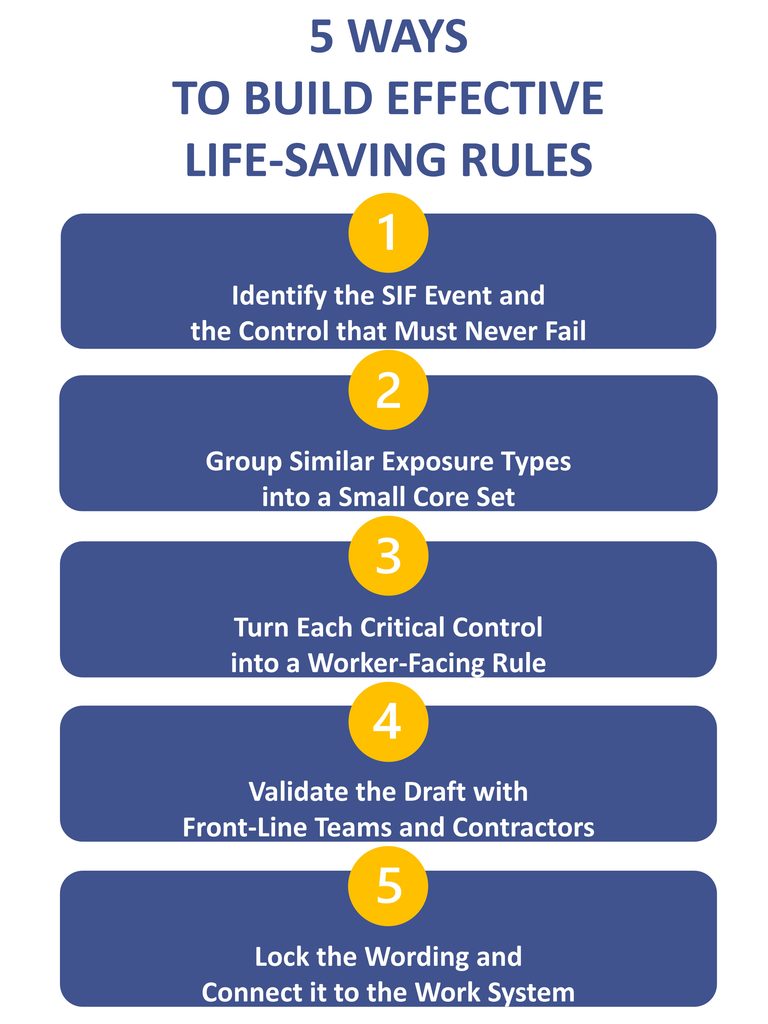
5 Ways to Build Effective Life-Saving Rules
1. Identify the SIF Event and the Control that Must Never Fail
Every potential rule should begin with a serious event pathway. Using bowtie analysis for SIF risks can help define the credible worst case, then name the control that prevents it. For example:
- If the event is unexpected energy release, the control may be “isolation” and “verification.”
- If the event is a fatal fall, the control may be “protected area design” or “100% tie-off outside that area.”
2. Group Similar Exposure Types into a Small Core Set
Most organizations do not need dozens of life-saving rules. They need a short list of disciplined rules that cover the highest-consequence exposure families. Common categories include energy isolation, working at height, confined space, driving, hot work, line of fire, lifting, bypassing safeguards, and work authorization. The exact list can vary, but the standard should stay tight. If everything becomes a life-saving rule, the term loses meaning.
3. Turn Each Critical Control into a Worker-Facing Rule
Draft the rules in plain language. They should tell the worker what must be true both before and during the task. Avoid long paragraphs, technical exceptions, or legal wording. Those belong in procedures and permits, not in the rule itself.
Questions to test the wording:
- Can a worker repeat the rule correctly after one read?
- Can a supervisor observe whether the rule was followed?
- Does the rule reflect the real job, not the ideal job?
- Would a contractor interpret the rule the same way as an employee?
- Does the rule point to the critical control that prevents a fatal outcome?
4. Validate the Draft with Front-Line Teams and Contractors
This step is critical because many rule sets fail at the interface between policy and work. Run the draft rules through real crews, permit issuers, maintenance leads, operators, and contractor supervisors. Ask where the rule is clear, where it conflicts with current practice, what conditions make compliance difficult, and what tools or planning steps are required for success. If a rule cannot be followed under normal operational pressure, the design problem sits with the system, not only with the worker.
5. Lock the Wording and Connect it to the Work System
After validation, standardize the final language. Keep the core wording stable across sites. If you use icons or visual aids, keep them consistent as well so recognition improves over time. Then link each rule to the tools that make compliance possible: permits, lockout procedures, driving standards, lift plans, gas testing, line-of-fire barriers, pre-task risk assessments, and the critical control register.
| Development Step | Primary Question | Output |
| Find the Exposure | Which work situations can lead to SIF events? | Prioritized SIF exposure list |
| Define the Control | Which critical control prevents the worst case? | Control map for each exposure |
| Draft the Rule | What must the worker do or verify? | Short, observable rule statement |
| Test in the Field | Is the rule practical across crews and contractors? | Revised wording and implementation needs |
| Integrate and Launch | Where does the rule sit in permits, training, and supervision? | Standardized rule set with supporting processes |
What Belongs in a Life-Saving Rule, and what Does Not?
Not every important safety expectation should become part of the core rule set. A life-saving rule should be reserved for exposures with severe consequence potential and a small number of non-negotiable controls. If you keep adding site-specific or lower-consequence topics, the set becomes harder to remember, harder to teach, and less credible.
A good screening test is whether the risk is both high consequence and common enough across the organization to justify a standard worker-facing rule. If not, manage it through local procedures, training modules, permit conditions, engineering standards, or targeted campaigns. This is often the right place for topics such as general PPE details, smoking restrictions, or other controls that matter but do not fit the threshold or format of a core SIF rule.
The goal is not to minimize those risks. The goal is to protect the meaning of life-saving rules so people know these are the controls on which the organization will not compromise.
Roll Out One Standard Across Employees and Contractors
One of the strongest reasons to develop a disciplined life-saving rule set is standardization. When employees, supervisors, and contractors all work under different critical rule systems, confusion rises where clarity matters most. Training becomes fragmented, field coaching becomes inconsistent, and incident learning does not transfer effectively between projects or sites.
A shared rule set creates a common safety language. It helps contractors moving between locations understand what “good” looks like before work starts. It also reduces the burden of relearning similar expectations under different names. This is especially important in high-risk work where timing, crew mix, and subcontracting can change quickly.
Standardization does not mean every site is identical. It means the core rules stay the same, while local procedures explain how each rule is applied within local hazards, permits, and equipment. That balance keeps the message simple without ignoring operational reality.
Build Reporting, Intervention, and Exception Control into the System
Rules do not reduce SIF risk on paper alone. People must know what to do when they see a breach, when a condition changes, or when a rule cannot be met. That is why strong programs define intervention expectations as clearly as the rules themselves.
What Happens When a Rule Cannot be Followed?
The answer should never be to continue and hope for the best. If the critical control is missing, underperforming, or impossible to verify, work should not start, or it should stop immediately. The focus then shifts to supervisor involvement, reassessment of the hazards, and restoration of the control before work resumes. This is where stop-work authority becomes a real life-saving mechanism rather than a slogan.
How to Handle Noncompliance Without Driving Problems Underground
Organizations still need consequence management, especially for deliberate violations around high-risk work. But compliance alone won’t prevent SIFs if every event is treated only as a discipline case, because workers will hide weak controls, near misses, and workarounds. That makes SIF exposure harder to see.
A better approach is accountability with learning, which considers factors like:
- Was the rule unclear?
- Was the permit weak?
- Did production pressure override planning?
- Was the tool or barrier unavailable?
If a person saw a breach and did nothing, that is also a serious issue because intervention is part of the control system. The goal is accountability with transparency, not fear-based silence.
Verify the Rules in the Field and Measure Whether They Work
Implementation should show up in day-to-day work, not just in classroom training. Use pre-task risk assessments, shift-start briefings, and permit reviews to identify which life-saving rules apply to the job. During execution, supervisors should use field checks to verify critical controls, not just that paperwork exists.
Mid-job checks are important because SIF exposure often changes after the initial briefing. Equipment moves, weather changes, barriers are opened, or the job scope drifts. A rule system only works if the controls are rechecked when the work changes.
Measure success with a mix of lagging and leading indicators. Fatalities and serious injuries remain the outcome measures, but you should also track:
- Whether critical controls were verified
- Where exceptions were requested
- How often stop-work was used
- What recurring rule deviations appear
- Whether event analysis shows the same control failures repeating.
If the same breakdown keeps returning, the rule may be right but the system supporting it is still weak.